Collaborating with Heidegger, The Landscape and My Body
NOTE: I have knowingly ignored the creative toolkit as an entrypoint. As I will explain, due to the current lack of live, human collaborators, I have sought an alternate model of collaboration – and this arrived in fairly solid form without the need for the toolkit’s prompts.
Project Aims
To develop a tool and technique to record the phenomenology of human presence within a landscape.
To carry out a small selection of tests to record the interaction between the human body and the landscape it is present in.
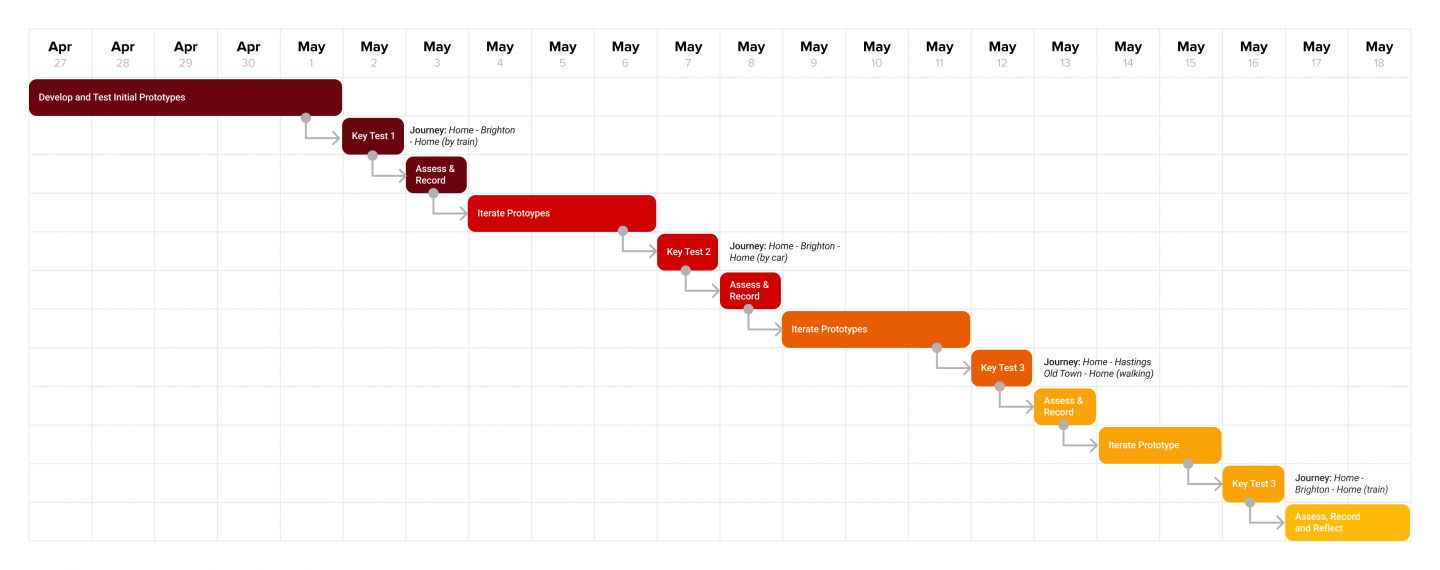
Timings
During the previous unit, 2.1 ‘Ideas, Research and Writing’, my work begun developing an autoethnographic framing as I explored themes of identity(see: https://ideasresearchwriting.nikolashead.co.uk/2025/07/06/p3-ex3-artist-statement-redux-2/), especially the recognition and ownership of my white privilege. As I’ve mentioned before (see: https://experimentalencounters.nikolashead.co.uk/2026/04/12/project-1-exercise-3-reflecting-on-my-experiences/) and have discussed during my first tutorial with Hayley, these are themes – and the practices I have being developing – that I want to continue to pursue. I have ‘established a groove’ that I want to continue to wear away at, and I don’t want to change direction purely to meet the requirements of this unit – this is my degree after all! The question I have been holding is how to explore these themes through collaborative practice.
At that same first tutorial, Hayley suggested a few starting points.
- Collaborate with something ‘other’. Start small, explore the materials as a way into collaboration, as a form of collaboration. Keep it simple to start with but allow it to grow organically. Expose audiences to the results to bring them into the collaborative fold.
- “just start to develop and grow what you already have – think about existing networks – of meanings, equipment, materials and relationships that you engage with and consider perhaps a more speculative approach to your practice to build on” (Lock, H, 2026)
- Then the mention of Martin Heidegger’s ‘being-in-the-world’: and before I had even researched this topic, there was an immediate resonance back to my desire to continue an autoethnograpic/ ethnographic exploration of the world
Nascent Explorations and Questions
My stepping-off point (no jumping yet) was to research Heidegger’s ‘Being and Time‘. I’d already developed a inkling of a direction to pursue, based purely on the name of Heidegger’s book, an inkling that could harness my interests with a collaboration with materials and equipment. But inklings are, in their very nature, slight, and I needed to build a deeper relationship with Heidegger’s philosophy to sink robust foundations that could underpin a creative process. More so, I needed to develop a question (or questions) from which I could begin explorations.
A free to download copy of Macquarrie and Robinson’s translation was too long and dense for quick, formative research, but I did discover a series of articles in the Guardian from 2009 by Professor Simon Critchley of the New School for Social Research in New York. These provided me a refined but nascent understanding of the key philosophical concepts, enough for me to start generating questions for exploration: my research into ‘Being and Time’ can be found here – https://experimentalencounters.nikolashead.co.uk/2026/05/04/heidegger-and-being-in-the-world/.
From this research, I distilled a series of observations and insights from which I could form questions:

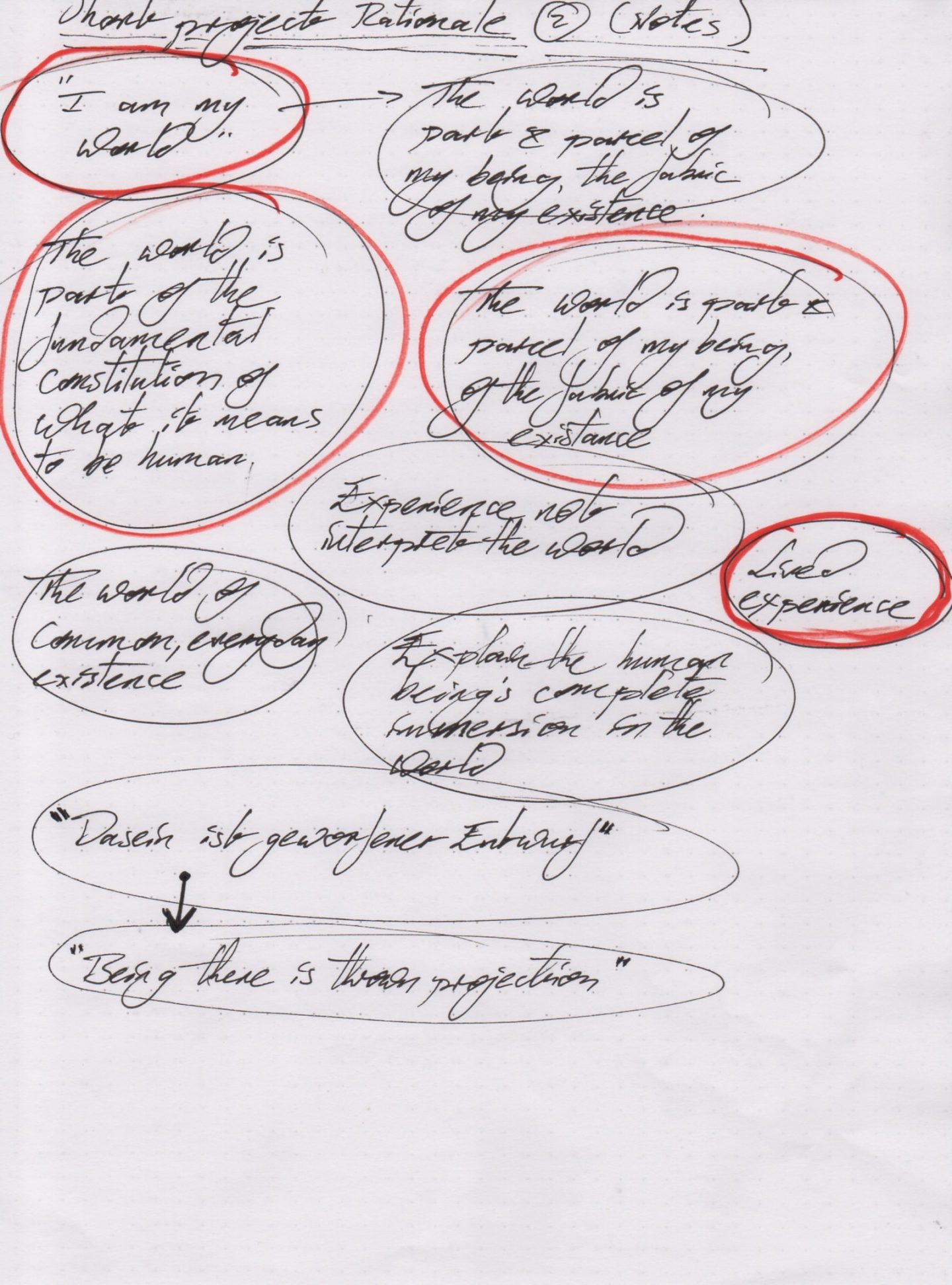
- How can ‘Being there’ be represented creatively?
- How can I represent my and others ‘Being There-ness”?
- How can our “already-in-the-world-ness” be presented visually”
- How to explain our physical and temporal existence?
- What are the components of the self? What are the unconscious components that we take for granted – breathing, thinking, motility, our hearts beating – an how are these key explanators of our being in the world?
- Creating a record of our being-there-ness
- How do I explain/ present/ represent/ visualise ‘being’?
- How do I help people explore their ‘being-as-such”?
- Create a series of techniques to help people explain their ‘mineness’, their own existence.
- What constitutes our authentic self/ selves? How to we explain it?
- How can explain our existence in (as in ‘as part of the world’)?
- What might ‘Dasein is being-in-the-world’ mean? How can it be explained?
- How do I enable others to take an autoethnographic perspective of their world”
- How do I enable others to explore, understand and explain how the world is a fundamental part of what it means to be them?
- How can I bring people closer to their world? (Their cabinet of consciousness)
- Represent the experience not interpretation of the world
- The world of common everyday existence
- Attend much more closely to that which shows itself
- Explain the human being’s complete immersion in the world, their lived experience
- Explain the practical relationship to the world – the ready to hand
- Explain how, who we are as human beings is inextricably bound together with the complex web of social practices that make up my world.
- to cut oneself off from the world is to miss the point entirely: the fabric of our openedness to the world is one piece.
- Experiencing the world with others
- we cannot exist independently of our relation to the world; and this relationship is a matter of mood and appetite, not rational contemplation.
And from that distillation came three key questions:
- How can collaborative creative practice render lived experience as phenomenon rather than narrative?
The foundational representational problem. Is it possible to make creative work that shows existence as it is lived – immediate, embodied, pre-reflective – rather than translating it into story, symbol or interpretation. How can I prevent this line of questioning falling into conventional documentary or illustration? - How can collaborative creative methods bring the pre-reflective, habitual dimensions of being-in-the-world into shared conscious attention -without distorting them through the act of attention itself?
How to design techniques to make the unconscious habitual body visible – breath, mood, motion, the ready-to-hand – without destroying precisely what I am trying to illuminate? - How can collaborative creative practice hold the tension between “mineness” – the irreducible particularity of each person’s existence – and the shared, co-constituted world that makes existence possible?
Collaboration only becomes meaningful if it can genuinely hold both positions simultaneously
There is a fourth question, more practical in nature, but essential to ask at this time:
- At this time, at the very beginning of a creative exploration into these questions, what does collaboration look like when I don’t have ‘live human collaborators’?
The “Journey Camera”
The “Journey Camera” (name in progress) is my vehicle for beginning an exploration of all the above questions, particularly – at this time – what collaboration looks like at this moment in time where no human collaborators are available. Mulling on Hayley’s statement in the tutorial notes…
“just start to develop and grow what you already have – think about existing networks – of meanings, equipment, materials and relationships that you engage with and consider perhaps a more speculative approach to your practice to build on”
…I ruminated around the intrinsic potentiality of materials to document the phenomenological layers of my lived experience. How could materials be employed to collaborate with my existence, to render my ‘Mineness‘ (Heidegger’s Jemeinigkeit)? What are the unconscious layers of my ‘being‘ and how do I investigate my “being as such” through a material collaboration?

Way back in 1.1 Exploring Drawing Media, I produced a series of works based on my movements and positions during pilates sessions. These captured static visual representations of my physical being in space, but they didn’t capture my presence, my being, the phenomenon of me during these sessions. My thinking turned towards how to capture the intangible somatic aspects of my bodily experience, not just during classes, but generally, everyday – how to describe my everyday existence in time. How could I apply materials and process to describe my being-in-the-world without exerting the direct control of them that can lead to narrative representations?
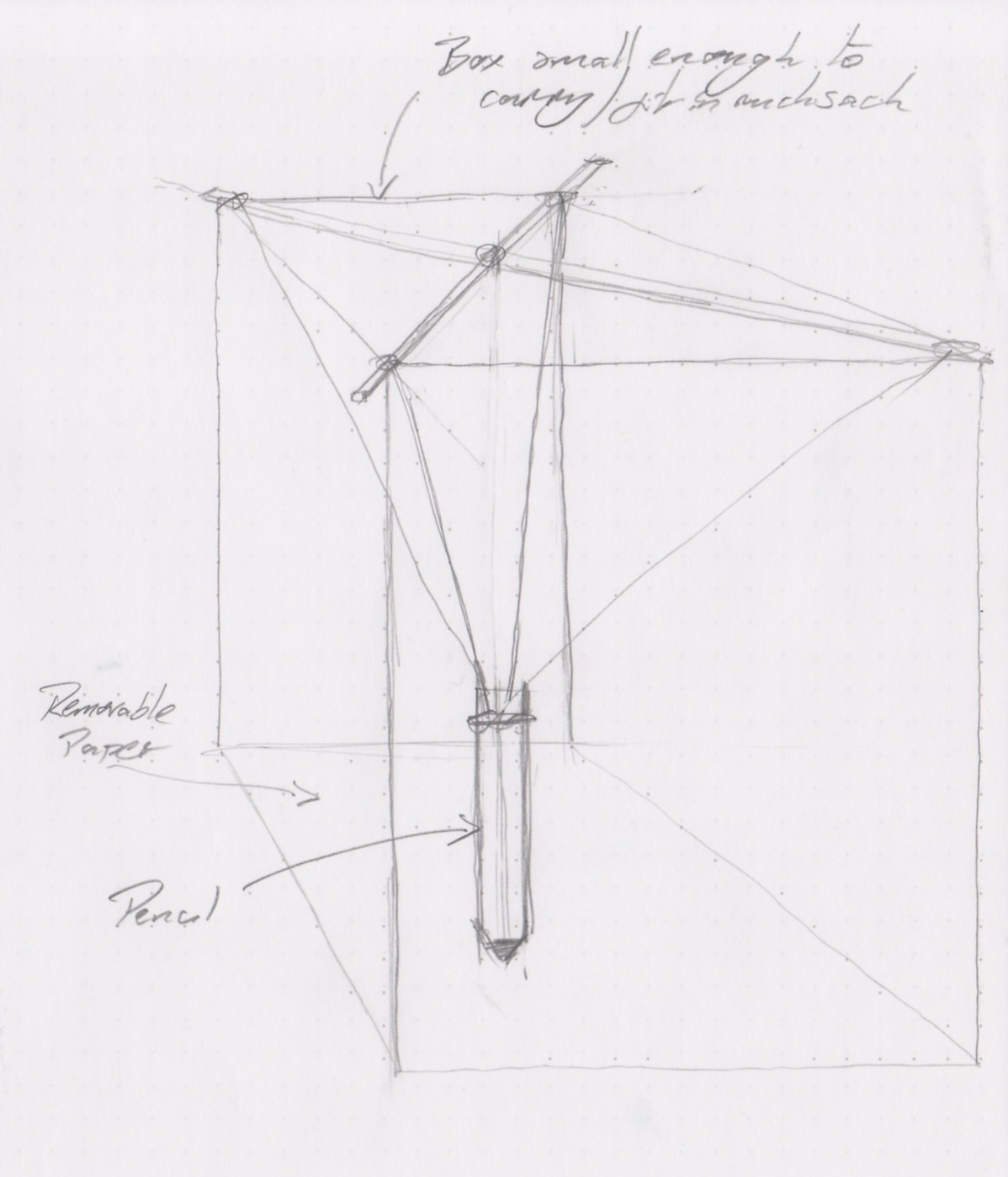
The idea I landed upon, initially through a serendipitous realisation, is based upon the concept of a pendulum. Suspend a drawing implement in an enclosed space, the tip of which is in contact with a suitable substrate. The drawing implement marks the substrate in response to movement that effects the box. In theory a drawing is produced that reflects my presence in time and space, without me being in direct contact with the tool. I can carry the box in a rucksack, or strap it to my body somehow.
My initial thoughts were to use it to record journeys – that’s were there is a lot of physical movement. Big boxes with larger paper could be used for bigger, longer journeys. Smaller boxes for smaller journeys. Different drawing instruments, different shaped boxes, different people carrying the boxes, different surfaces, different colours – there are a wealth of dimensions that can be explored and experimented with – but those dimensions cannot be applied arbitrarily, they need to be consciously related to the purpose of each individual process.
In my professional sphere, we work to a “launch, learn and iterate” approach; design and build something, see how it’s used, then iterate based on feedback. And that’s the approach I took to developing test versions.
Version 1 (first right): 8B pencil suspended from fishing line. Kinks in the line from being coiled around a reel were influencing and restricting the motion of the pencil
Version 2 (second right): experimented with adding weight to the pencil – taping 6 one pence coins. Motion still being restricted by the fishing twine
Version 3 (third right): Replaced fishing line with garden twine fixed at the four corners of the box. Movement freer, but marks being made by pencil very faint – more weight needed
Version 4 (fourth right): Addition of cross bars, with a weighted 8B pencil suspended from a single point in the centre. Freer movement, more firm mark making
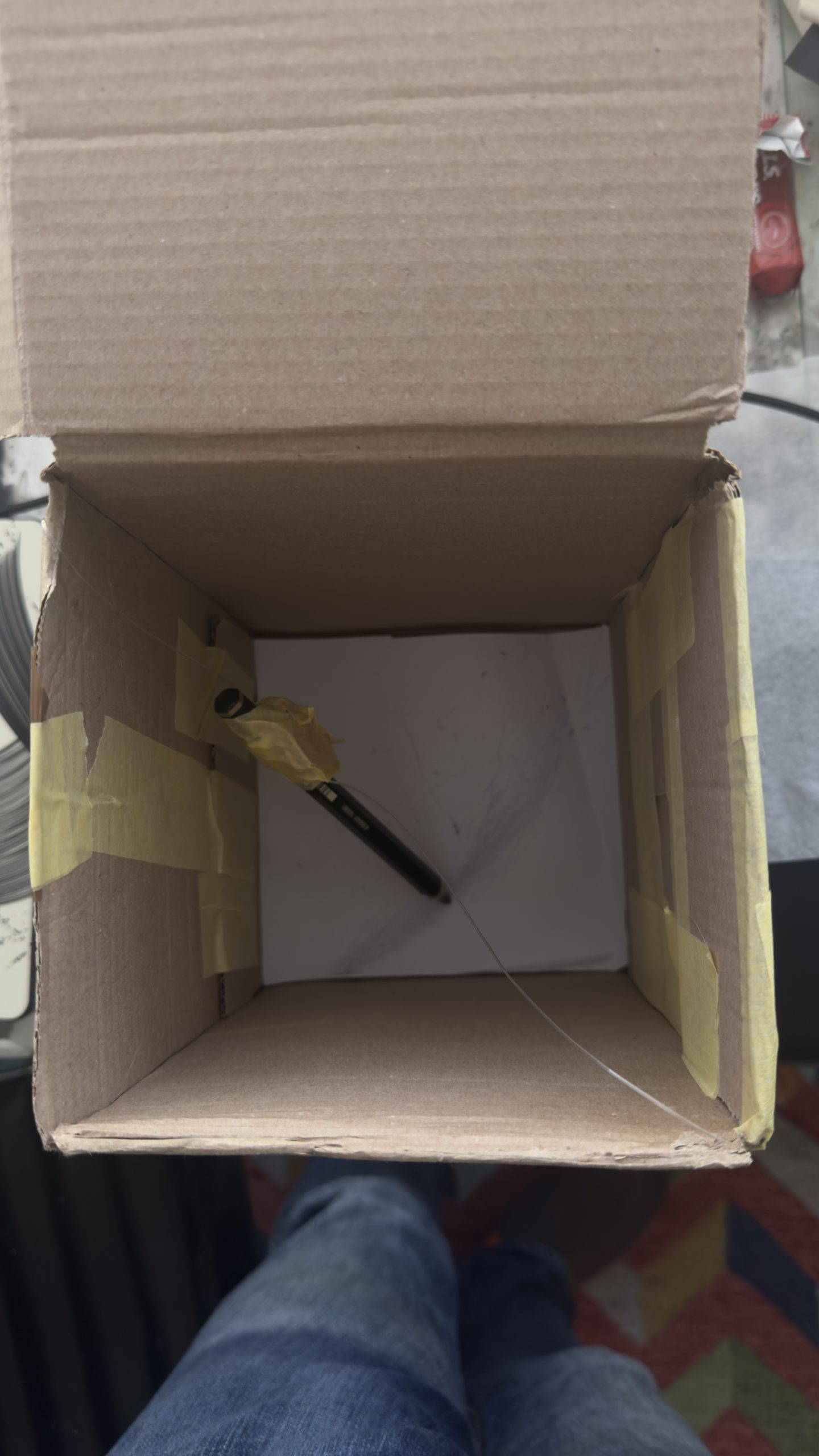
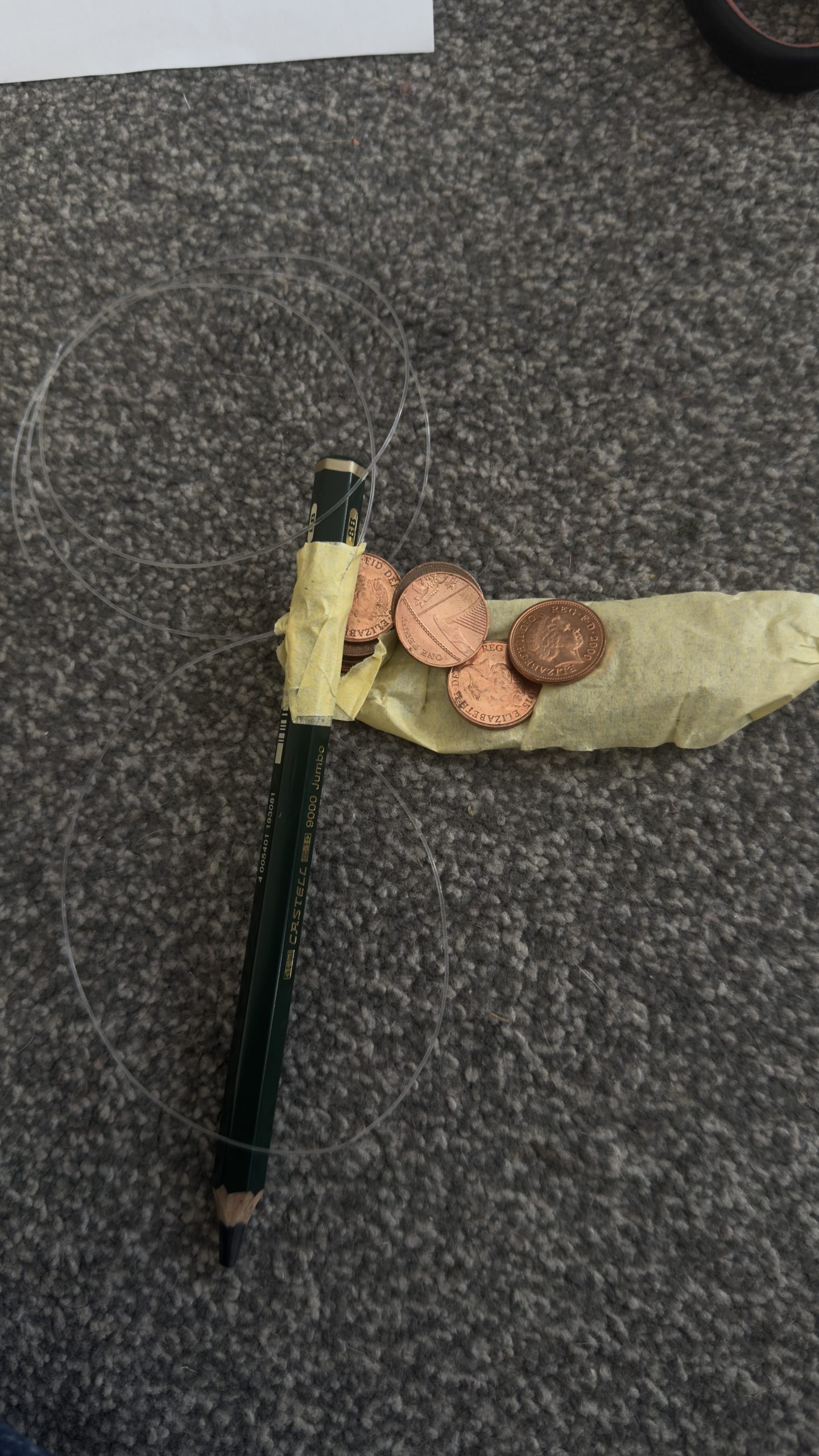
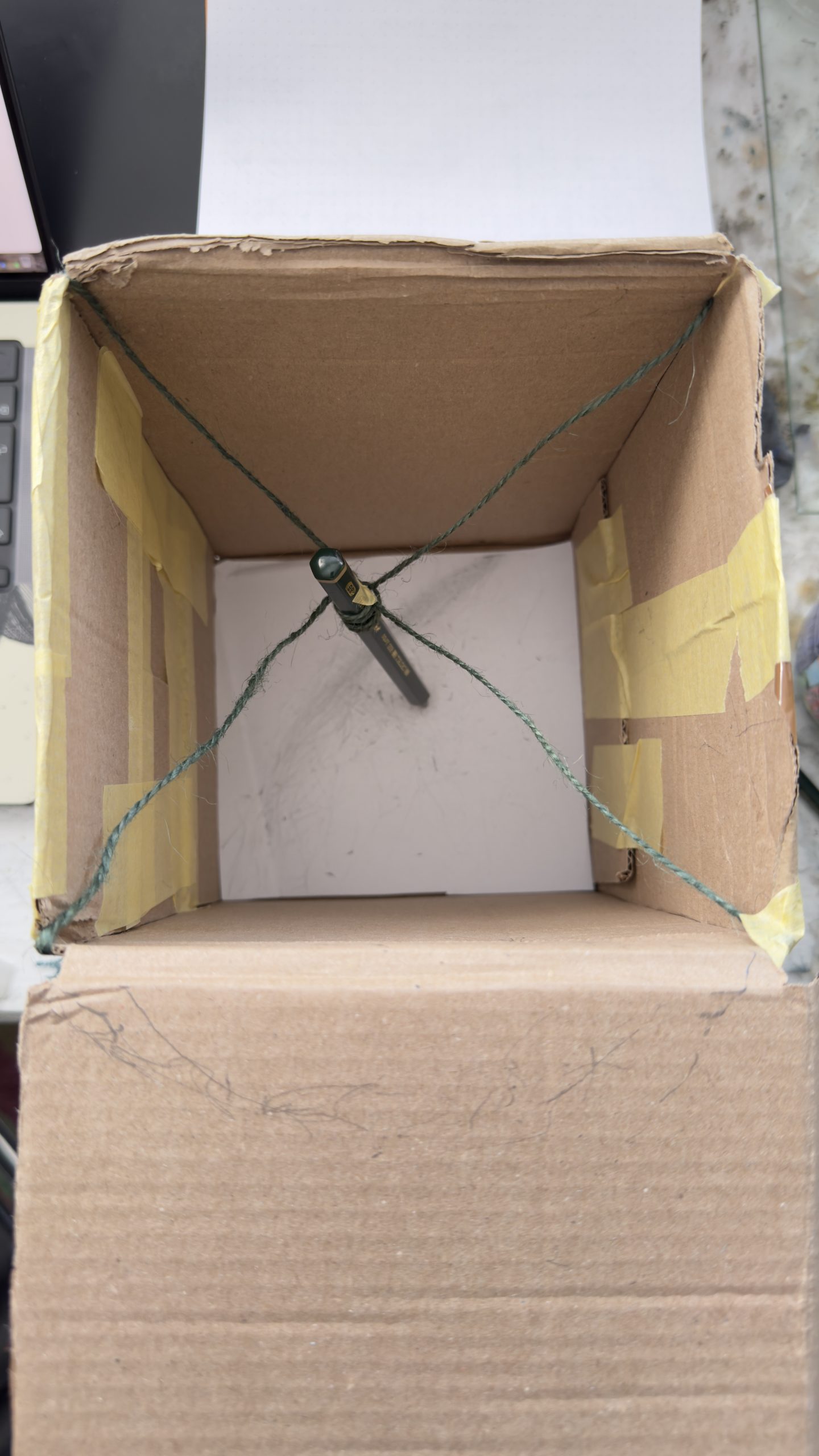
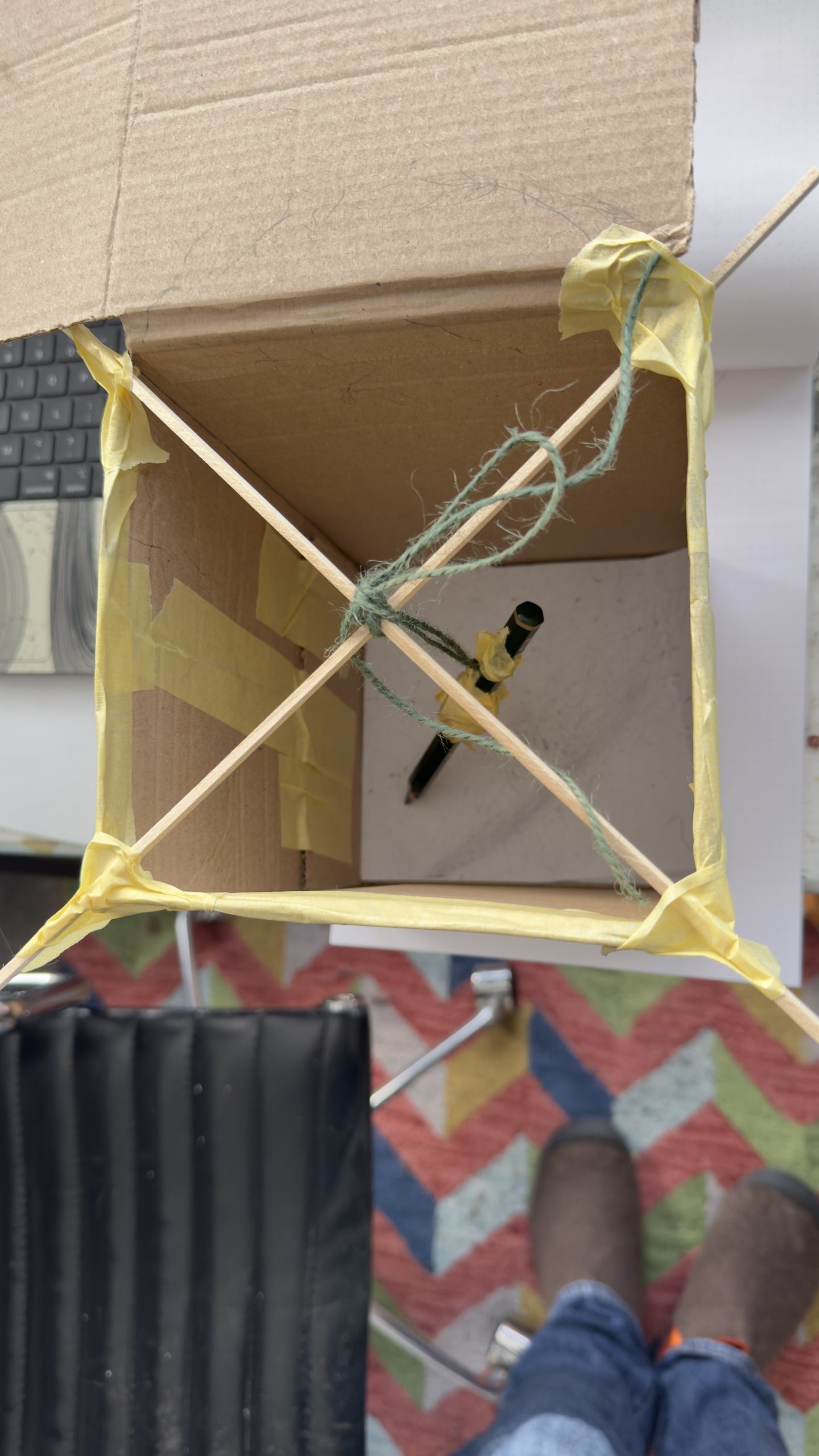
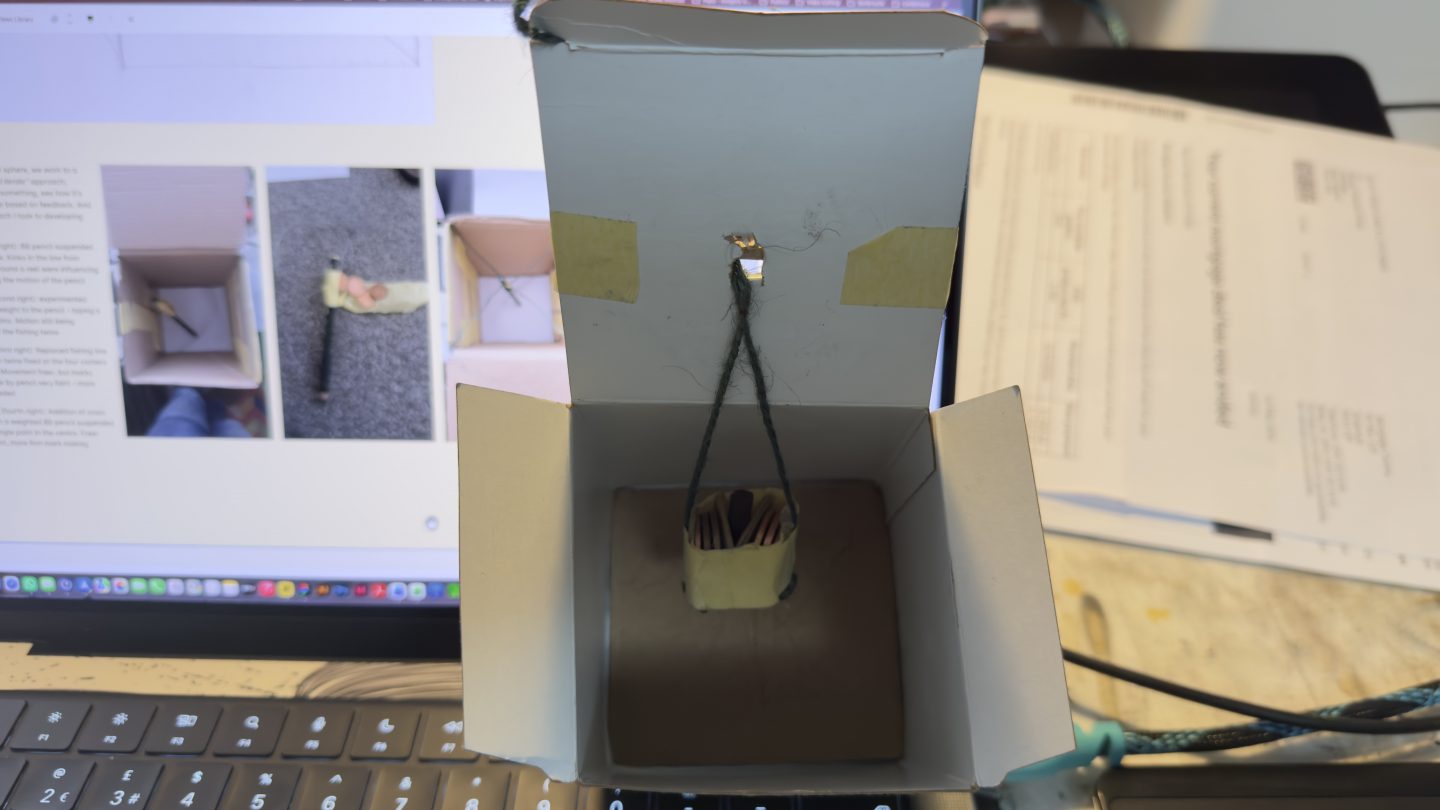
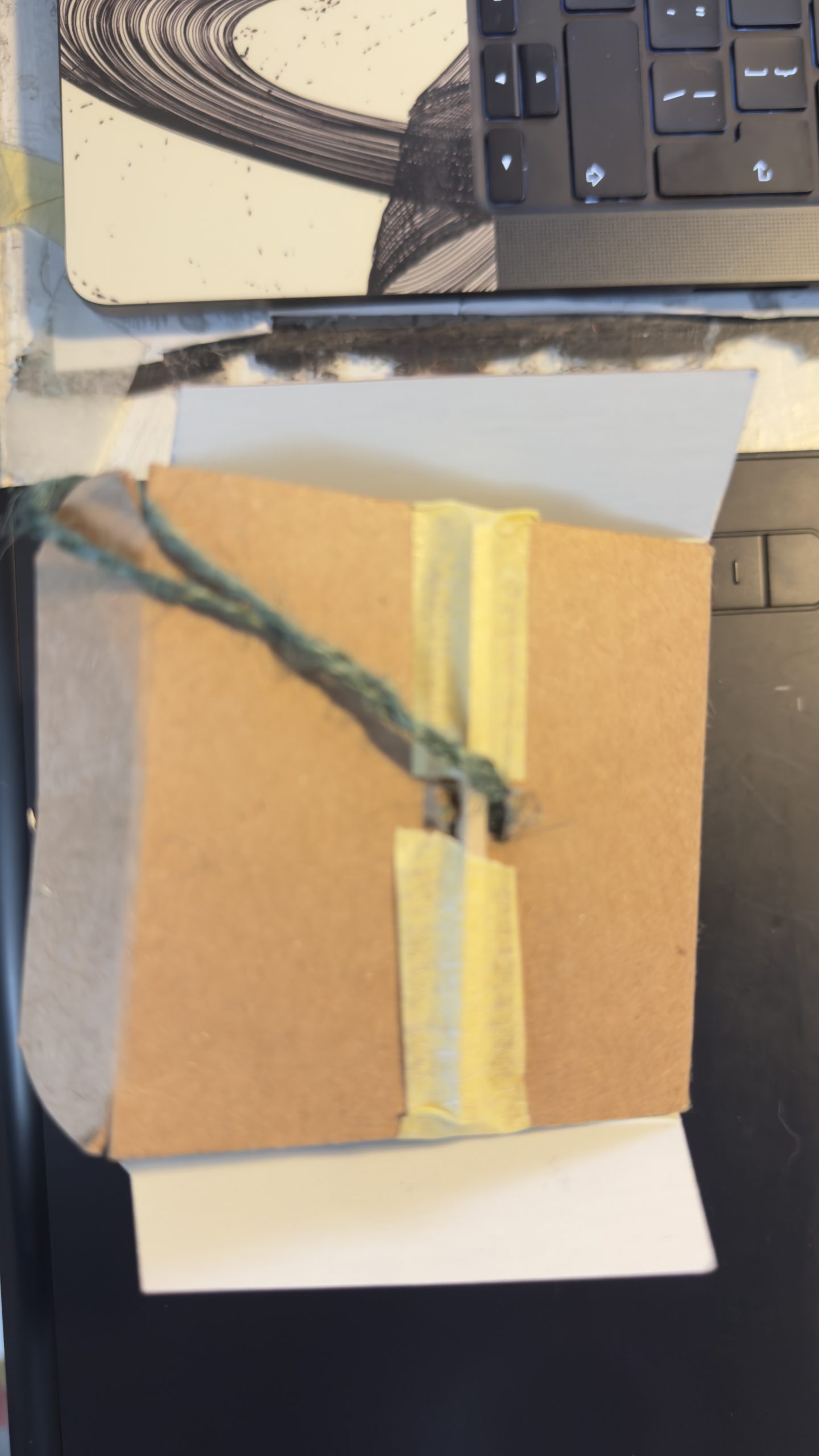
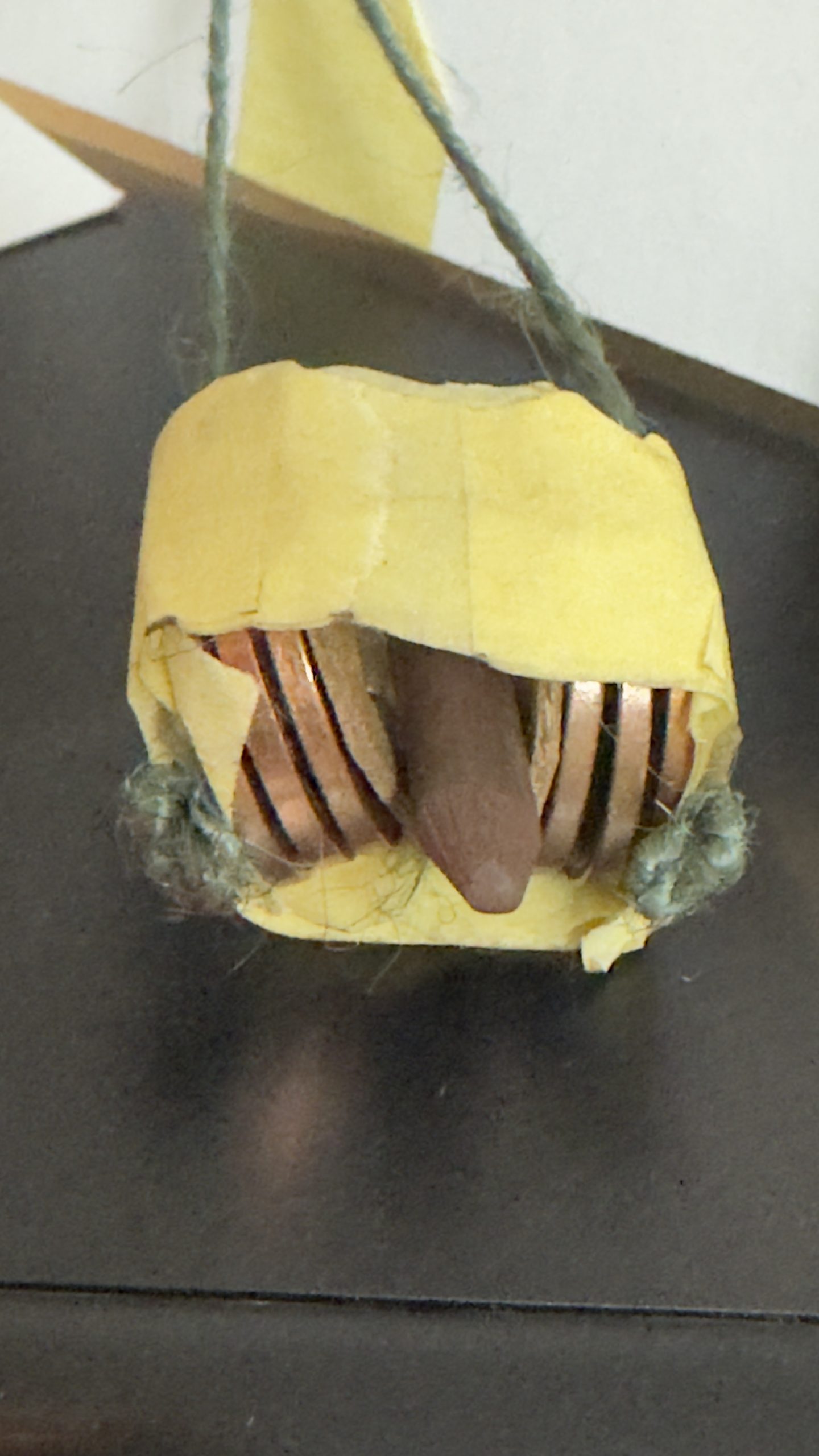
More promising results were achieved with a smaller box (7.8 cm wide x 7.8cm deep x 8.5cm high), a hole punched through the lid and the drawing implement suspended from a single point on a crossbar stuck to the lid. The drawing implement in this version was a sanguine Conte pencil led glued in the middle of a stack of one pence coins.
Initial tests with this tool were conducted at home, walking up and down stairs, around rooms, over furniture and around the garden. This process allowed me to continually refine the tool and was instrumental in me developing the smaller box, which offer a more discreet and portable tool for use in more public environments.
Once more effective working prototypes had been developed, I then took them further afield and for longer periods of time, specifically on several car and train journeys to Brighton and once as I walked to my weekly life drawing group.
Creative Output
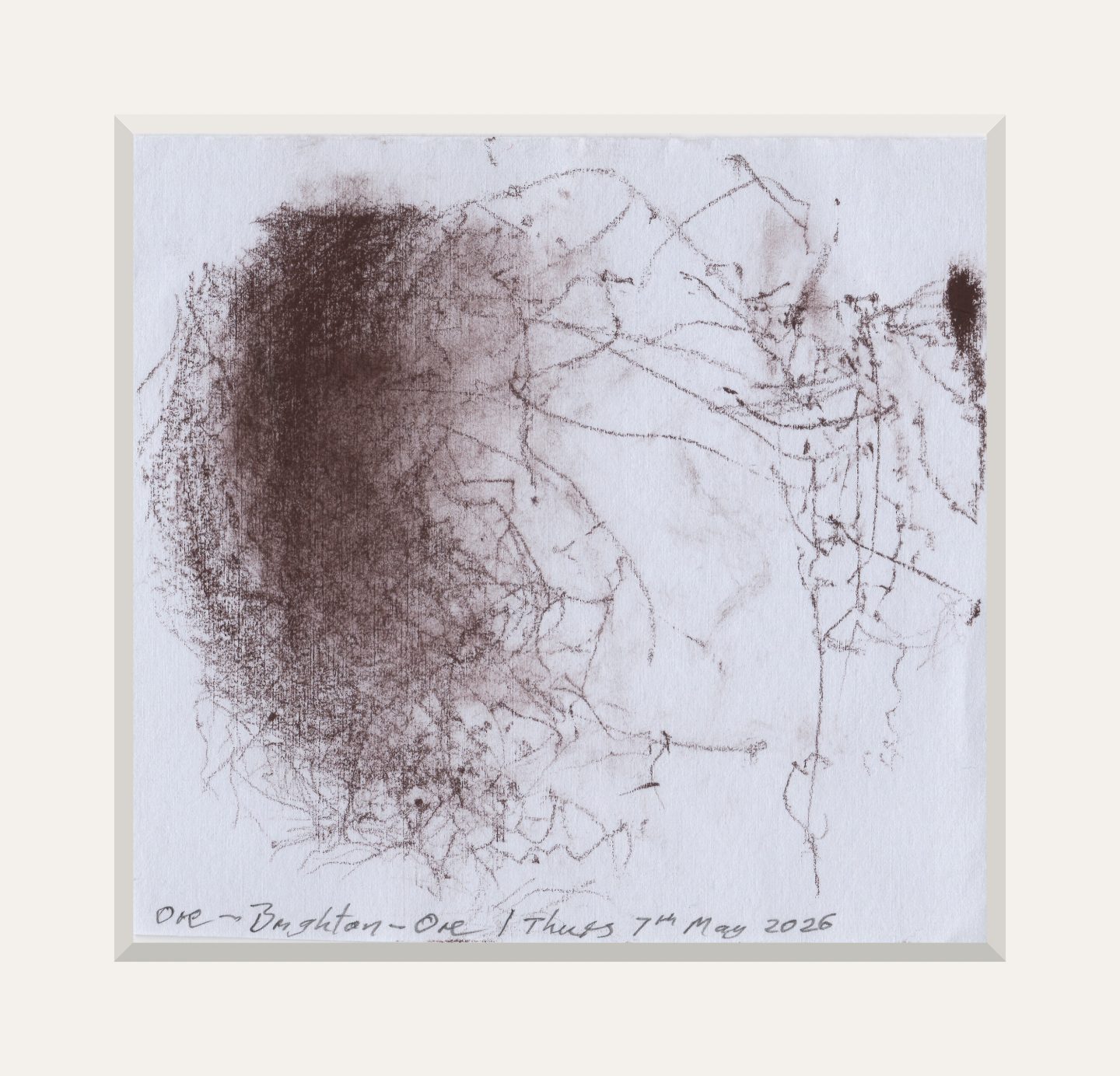
- Ore (Home) – Brighton – Home (by Train) / 12 hours / Thursday 7th May 2026/ Conté Pencil on Cartridge Paper (8 x 7.5 cm)
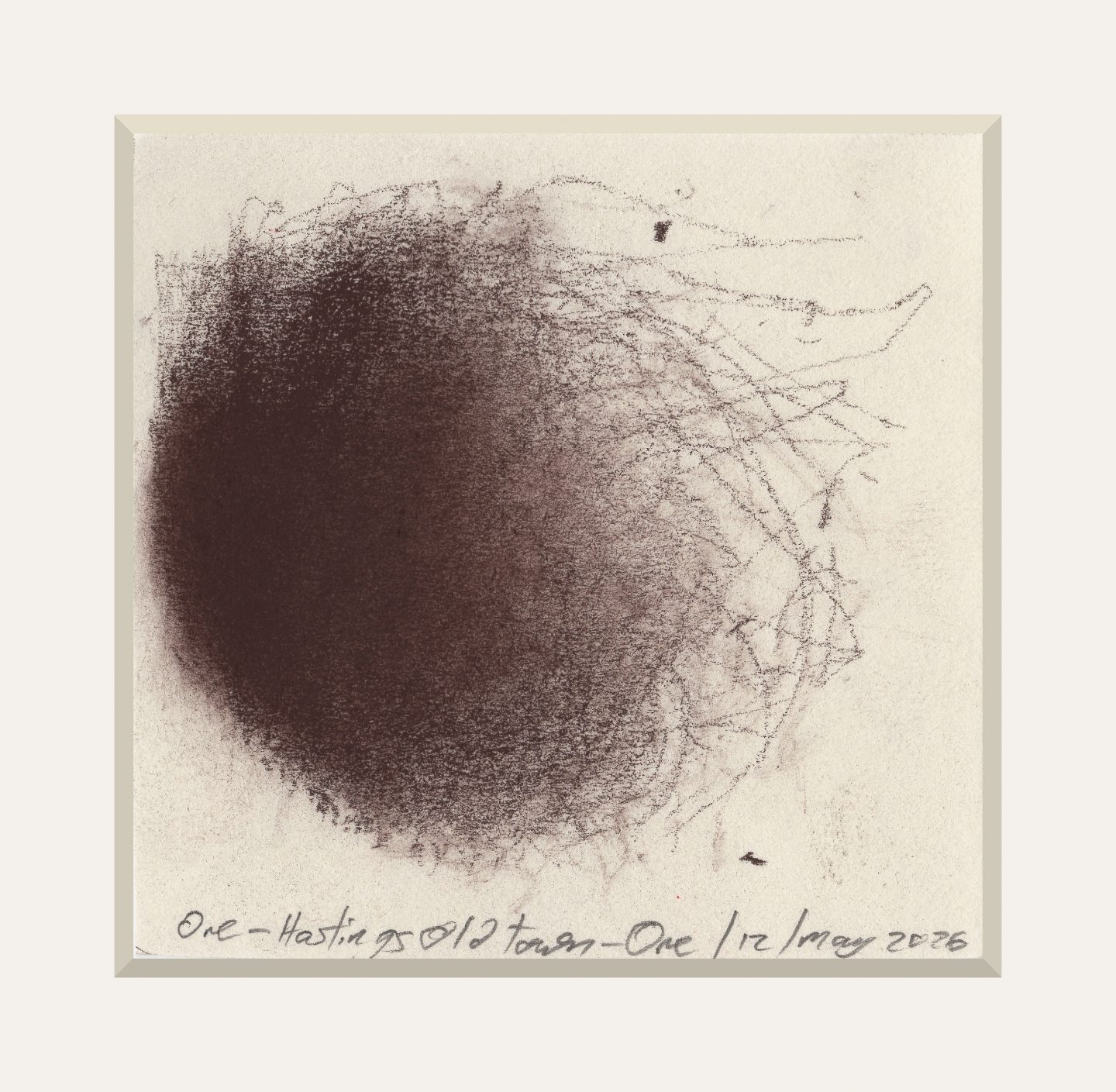
2. Ore (Home) – Hastings Old Town – Ore (Walking)/ 3 hours/ 12th May 2026 / Conté Pencil on Cartridge Paper (8 x 7.5 cm)
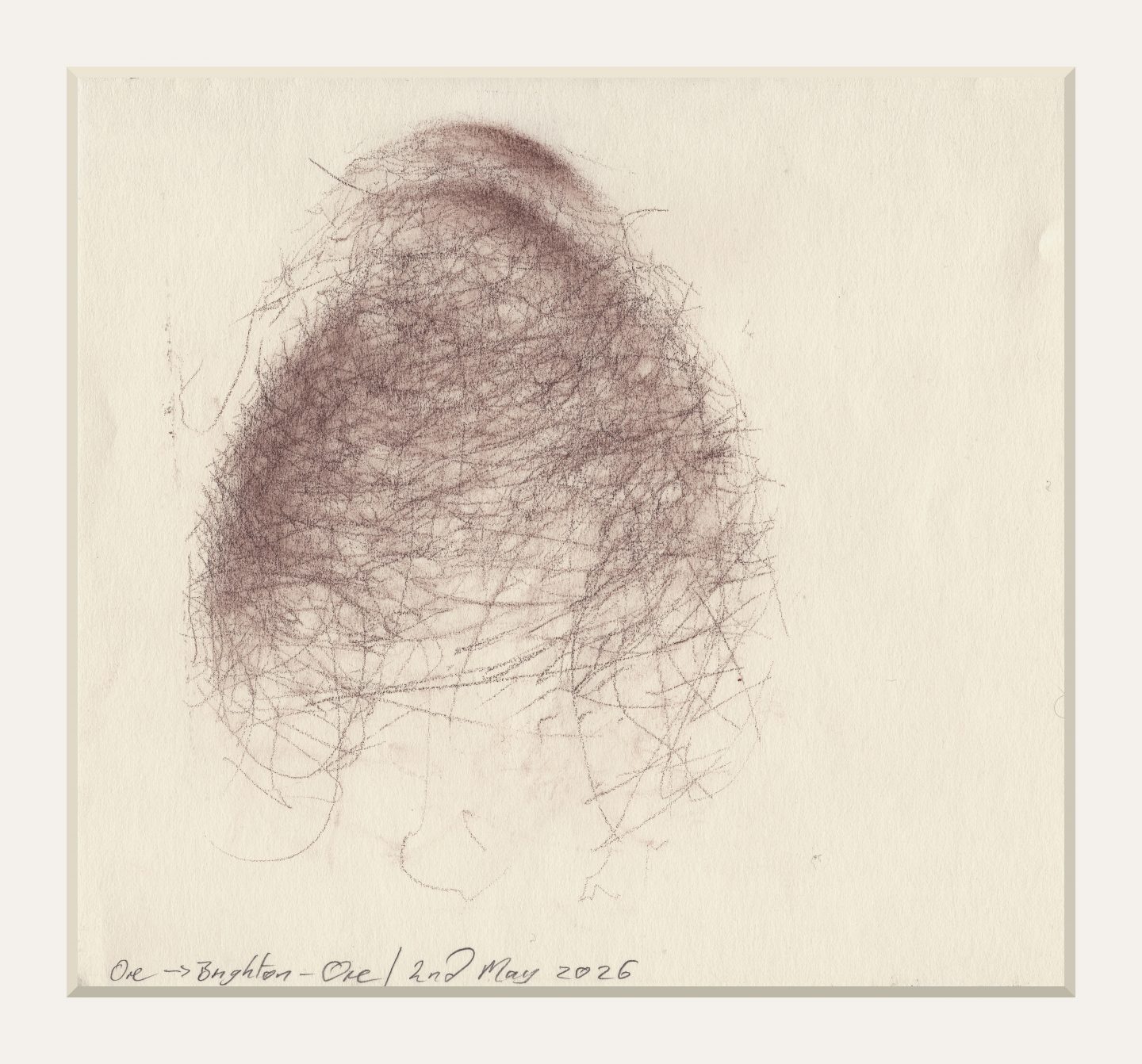
3. Ore (Home) – Brighton – Ore (by Car)/ 6 hours / 2nd May 2026 / Conté Pencil on Cartridge Paper / (15.9 x 14.6cm)
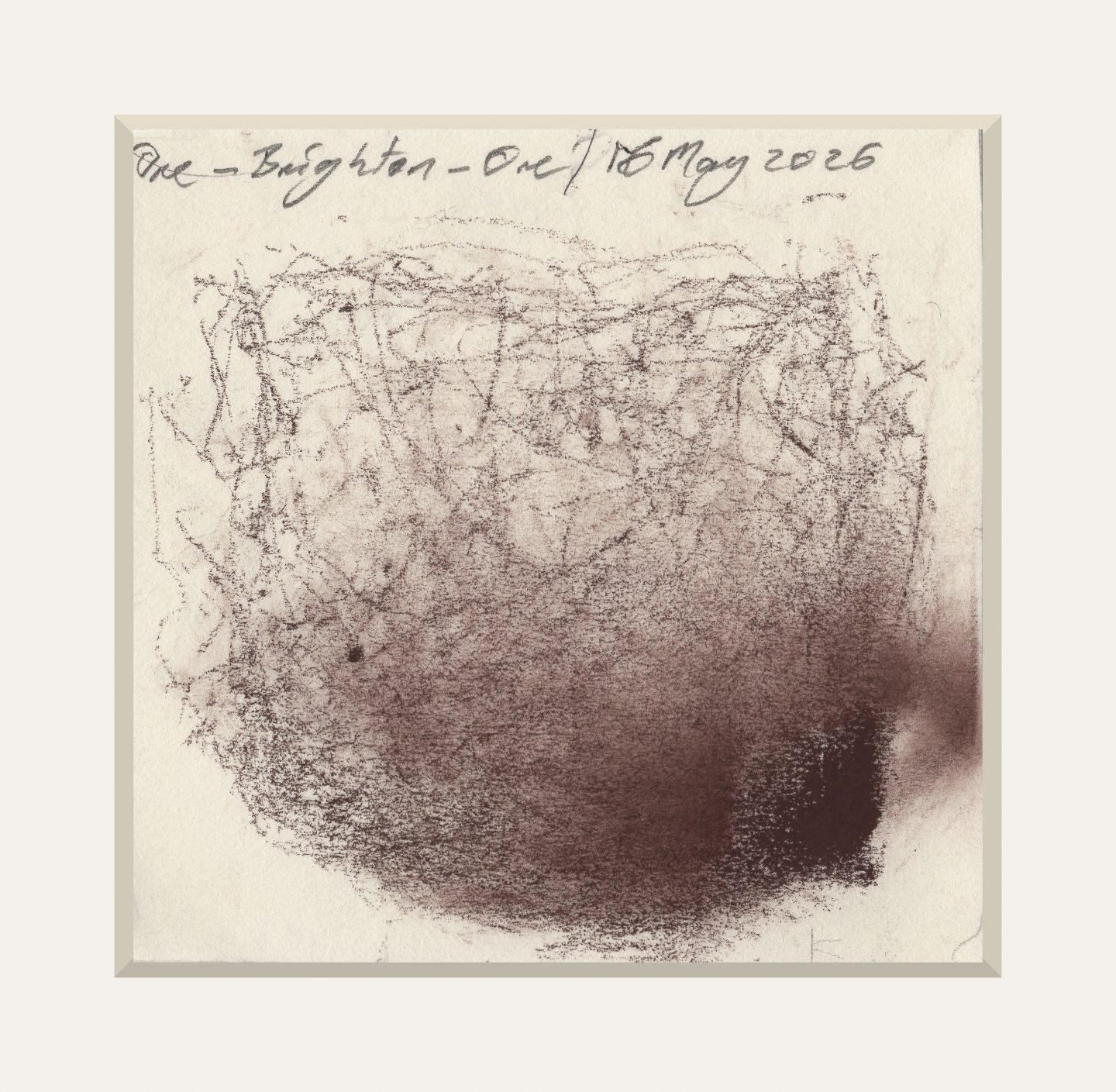
4. Ore (Home) – Brighton – Ore (by Train) / 9 hours/ Conté Pencil on Cartridge Paper / (8 x 7.8 cm)