
Encounters with Home
1.1 Project Outline
We shall not cease for exploration
And the end of all our exploring
Will be to arrive where we started
And know the place for the first time(Eliot, 1943)
Hastings and St Leonards form my home town. They are not separate places, to the ‘current me‘ they are one – the physical boundary between each is long gone, the individual characters each may have, appear to grow into each other like the interwoven roots of trees. Yet this is merely a cursory position, formed from a lack of a mindful awareness to place driven by familiarity. And therein lies a realisation that was the initiator for this project.
This project is about experiencing my hometown in new ways, seeing it afresh, through encounters that are creative and reciprocal in nature. More than acting as subject or inspiration, my hometown becomes a collaborator, a body, a thing with material, atmospheric and historical agency, the encounters between myself and it having mutual affect.
This project is also about building a phenomenological archive of those encounters, and positioning the wholeness of that archive as the creative process and output. This archive will be multi-modal by design: no one material realisation will be preferred as a definitive recording method. Paintings, sound recordings, writings, videos, found objects, prints, rubbings (and many more) will all act as different ‘registers of knowing’, that, when combined, exceed what any single medium could capture: the encounter becomes the unit-of-data, the ‘registers’ the artwork in all its form act as the evidence.
I intend for this project to be grounded in research-based practice, with a light nod to phenomenological methods and agential realism – I say ‘light nod’ as I do not want to be burdened by theory: I want to allow the project to develop and suggest its own pathways. Maybe at some future juncture, maybe beyond this unit and course, those theories will exert more influence.
The project will make its own methodological tensions though – between documentation and experience, between my biography and research. These will be embraced within the archive, as findings and not as failures of process.
1.2 Project Aims
- To construct a phenomenological archive of reciprocal encounter between myself and place, with my hometown of Hastings and St Leonards as the primary collaborator
- To develop and test a multi-modal creative practice, in which no single medium is prioritised as the definitive record of encounter
- To explore the degree to which a non-human (the town, its geography, its climate, its material culture etc) can be said to possess and exert collaborative agency
- To show the limits of the research and the researchers perspective within the archive, rather than trying to smooth them over, obscure them or resolve them in any way
- And, on a more personal level, to use creative methodologies to overcome my habituation to my hometown and to encounter it with more openness and awareness
1.3 Documentation Methods
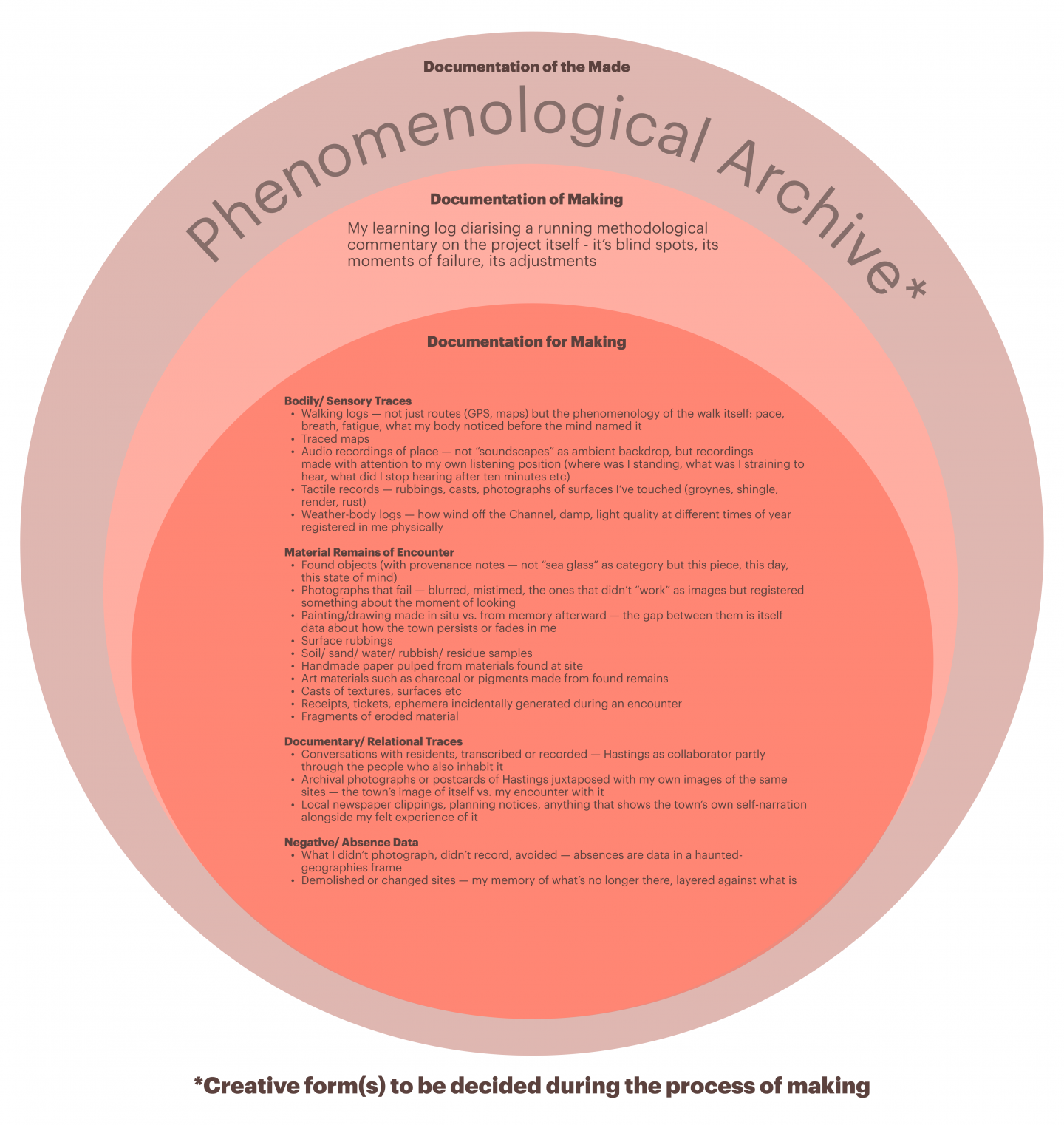
1.4 Documentation Plan
- The nature and conditions of each walk, the environment it takes place in, the dimensions encountered will all influence what methods of documentation are used for specific walk
- The above diagram will act as an aide memoire. After each walk, output will be assessed against it, to see what could have been captured, as a guide to what can be considered on the next walk
- There will be empirical evidence for each walk, the dimensions for which will remain consistent across each e.g. duration, weather, temperature etc
- As each walk is an unknown until it takes place, documentation will take place during and after.
- There are some core methods of ‘data capture’ that are predictable at this stage, and will be consistent across all works
– Video capture with GoPro
– Audio capture with GoPro and iPhone
– Still photographs with iPhone and digital camera
– Drawing: sketchbook and graphite. Other drawing implements will be carried
– Small resealable and labelled plastic bags will be used to store and carry collected objects back to the studio
1.5 Project Timeline
This timeline is subject to change and continued development. Only the first activities are stated as onward steps could be dependent on those previously taken
Activities for July 2026
- Consider the different dimensions for/ of an encounter
- Refine a taxonomy for the archive records. Define key parents, but allow for flex at a child level
- Consider the empirical evidence vs the personal/ emotional evidence
- Determine the balance between each in the ‘physical’ record
- Design a ‘physical’ (as in User Interface) structure for an archive record of an encounter within my learning log
- Identify methods/ tools for recording walks that limit direct, personal human interaction (e.g. chest mounted Go Pro, iphone with microphone on open record)
- Identify and map between 3 and 5 walking journeys within what I consider to be the boundaries of Hastings and St Leonards
- Plan a schedule for repeated encounters with those journeys
- Walk one journey as a test. Record and reflect on the encounter
- Build out an archive record of that encounter
- Reflect on the process of the journey and the recording
- Identify learnings to take forward
Activities for August 2024
TBD.
Preliminary Project End – 01/01/2027
Unit End – 01/03/2027
1.6 Project Collaborators
Lead artist – Nikolas Head
Collaborator/ Contributor – The town of Hastings and St Leonards
As the project progresses, and process, new encounters, new research interests are defined, further human collaborators/ contributors will be invited into the project. Their inclusion cannot be predetermined at the start as the project is organic, with tasks/ processes/ interests being defined at each step, and as a result of previous activities.
1.7 Potential Risks
Methodological Risks
Comfirmation bias/ the town as a mirror
The most structurally embedded risk as I am both subject and researcher, with deep biographical ties to the town. There is a danger that the archive could become a record of what I already believe about Hastings and St Leonards – its decline, its haunted quality, its edges, rather than an encounter with it. I need to be aware of my own presupposition and look for methods to bracket that.
Over-Theorisation at the Expense of the Encounter
Choosing to work within a strong theoretical framework (e.g. Ingold, Barad, WalkingLabs) could guide my attention in useful ways, but it could also preshape what gets noticed. If I am consciously looking for evidenced of “intera-action” or ‘thrownness”, I may generate data that confirms those frameworks instead of being surprised by my hometown.
The “Afterward Problem”
As the intention is this project is phenomenologically led, the gap between in-situ experience and studio-reflection is crucial. There is a risk though that the studio work could dominate, aesthicising and resolving what the raw encounter left open. I do not want the archive to look more like a finished artwork that research.
Ethical Risks
Who does Hastings Belong to?
I am using Hastings and St Leonards as a Collaborator, but its residents have no say in that framing. The archive will include conversations, overheard speech, photography of people etc – standard ethics considerations apply – consent, anonymisation, right to withdraw. The deeper question for me – is this “collaborative” framing ethically coherent when one party (the town and its residents) hasn’t agreed to the role?
Representation of a Declining Community
There is a tension between my phenomenological-researcher-artist position and the lived reality of Hastings as a place with deprivation, housing precarity and other difficulties. Aetheticising decline risks looking like “poverty-tourism” if I am not careful with my framing.
My Own Biographical Implication
If and where the project draws on my own personal history in the town, I may surface difficult material – for myself or for others I know. I may need to consider some form of ethics board in place to address this issue.
Practical and Archival Risks
Volume and Entropy
This is a multimodal and encounter based archive – which will grow quickly. I need to be disciplined with structure (tagging, metatdata) from the outset, to ensure that it doesn’t become unnavigable. There are risks that the early material gets buried and the archive loses coherence over time.
Technology dependency and format obsolescence
Data formats (audio files, scans etc) can age. Formats become unreadable, hard drives fail, cloud services have costs and change terms. In the short term – the length of this project and unit – this is of less concern (and the output will be hosted on my own website so reducing the possibility of deletion with leaving OCA post graduation), but if I want to consider how the archive will continue – is physical and digital redundancy needed?
The Encounter becoming habitual
Repeatedly returning to the same sites is methodologically important, but there is risk in repetition – the walks become routine, attention becomes habitual, and I could stop genuinely encountering the town, merely visiting it. I need to explore methods for disrupting my methodology (e.g. different time of day, different weather, walking with another)
The Underlying Tension
I cannot be both fully inside the experience and fully rigorous about exploring it
When I reach for a recording device, I will have shifted register – from being-with to documenting. The archive necessarily records something other than the encounter itself – the project’s productive paradox and its core vulnerability. Being explicit about that gap – making it visible in the archive – may be the most honest methodological response.
1.8 Areas of Strength
Methodological Strengths
The multi-modal archive as epistemological argument
I’m not wedded to a specific way of working or material expression: I want to allow this project to leverage what I am experienced with and uncover the new. Each medium will be “equivalent data”. The project will argue that different ways of knowing (e.g. bodily, aesthetic, lingusitic, material) will capture different aspects of a phenomenon better than any single mode. This will be embodied in the structure of the archive, not merely stated.
This is an opportunity to be curious and exploratory about something that I have become habituated to. I need to be careful in not using a process or material purely for the sake of using them – what I choose should be intrinsic to the exploration of an encounter
The Treatment of Risk as Method
This project will attempt to make risk visible, so transforming potential research findings into research findings. Where my project breaks down, I want to say here’s where my method broke down, and here is what is revealed.
Form matches the content
This archive will grow through encounter. It is shaped by what the town offers and what I bring and will remain open ended, offering me a route for expansion through further exploration. This is a phenomenological project about reciprocal relationship between self and place, itself strucured as reciprocal relationship.
Conceptual Strengths
I am taking non-human collaboration seriously
I want to treat Hastings as a collaborator as opposed to a subject or backdrop. This is worked through practically in the archive’s collaborator-status axis: i want to actively consider the question about collaboration could mean beyond the human. There are theoretical frameworks I could ground this in further (Barad’s Intra-action, agential realism), but I don’t want to be slaves to these. I am experimenting, this project is about trying to evidence the fullness of my experiences, I’m not setting out to prove theories
My relationship to and with Hastings as strength, not just risk
I am deeply connected to Hastings, a relationship that extends beyond my personal history. Whilst this also presents a methodological risk (as noted in the risks section above), my relationship is also what makes the project more possible than it would for an external artist. The town, ‘my’ town isn’t neutral territory, every encounter is already layered and complex.
The ebbs and flows of the town as a live subject
The societal, historical and economic ebbs and flows of this town are, I feel, underrepresented as a subject of artistic and research attention, despite Hastings (perhaps?!) being a foundational fulcrum of modern Great Britain. Obviously, much attention is paid to London, but discussions of coastal communities – especially those in decline or those enjoying growth – trend around more prominent locations – Margate, Brighton, Blackpool etc.
The Archive as an artistic form not just a container for work
By making the archive itself the work, instead of it acting merely as a record or container for separate artworks, whilst attempting to do something distinct – phenomenological, relational, explicitly co-authored as opposed to documentary or co-authored – I am drawing on a tradition of artists using the archive as a primary artistic form – e.g. John Akomfrah
Practical Strengths
Scalability
This project can accept almost anything as a “unit of data” – a chance conversation, a painting that goes wrong, a walk that produces nothing, a found object. The encounter itself is the unit rather than the constituent components, so nothing is wasted. This means the project can grow organically without it feeling as if it is drifting without aim.
Built-in Duration
Other than the unit end, this is a project that will be built around repeated return to the same sites over time. And that process of ‘re-turning’ will generate will (should!?) produce a genuine layering, a record of change in both the town and in me.
Legibility across contexts
This project could be read as several different things – fine art practice, practice-led research, autoethnography and as a contribution to studies of a place: it could be framed differently for different audiences – galleries, research journals undergraduate coursework!
The Deepest Strength
This projects deepest strength is it’s central question: What does it mean to be in a reciprocal relationship with a place? The intent is this project is more than just a study, a representation of a place; it is a record of encounters with a place that change me and if it, in return, registers me.
1.9 Areas of Potential Challenge
- Staying genuinely open to what Hastings reveals, rather than looking for evidence that confirms what I already think
- Not allowing theory or analysis to influence or shape my first impressions
- Balancing the risk of turning the ebbs and flows of the town and its community into a subject for artistic process, with the value of my own lived experience
- Creating and managing a growing archive of different materials, without forcing it into a neat story after the fact
- Avoiding familiarity turning repeated visits into routine instead of fresh encounters
- Working with the tension that documenting an experience changes it, without trying to solve the contradiction or letting it stop the creative process
- Keeping encounters and methodological reflections in balance, so neither overshadows the other
- Making sure that the ‘afterwards’ work doesn’t overwhelm or close down the openness that the original archive is intended to serve
- Looking after my own emotional resilience whilst working in a place to which I have a deep personal relationship
1.10 Questions
- Does the multi-modal, encounter base structure of the archive satisfy the unit’s requirements for a coherent and assessable body of work, or does its deliberate openness risk being read as a lack of openness?
- Is there a minimum viable scale that would constitute a sufficient body of practice for this unit?
- How important is it that I follow or respond to some form of theoretical framework – is it enough to ‘nod’ towards theory?
- Where does the assessable work begin and end? Can the archive as a whole be treated as an assessable artefact or does it need to be a curated selection of encounters, a methodological commentary or a combination of the last two?
1.11 Any Other Comments
- I need to be continually mindful of other commitments in the unit
- Project needs to be mapped against the demands of my full time job, so journeys may need to limited to 3, with at least one being a journey that is part of my normal week e.g. to life drawing
1.12 Associated Research and Documentation
List of References
Eliot, T.S. (1943) Little Gidding (No. 4 of ‘Four Quartets’) At: https://www.fadedpage.com/books/20191242/html.php (Accessed 28/06/26)