
Introductory note
I clearly understand that it’s common practice in academic settings to refer to multiple sources, however as this is extra-curricular research and I required a quick deep-dive into Heigegger’s “Being in the World” (which in itself makes for very dense reading), I have concentrated on this series of articles by Professor Simon Critchley of the New School for Social Research in New York written for the Guardian in 2009. I feel these have provided me with an opportune and robust introduction to the core concepts of Heidegger’s magnum opus.
Where I am able (time permitting), I will continue to read around and expand on this subject point.
Research Notes
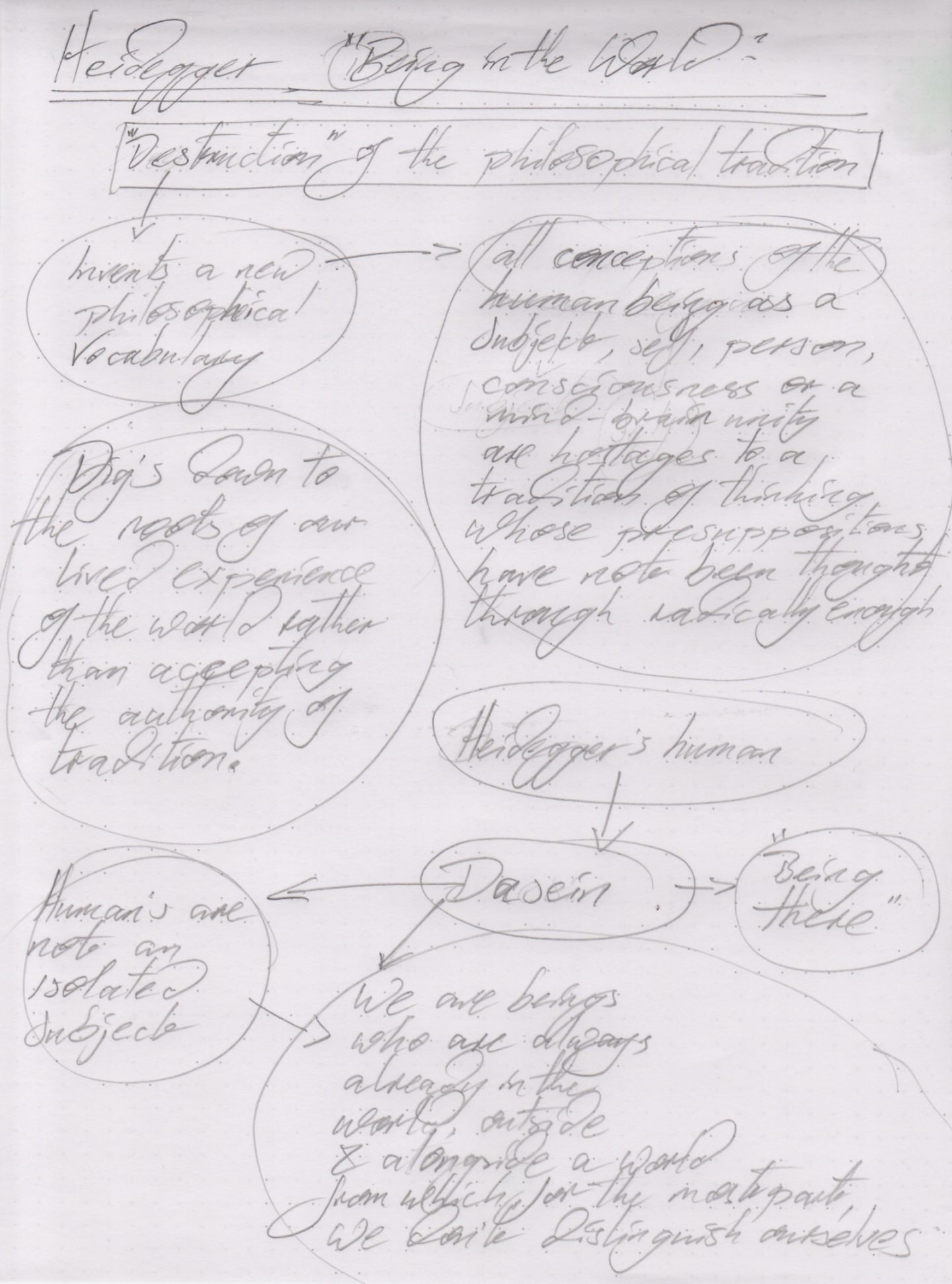
Heidegger is “a thinker who tries to dig down to the roots of our lived experience of the world rather than accepting the authority of tradition” (Critchley, 2009)
“The basic and very simple idea, as we will see in future entries, is that the human being is first and foremost not an isolated subject, cut off from a realm of objects that it wishes to know about. We are rather beings who are always already in the world, outside and alongside a world from which, for the most part, we do not distinguish ourselves.” (Critchely, 2009)
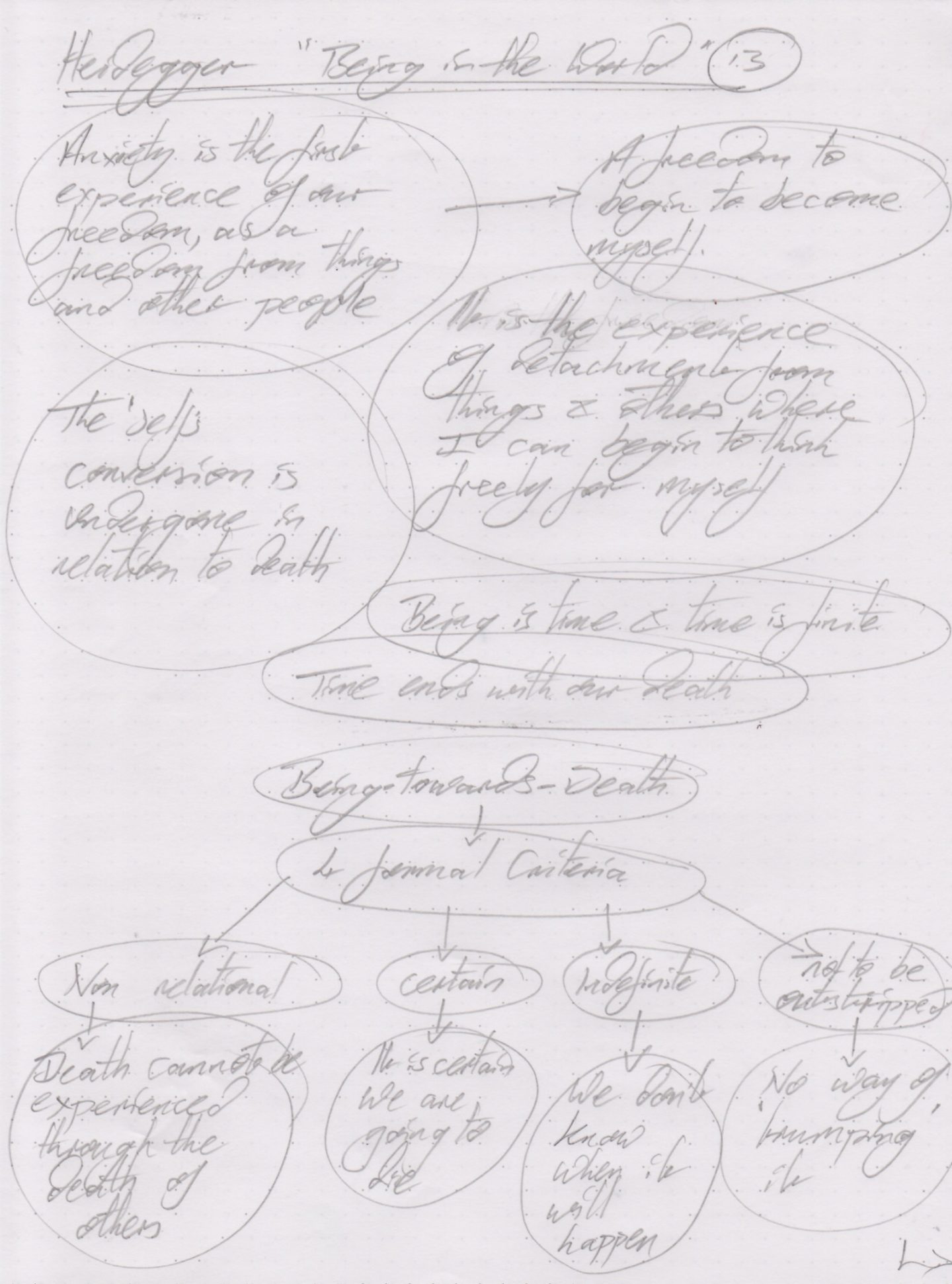
“That said, the basic idea of Being and Time is extremely simple: being is time. That is, what it means for a human being to be is to exist temporally in the stretch between birth and death. Being is time and time is finite, it comes to an end with our death. Therefore, if we want to understand what it means to be an authentic human being, then it is essential that we constantly project our lives onto the horizon of our death, what Heidegger calls “being-towards-death” (Critchley, 2009)
“The self can only become what it truly is through the confrontation with death, by making a meaning out of our finitude. If our being is finite, then what it means to be human consists in grasping this finitude” (Critchley, 2009)
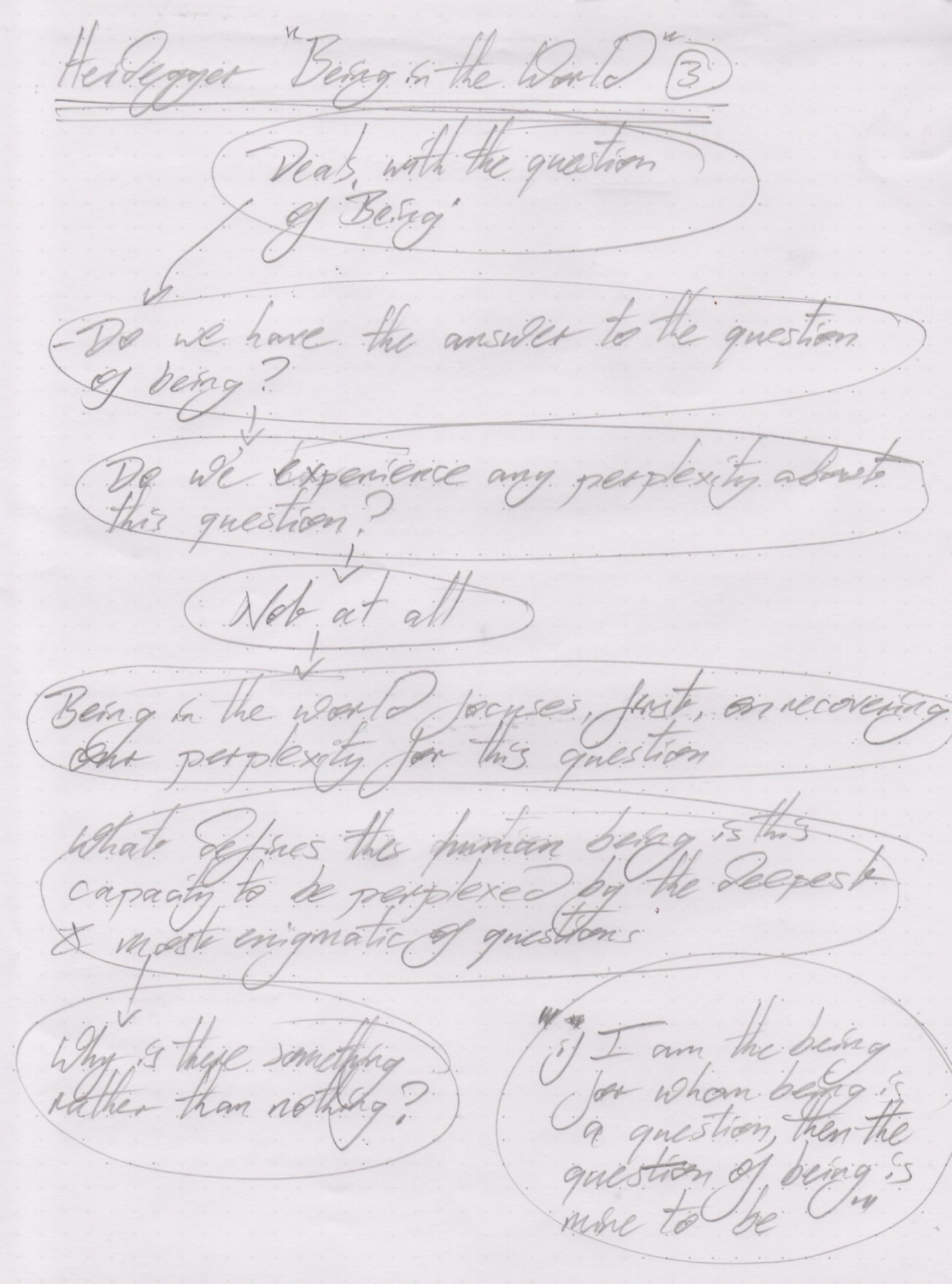
“Questioning is the piety of thinking” (Heidegger quoted in Critchley, 2009) True thinking is an act of reverance and obedience to the truth and not mere domination of ideas. It emphasises that questioning – rather than just demanding answers – is the highest form of respect for the complexity of existence.
“We are ourselves the entities to be analysed” (Heidegger quoted in Critchley, 2009)
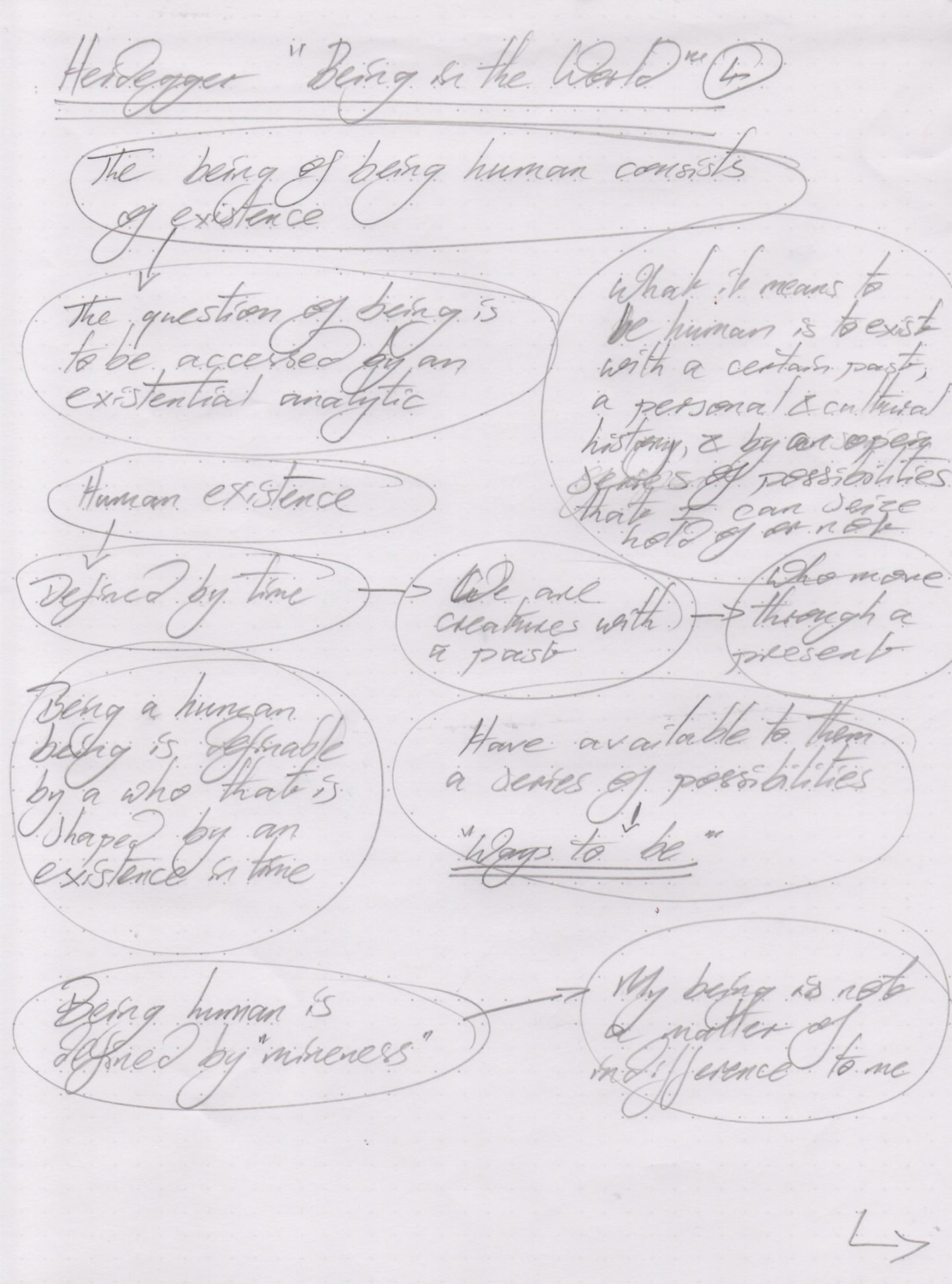
“Therefore, the question of being is to be accessed by way of what Heidegger calls “an existential analytic”” (Heidegger quoted in Critchley, 2009)
“the human being is not definable by a “what”, like a table or a chair, but by a “who” that is shaped by existence in time” (Critchley, 2009)
“What it means to be human is to exists with a certain past, a personal and cultural history, and by an open series of possibilities that I can seize hold of or not” (Critchley, 2009)
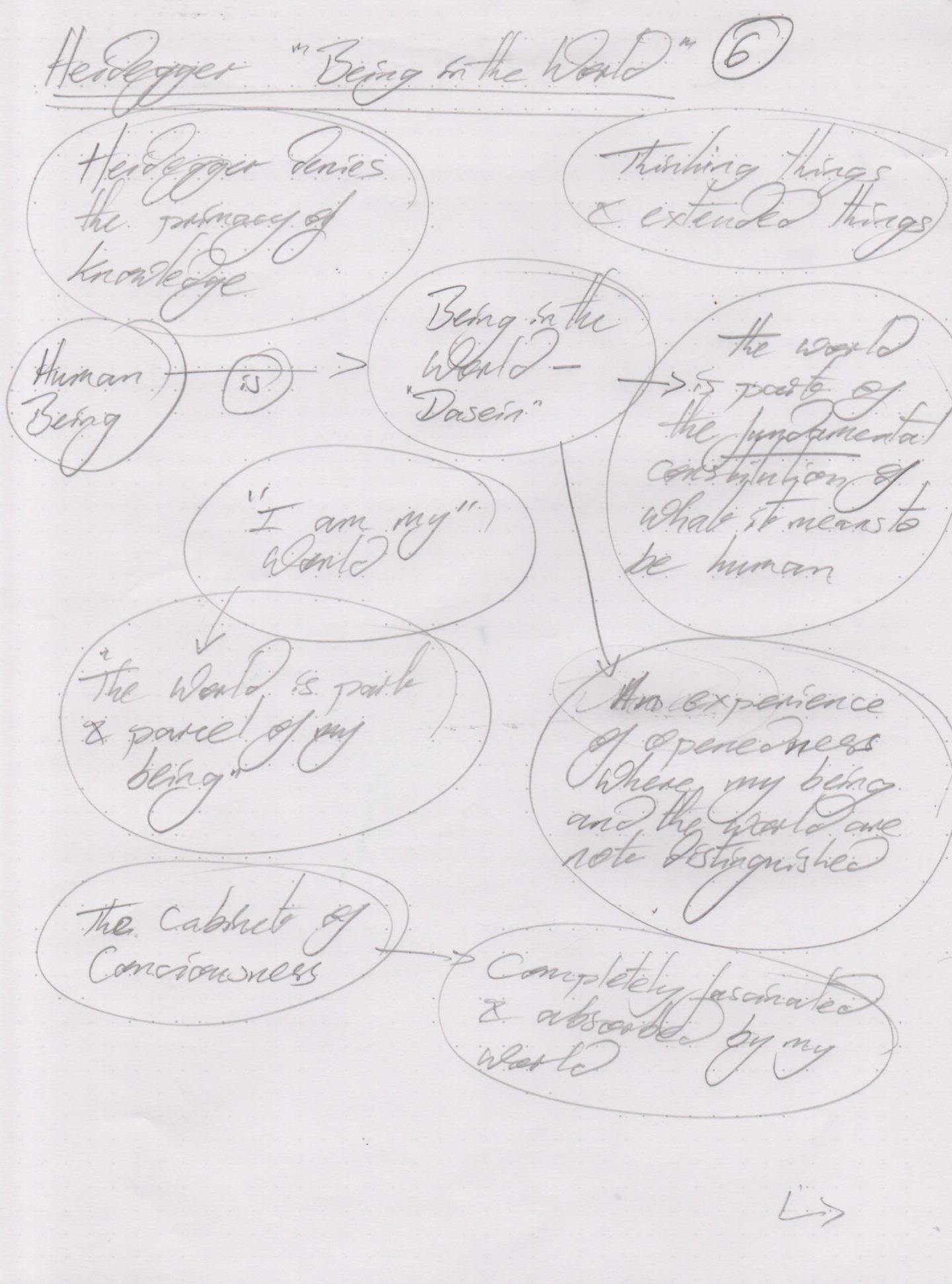
“If the human being is really being-in-the-world, then this entails that the world itself is part of the fundamental constitution of what it means to be human.” (Critchley, 2009)
“I am my world. The world is part and parcel of my being, of the fabric of my existence.” (Critchley, 2009)
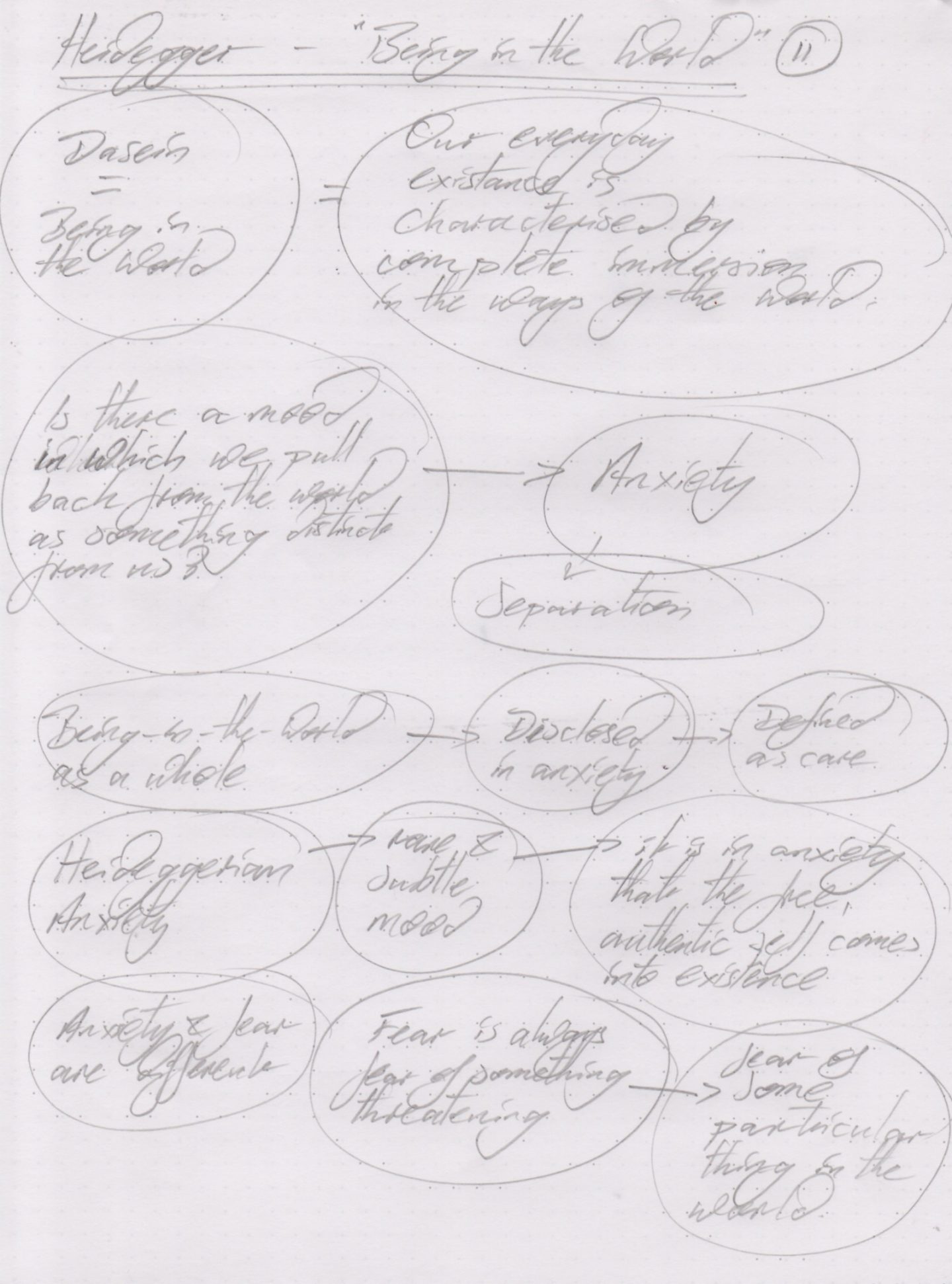
Dasein – “an experience of openedness where my being and that of the world are not distinguished for the most part” (Critchley, 2009)
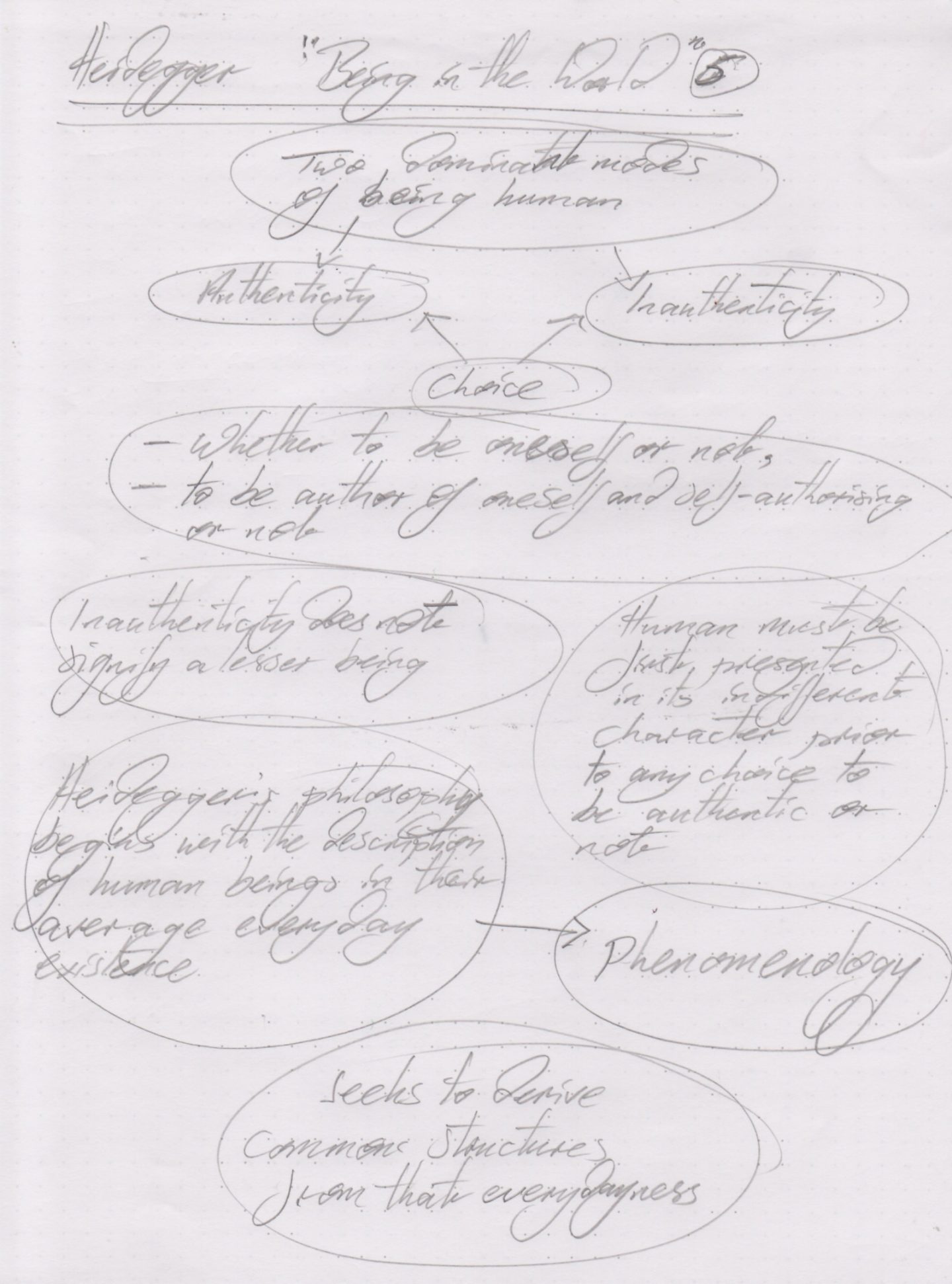
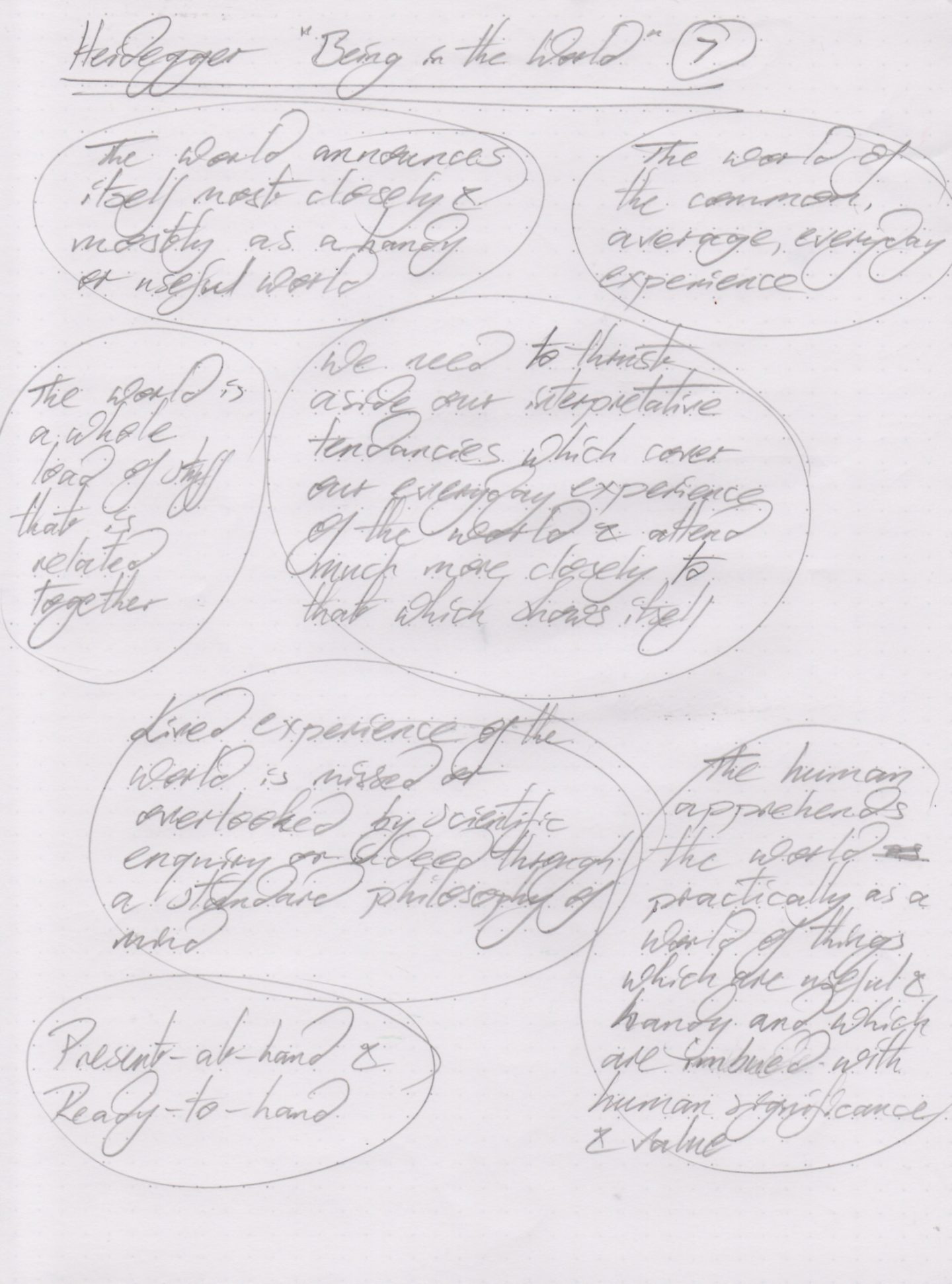
“Heidegger insists that this lived experience of the world is missed or overlooked by scientific inquiry or indeed through a standard philosophy of mind, which presupposes a dualistic distinction between mind and reality. What is required is a phenomenology of our lived experience of the world that tries to be true to what shows itself first and foremost in our experience” (Critchley, 2009)
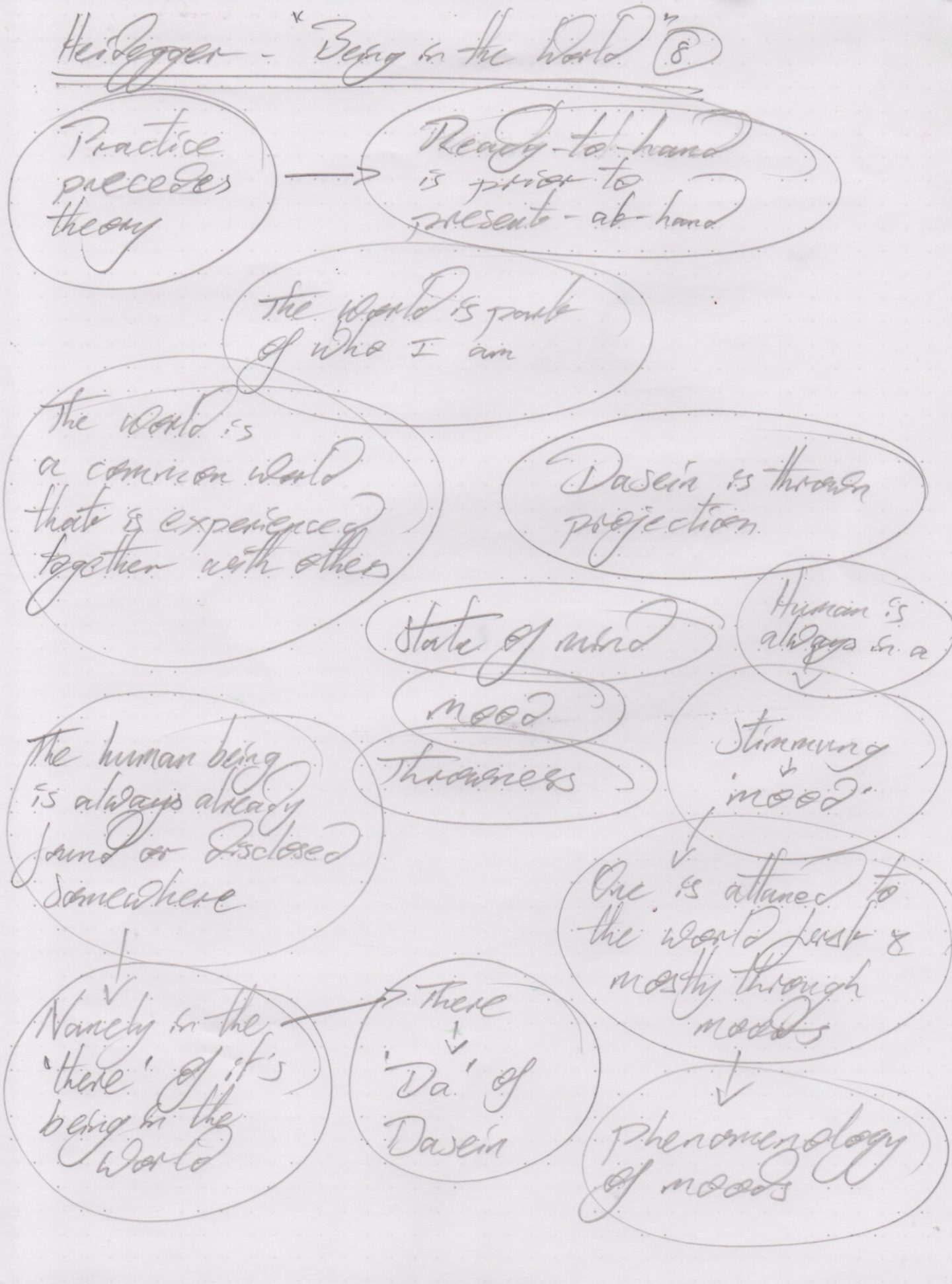
“practice precedes theory, and that the ready-to-hand is prior to the present-at-hand” (Critchley, 2009)
“who we are as human beings is inextricably bound up and bound together with the complex web of social practices that make up my world. The world is part of who I am” (Critchley, 2009)
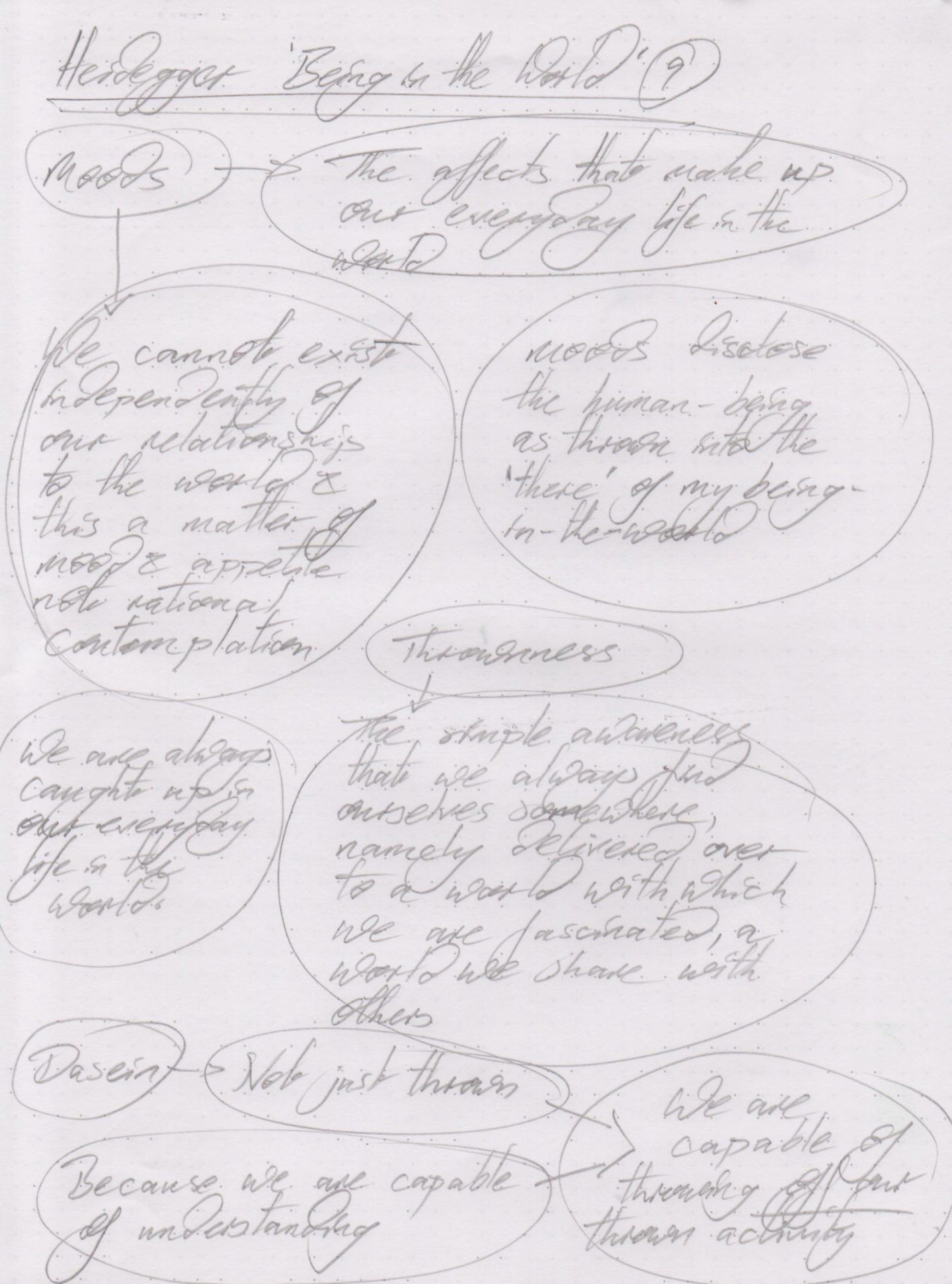
“we cannot exist independently of our relation to the world; and this relationship is a matter of mood and appetite, not rational contemplation.” (Critchley, 2009)
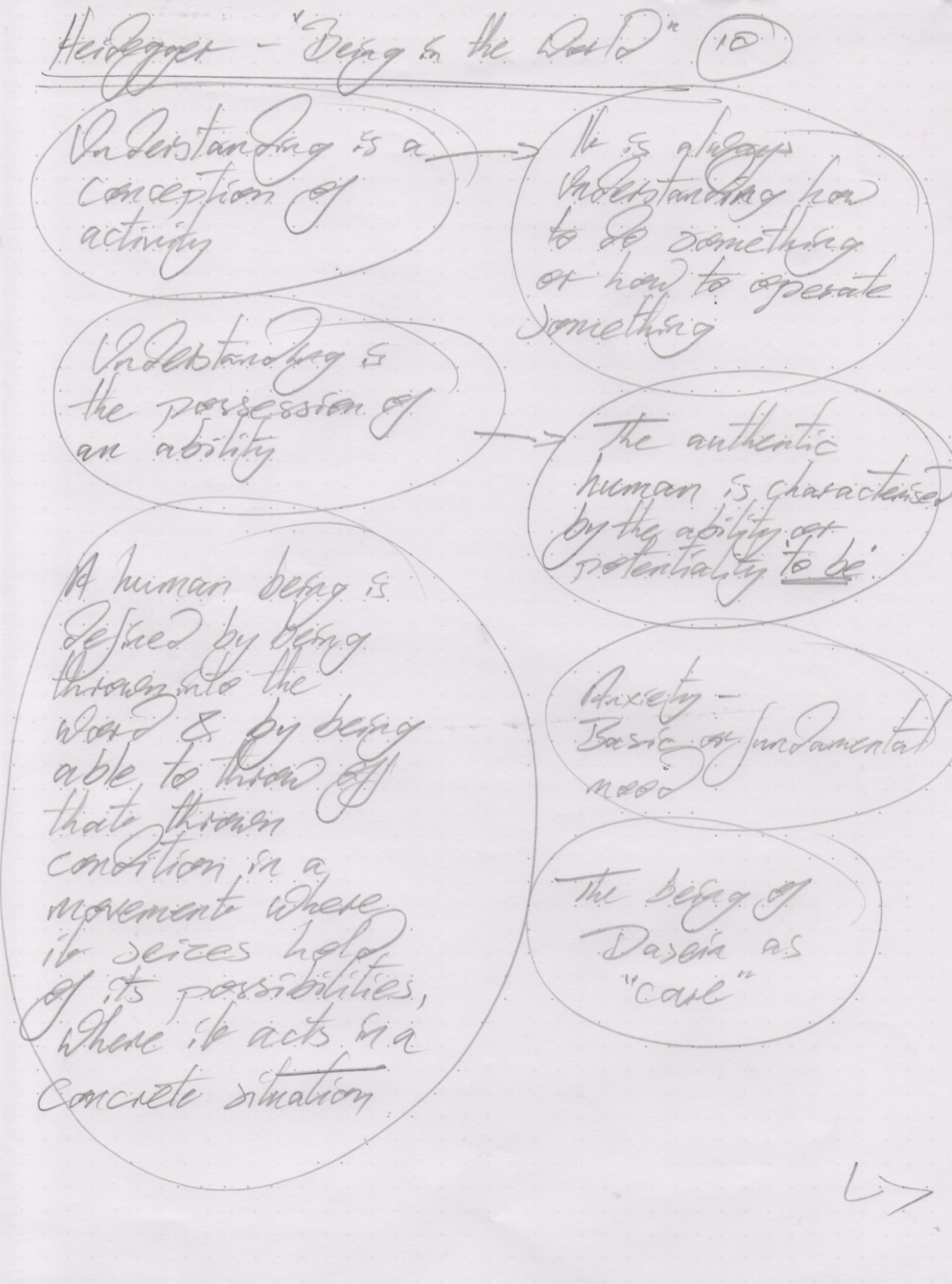
“Dasein is not just thrown into the world. Because it – we – are capable of understanding, we can also throw off our thrown condition.” (Critchley, 2009)
“Understanding is, for Heidegger, a conception of activity. It is always understanding how to do something or how to operate something” (Critchley, 2009)
“So, the human being is not just a being defined by being thrown into the world. It is also one who can throw off that thrown condition in a movement where it seizes hold of its possibilities, where it acts in a concrete situation. This movement is what Heidegger calls projection (Entwurf) and it is the very experience of what Heidegger will call, later in Being and Time, freedom. Freedom is not an abstract philosophical concept. It is the experience of the human being demonstrating its potential through acting in the world. To act in such a way is to be authentic.” (Critchley, 2009)
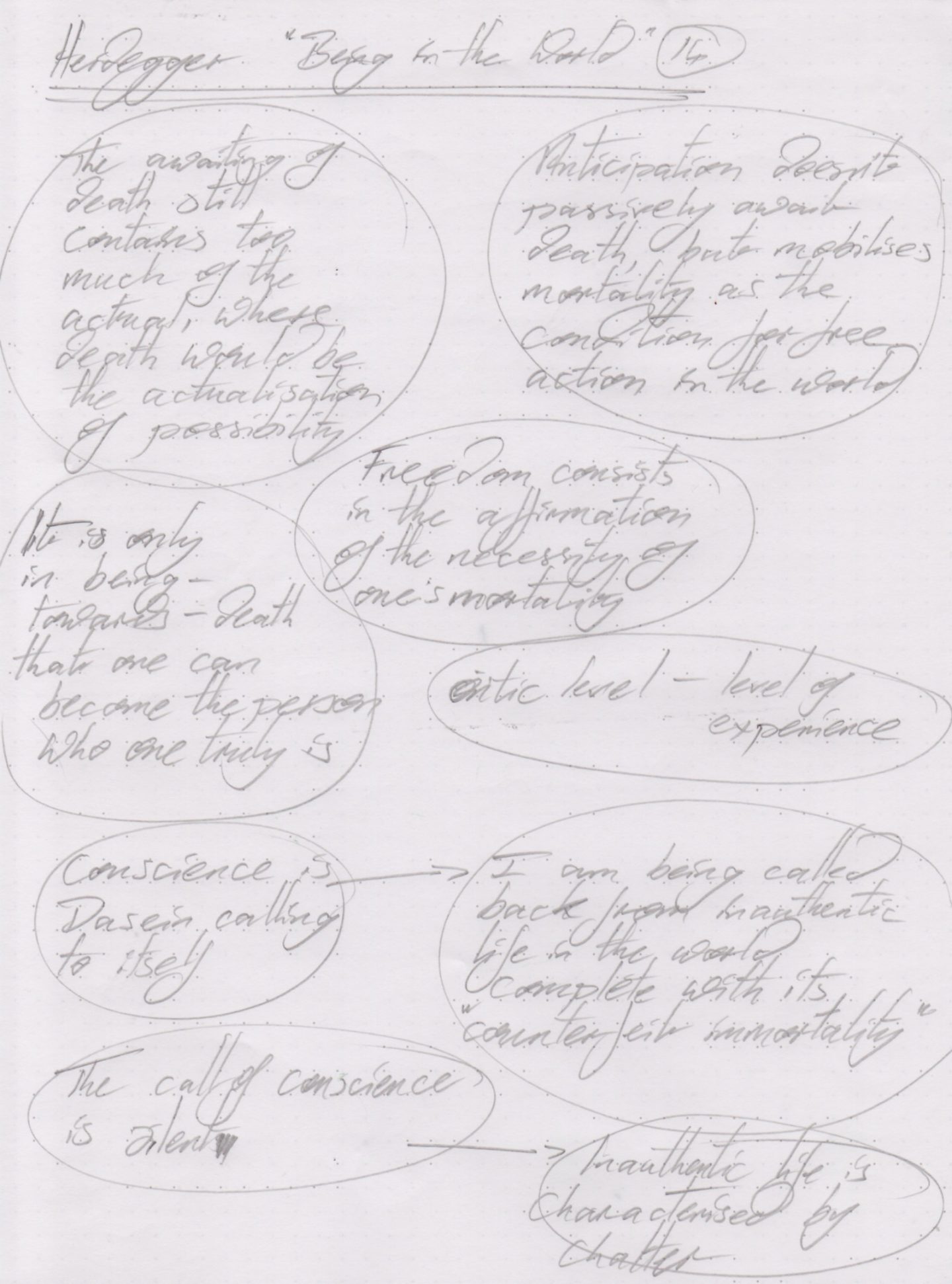
“Inauthentic life in the world is completely bound up with things and other people in a kind of “groundless floating” – the phrase is Heidegger’s.” (Critchley, 2009)
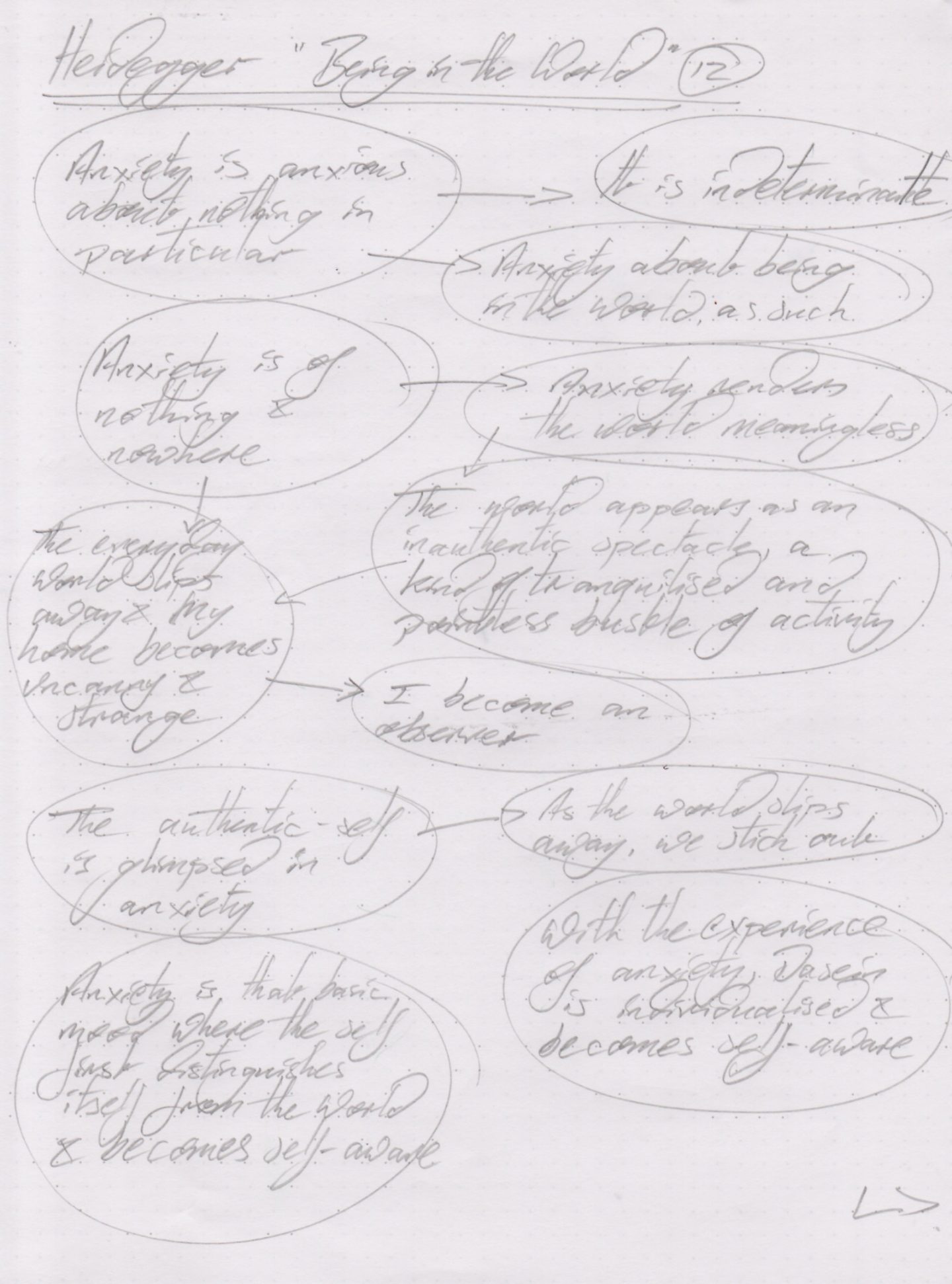
“Anxiety is that basic mood when the self first distinguishes itself from the world and becomes self-aware” (Critchley, 2009)
“Anxiety is the first experience of our freedom, as a freedom from things and other people. It is a freedom to begin to become myself.” (Critchley, 2009)
“if we want to understand what it means to be an authentic human being, then it is essential that we constantly project our lives onto the horizon of our death” (Critchley, 2009)
“If our being is finite, then an authentic human life can only be found by confronting finitude and trying to make a meaning out of the fact of our death” (Critchley, 2009)
“Death is that limit against which my potentiality-for- being (Seinkönnen) is to be measured. It is that essential impotence against which the potency of my freedom shatters itself.” (Critchley, 2009)
“freedom consists in the affirmation of the necessity of one’s mortality. It is only in being-towards-death that one can become the person who one truly is. Concealed in the idea of death as the possibility of impossibility is the acceptance on one’s mortal limitation as the basis for an affirmation of one’s life” (Critchley, 2009)
“being-towards-death pulls Dasein out of its immersion in inauthentic everyday life and allows it come into its own. It is only in relation to being-towards-death that I become passionately aware of my freedom” (Critchley, 2009)
“We are not the only creatures in the universe who are touched by the sentiment of mortality.” (Critchley, 2009)
“Conscience is a call. It is something that calls one away from one’s inauthentic immersion in the homely familiarity of everyday life” (Critchley, 2009)
“conscience is the experience of the human being calling itself back to its mortality,” (Critchley, 2009)
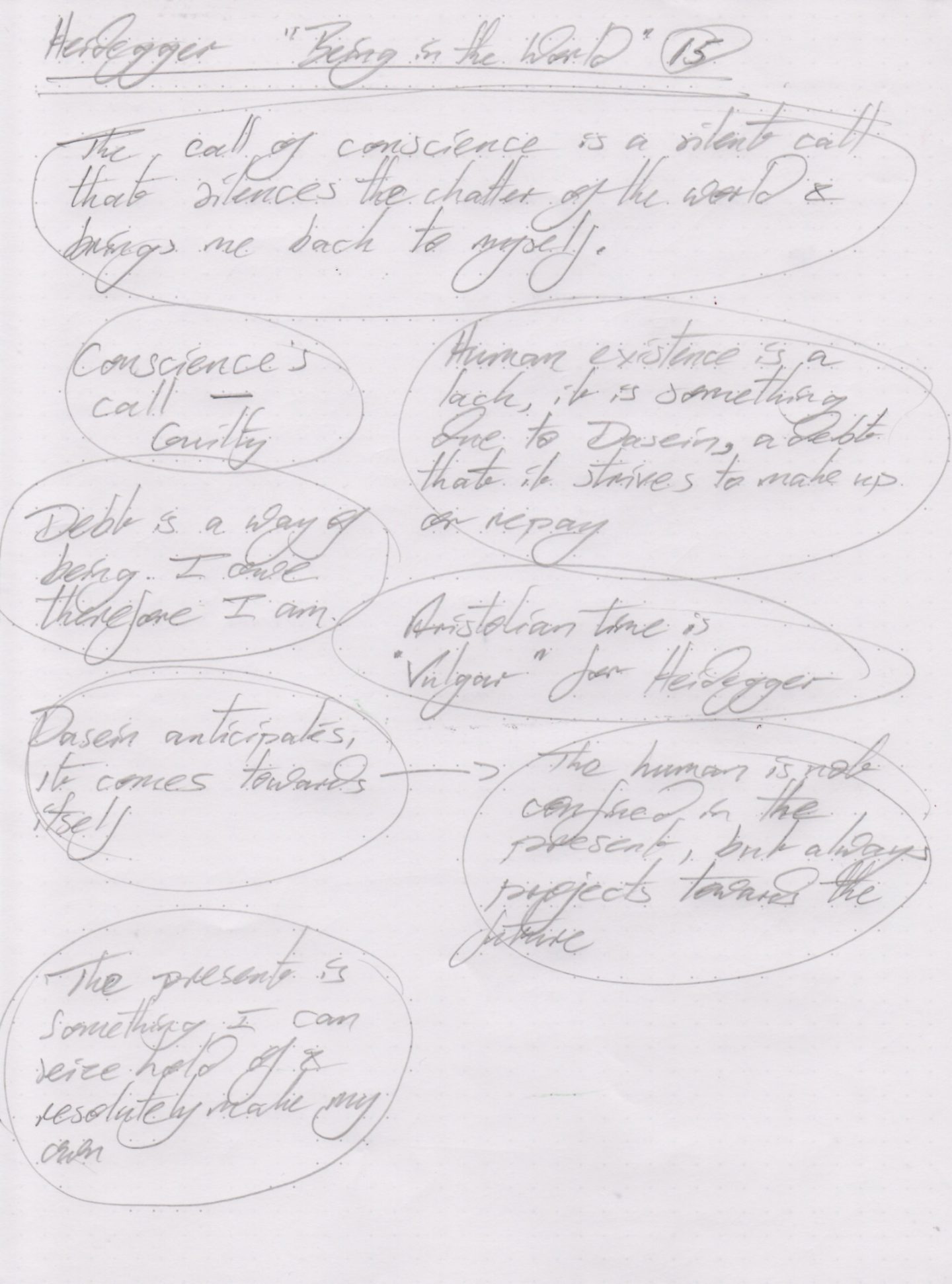
“So, the call of conscience is a silent call that silences the chatter of the world and brings me back to myself.” (Critchley, 2009)
“Heidegger’s claim is that guilt is the pre-moral source for any morality. As such, it is beyond good or evil. Is guilt bad? No. but neither is it good. It is simply what we are” (Critchley, 2009)
“What changes in being authentic is that the human being understands the call of conscience and takes it into itself. Authentic Dasein comes to understand itself as guilty” (Critchley, 2009)
“Dasein has chosen itself….what is chosen is not having a conscience, which Dasein already has because of its ontological want or indebtedness, but what Heidegger calls, rather awkwardly, “wanting to have a conscience”…I choose to want the want that I am. “ (Critchley, 2009)
“responsibility…consists in understanding the call, in wanting to have a conscience. To make this choice, Heidegger insists, is to become resolute.” (Critchley, 2009)
“in anticipation, I project towards the future, but what comes out of the future is my past, my personal and cultural baggage,…But this does not mean that I am somehow condemned to my past. On the contrary, I can make a decision to take over the fact of who I am in a free action. This is what Heidegger calls “resoluteness”.“(Critchley, 2009)
“the present is something that I can seize hold of and resolutely make my own. What is opened in the anticipation of the future is the fact of our having-been which releases itself into the present moment of action.” “This is the moment of vision. What appears in the moment of vision is authentic Dasein” (Critchley, 2009)
“Time should be grasped in and of itself as the unity of the three dimensions – what Heidegger calls “ecstases” – of future, past and present. This is what he calls “primordial” or “original” time and he insists that it is finite. It comes to an end in death.” (Critchley, 2009)
“For Heidegger, we are time. Temporality is a process with three dimensions which form a unity. The task that Heidegger sets himself in Being and Time is a description of the movement of human finitude. The question that he leaves hanging at the end of the book is the issue that began the whole enterprise, namely the question of being as such. We have been given an answer to the question what it means to be human, but no sense of how we might answer the question of being as such” (Critchley, 2009)
Useful Vocabulary
Augenblick – the moment of vision, the “glance of the eye”, the right or opportune moment
Befindlichkeit – ‘already-having-found-oneself-there-ness’
Dasein – “Being there” – Heidegger’s definition of a human-being
Dasein ist geworfener Entwurf – Dasein is thrown projection
Entwurf – projection
Existenz – Existence
Erwaten – Expectation or awaiting
Eigentlichkeit – Authenticity – what is proper to the human being, what is its own
etwas können – Understanding is the possession of an ability
Gewesenheit – having-been-ness
Gewissen-haben-wollen – wanting to have a conscience
Geworfenheit – Thrownness – is the simple awareness that we always find ourselves somewhere, namely delivered over to a world with which we are fascinated, a world we share with others.
Grundstimmung – basic or fundamental mood
Heimlich – Homely
Jemeinigkeit – Mineness
Mitsein – “being-with” – the world is a common world that experienced together with others.
Stimmung – mood – This is mood is the strong Aristotelian sense of pathos, a passion of the soul or an affect, something befalls us and in which we find ourselves. The passions are not, for Heidegger, psychological colouring for an essentially rational agent. They are rather the fundamental ways in which we are attuned to the world. (Critchley, 2009)
Seinkönnen – the authentic human is characterised by the ability or potentiality to be.
Sorge – care
Seinkönnen – Potentiality for being
Schuld – Guilt, debt
Umwelt – environment, the world that surrounds the human being and in which it is completely immersed for the most part.
Unheimlich – Uncanny
Unüberholbar – Outstripped
Vorhandenheit – The present-at-hand – our theoretical apprehension of a world made up of objects
Vorlaufen – anticipation
Verschwiegenheit – reticence
verantwortlich – answerable, responsible
Zuhandenheit – The ready-to-hand – describes our practical relation to things that are handy or useful
Zukunft – the future
Zukommen – come towards


References
Critchley, S. (2009) ‘Being and Time, part 1: Why Heidegger matters’ In: The Guardian 08/06/2009 At: https://www.theguardian.com/commentisfree/belief/2009/jun/05/heidegger-philosophy (Accessed 03/05/26)
Critchley, S. (2009) ‘Being and Time, part 2: On ‘mineness” In: The Guardian 15/06/2009 At: https://www.theguardian.com/commentisfree/belief/2009/jun/15/heidegger-being-time-philosophy (Accessed 03/05/26)
Critchley, S (2009) ‘Being and Time, part 3: Being-in-the-world’ In: The Guardian 22/06/2009 At: https://www.theguardian.com/commentisfree/belief/2009/jun/22/heidegger-religion-philosophy (Accessed 03/05/26)
Critchley, S (2009) ‘Being and Time, part 4: Thrown into this world’ In: The Guardian 29/06/2009 At: https://www.theguardian.com/commentisfree/belief/2009/jun/29/religion-philosophy (Accessed 03/05/26)
Critchley, S (2009) ‘Being and Time, part 5: Anxiety’ In: The Guardian 06/07/2009 At: https://www.theguardian.com/commentisfree/belief/2009/jul/06/heidegger-philosophy-being (Accessed 03/05/26)
Critchley, S (2009) ‘Being and Time, part 6: Death’ In: The Guardian 13/07/2009 At: https://www.theguardian.com/commentisfree/belief/2009/jul/13/heidegger-being-time (Accessed 03/05/26)
Critchley, S (2009) ‘Being and Time, part 7: Conscience’ In: The Guardian 20/07/2009 At: https://www.theguardian.com/commentisfree/belief/2009/jul/20/heidegger-being-time-critchley (Accessed 03/05/26)
Critchley, S (2009) ‘Being and Time, part 8: Temporality’ In: The Guardian 27/07/2009 At: https://www.theguardian.com/commentisfree/belief/2009/jul/27/heidegger-being-time-philosophy (Accessed 03/05/26)