Key Insights
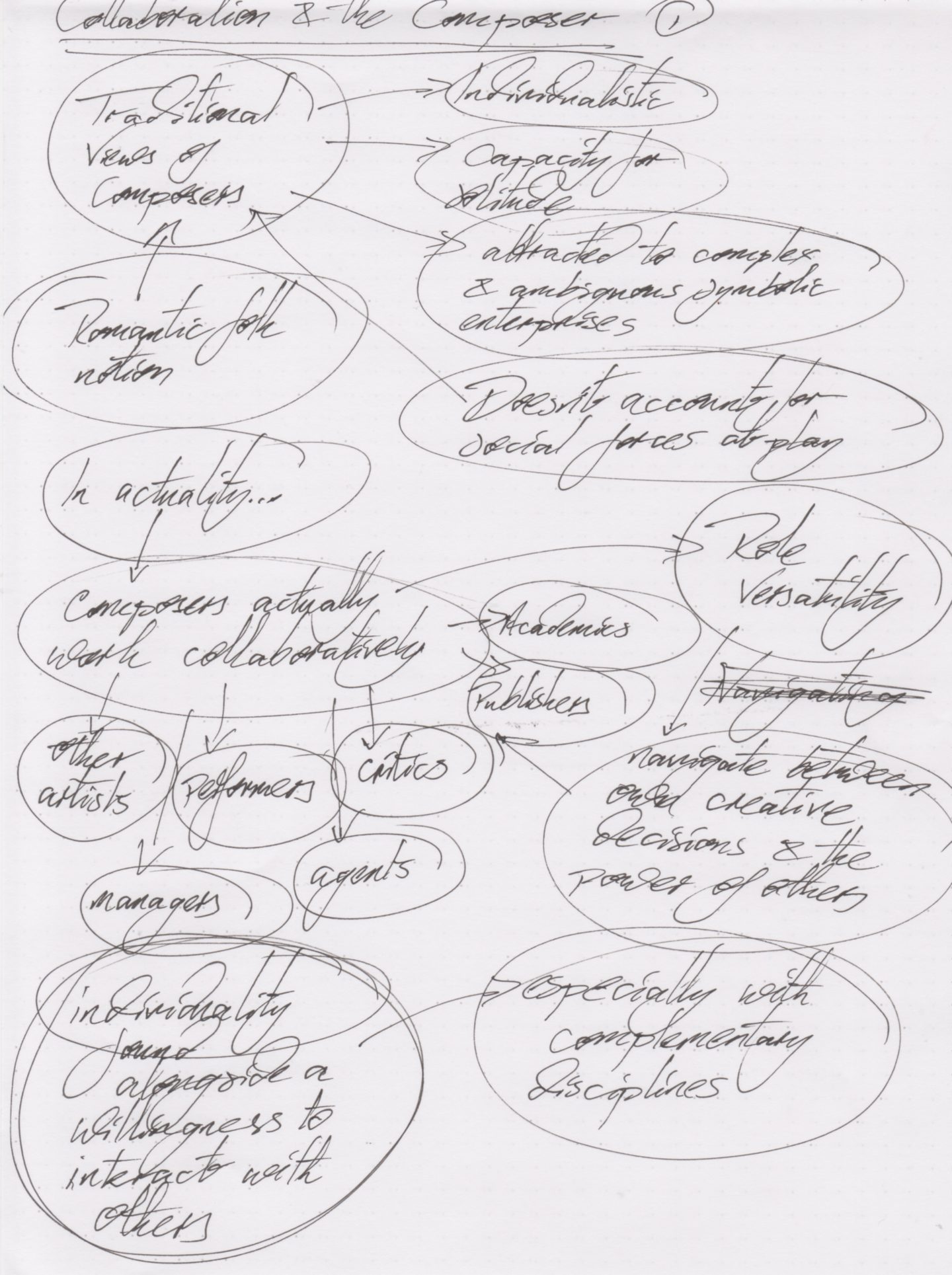
1. The composer-as-lone-genius myth is both true and false. Composers are drawn to solitary, complex symbolic work (Kemp), but Nash’s older research shows the “musical process” always runs through a web of performers, conductors, publishers, and institutions. The individualist myth and the collaborative reality coexist in tension rather than one replacing the other.
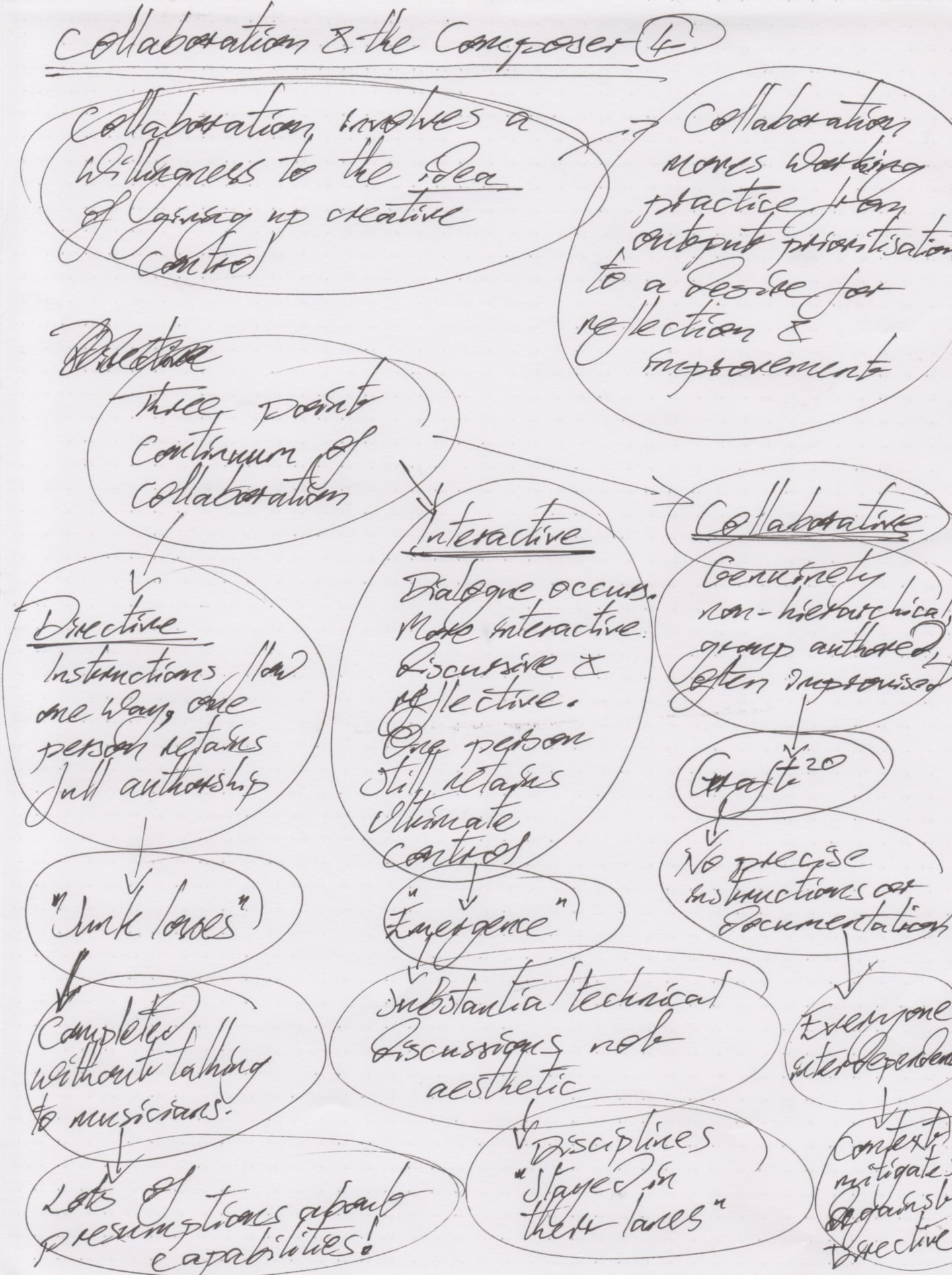
2. A three-point continuum of collaboration, not a binary:
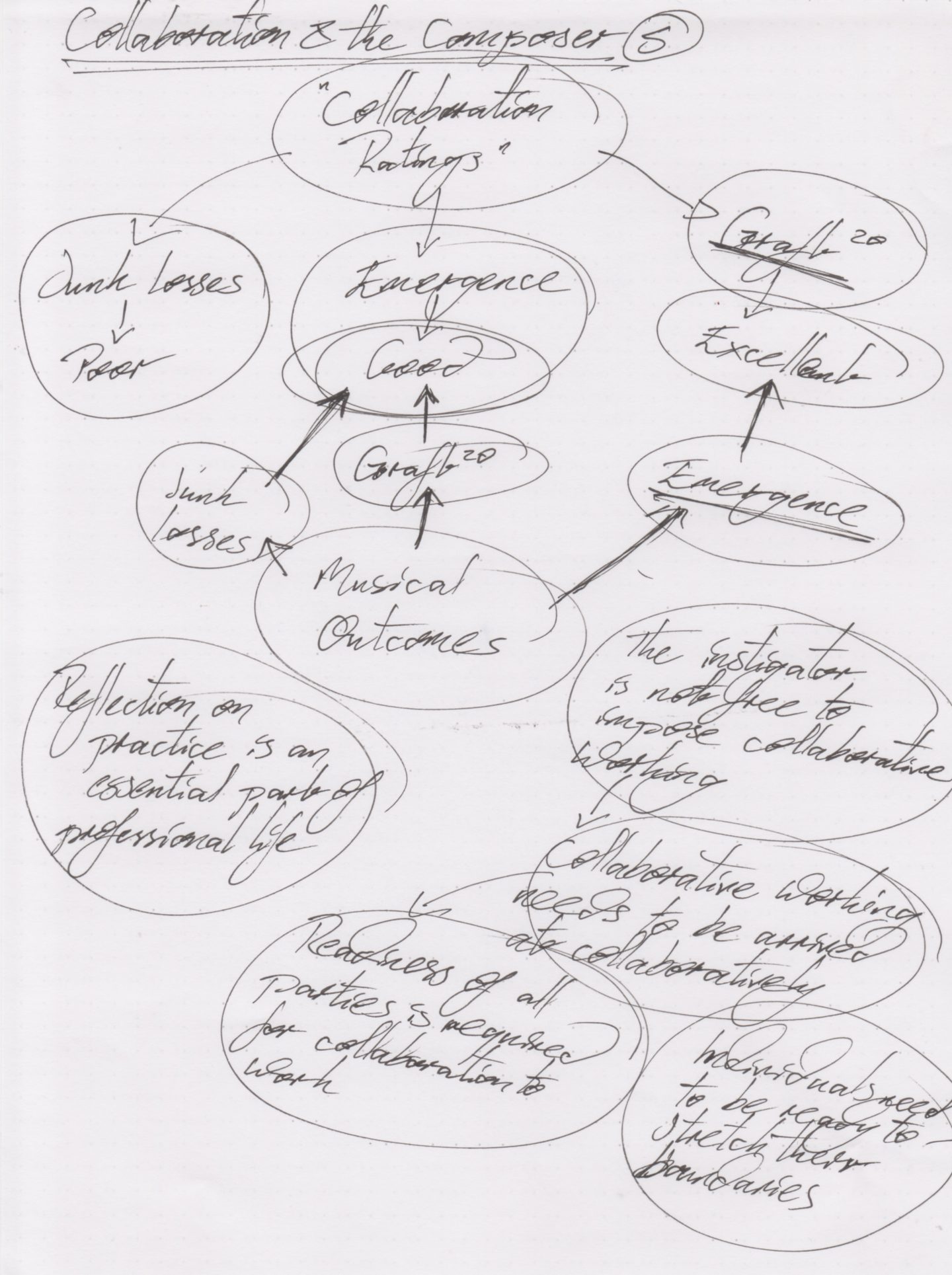
- Directive — notation/instructions flow one way, composer retains full authorship (e.g. Sunk Losses, an orchestral score handed to musicians nearly finished)
- Interactive — dialogue happens, but the composer keeps ultimate control (e.g. Emergence, where technical input from a soloist shaped details but not structure)
- Collaborative — genuinely non-hierarchical, group-authored, often with no fixed notation (e.g. GRAFT, where the electronic routing made everyone technically dependent on everyone else)
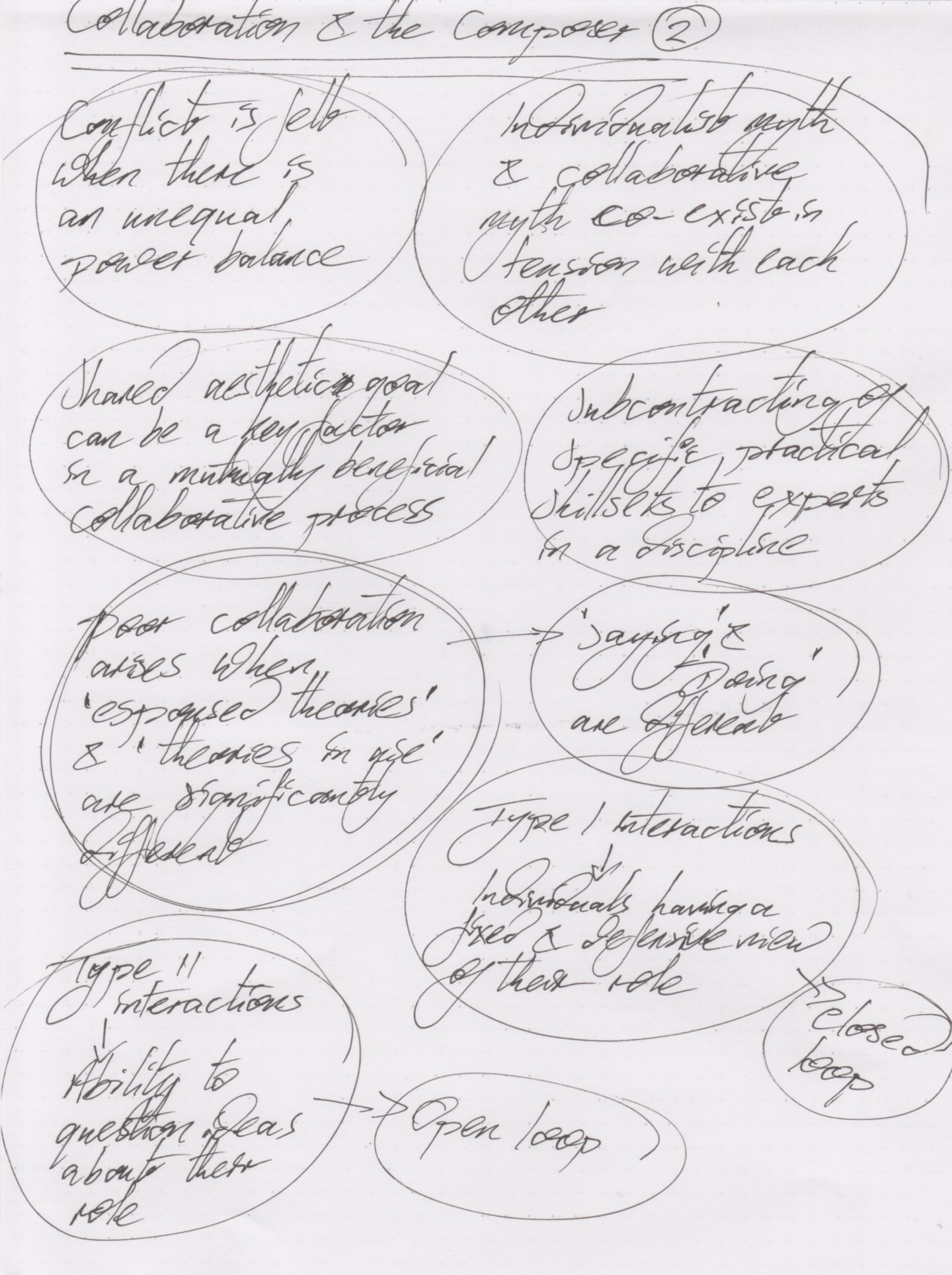
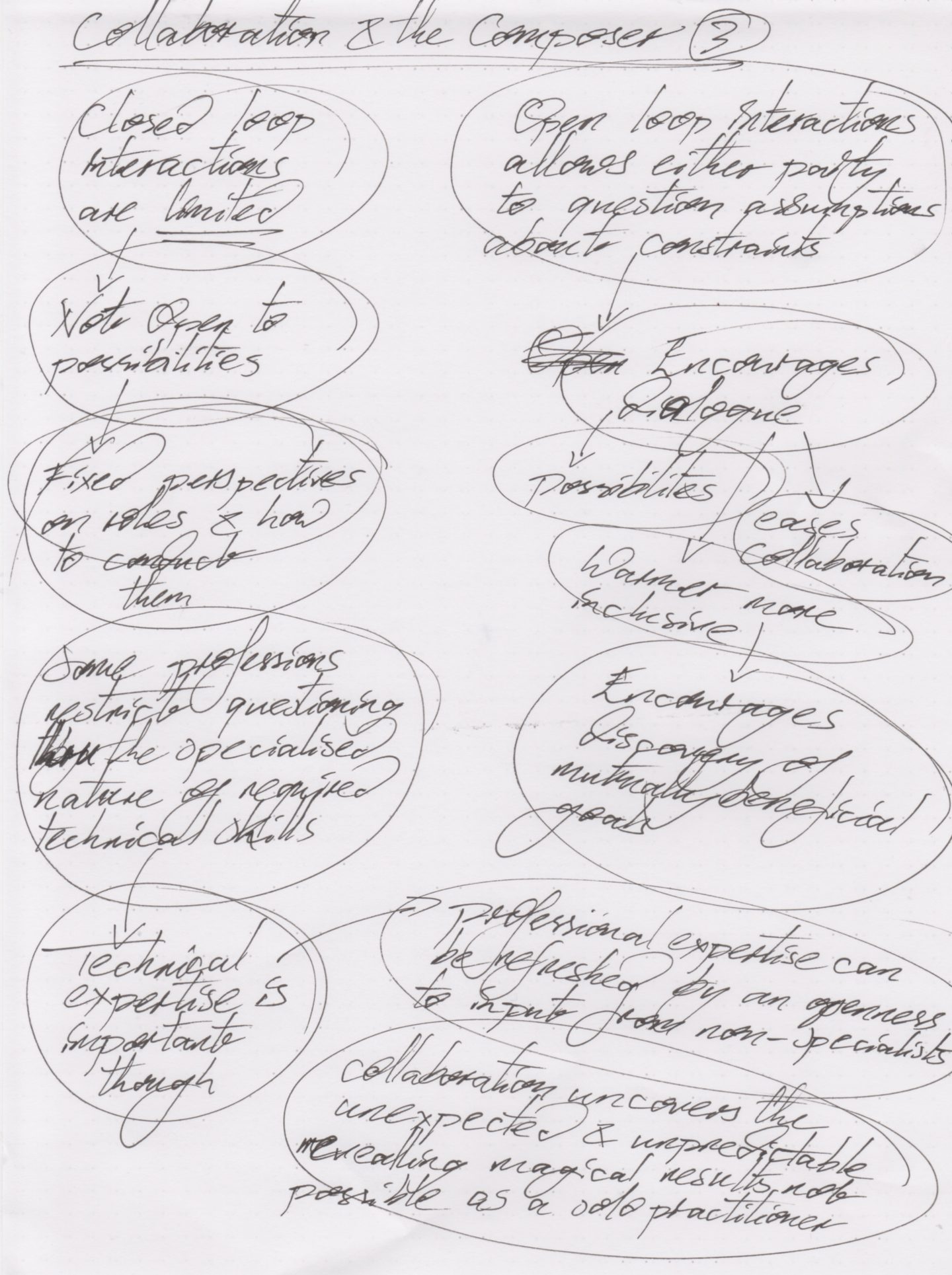
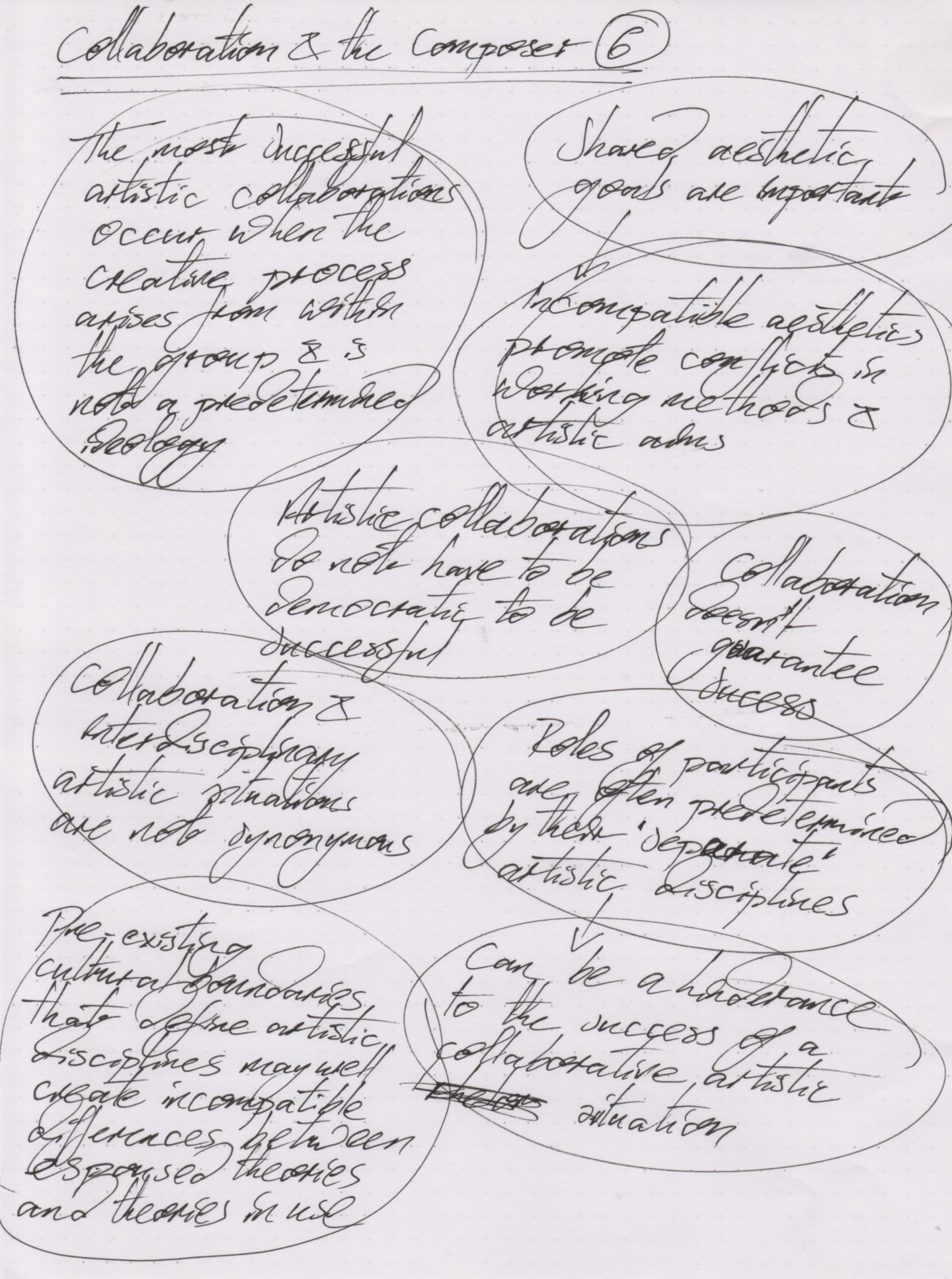
3. Espoused theory vs. theory-in-use (Argyris & Schön). What people say they want from collaboration (“I welcome your input”) often diverges from how they actually behave (resisting any input that threatens their role). Good collaboration requires type II / open-loop behaviour — being willing to question your own assumptions about your role, not just solve problems within it.
4. Process success ≠ outcome success. Their table is the sharpest finding: there’s no correlation between how well the collaboration went and how good the piece was. Sunk Losses was a poor collaborative process but a good piece; Relative Autonomy was a “very poor” collaboration yet judged excellent. Don’t conflate a smooth process with good work, or a difficult one with bad work.
5. The cautionary case — 3D-Music. The most self-consciously, institutionally-mandated “collaborative” project was the least successful, because participants brought fixed disciplinary assumptions (avant-garde composer vs. games-industry visual logic) they weren’t willing to abandon. Real collaboration requires people who’ll actually let their conceptual boundaries move — a shared aesthetic mission and genuine openness beat structural non-hierarchy.
6. Institutional valorisation of “collaboration” can become a hollow, imposed condition — funders demanding interdisciplinarity as a checkbox, when in practice pre-existing disciplinary roles just get reasserted underneath a collaborative label.
Application to my Practice
- Naming my own continuum. For the Hastings project, I could productively map where “collaboration” with the town, its archive material, participants/walkers, or ancestral history actually sits — directive (I shape the material into a fixed work), interactive (dialogue with place/archive shapes revisions but I retain authorial control), or collaborative (the walking process itself, or participant contributions, genuinely co-determine the work’s form). Being explicit about this — rather than assuming “collaborative” as a flattering label — mirrors Hayden’s own honesty about Emergence only fitting the interactive paradigm “in certain aspects.”
- Treating place as collaborator, tested against type I/II behaviour. I already frame Hastings as a collaborator with ancestral ties. Argyris and Schön’s framework offers a useful test: am I engaging in type II (open-loop) behaviour toward the town — letting it genuinely redirect method and form — or is “the town as collaborator” more of an espoused theory, with the actual practice remaining directive (I extract material, place supplying content on my terms)? This is exactly the gap the 3D-Music case exposes.
- Decoupling process quality from outcome judgement. If a phenomenological walk, encounter, or archival session feels effortful, resistant, or unresolved, that’s not itself evidence the resulting work will be weak — and a smooth, satisfying walk doesn’t guarantee a strong outcome either. Useful permission to sit with friction in the research process without treating it as a failure signal.
- Guarding against institutional/degree-context pressure to perform “collaboration.” Since this feeds into my degree tutorial materials, the article’s closing warning is directly relevant: don’t let assessment criteria push me into claiming a collaborative framing (with place, archive, or participants) that my actual practice doesn’t bear out — articulate precisely which parts of the process are directive, interactive, or collaborative, rather than defaulting to the more fashionable label.
Notes