Simon Faithfull “OoOO Navigation Part 1″

Fig.1. 0º00 Navigation Part I, (Still from video) (2009)
Fig.2. 0º00 Navigation Part I, (Still from video) (2009)
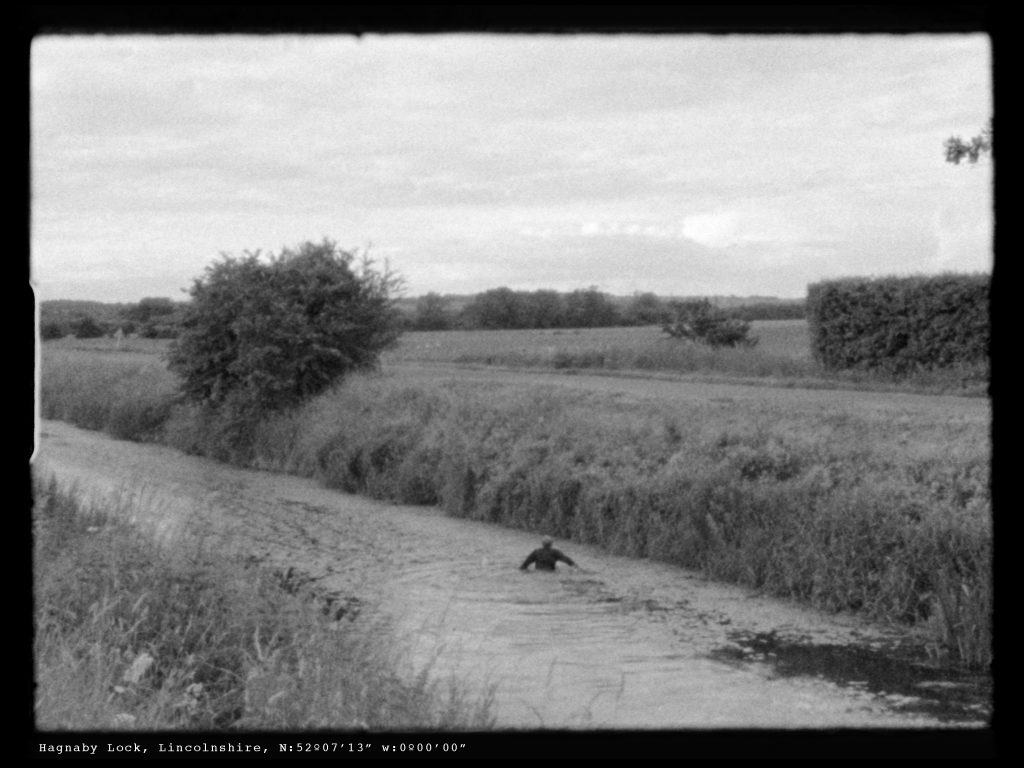

Fig.3. Accra Container Yard (2009)
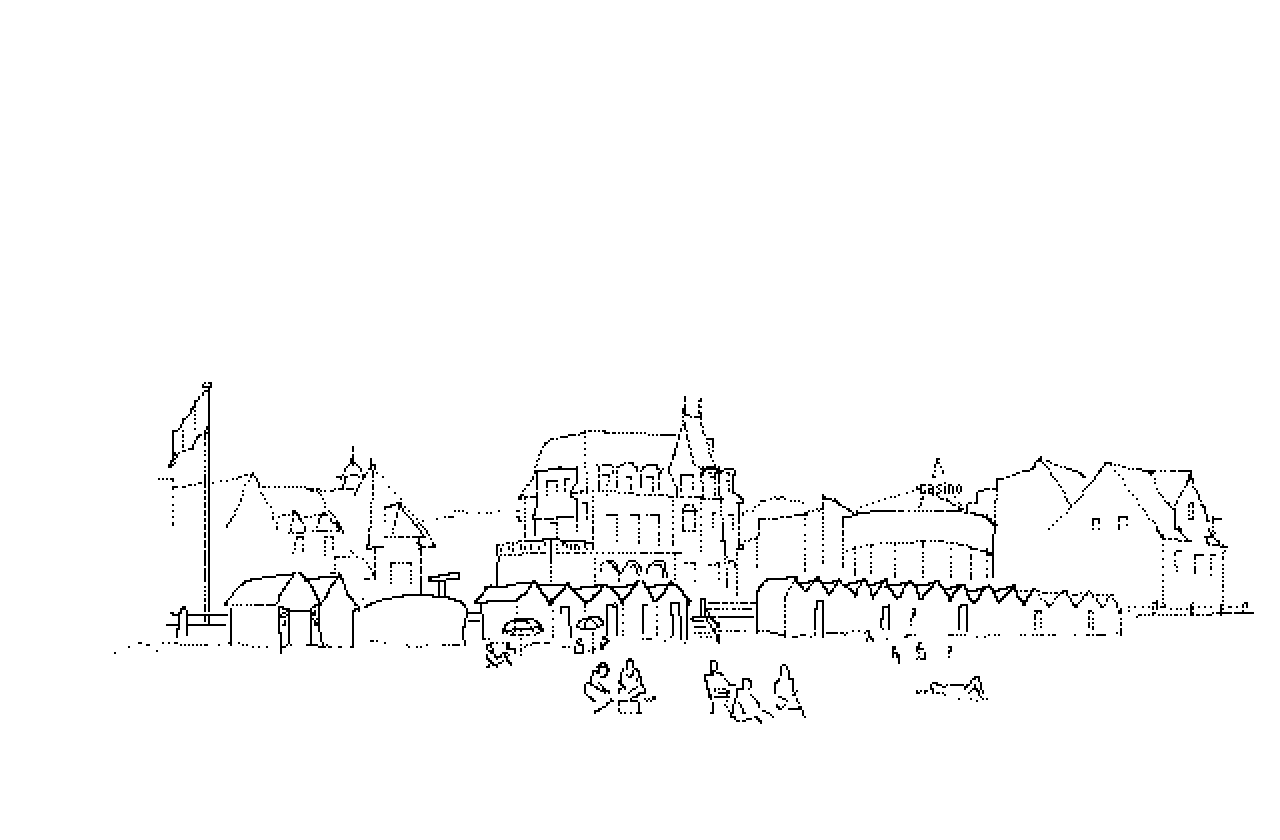
Fig.4. Villers sur Mer, France (N.49o326, E.0o00) (2009)

Fig.5. 0º00 Navigation Part II: A Journey Across Europe and Africa, (2023)
Fig.6. 0º00 Navigation part I – A Journey Across England (details) (2009)

Research Notes
Description of The Work
Simon Faithfull’s film 0°00 Navigation shows an ‘obsessive’ yet playful journey exactly along the Greenwich Meridian.…Faithfull explores the hypothetical, geographical construct of the Greenwich Meridian line as a physical route to be explored. His practice has been described as ‘an attempt to understand and explore the planet as a sculptural object – to test its limits and report back from its extremities’. 0° 00 Navigation Part II, A Journey Across Europe and Africa was completed in 2015 (University of Salford, s.d.)
Simon Faithfull’s new work, 0°00 Navigation, an ambitious undertaking in which the artist set out to walk, climb, wade and swim his way across the whole length of the United Kingdom, from the English Channel to the North Sea, keeping strictly to the Greenwich Meridian, the zero longitude point from which all international navigation is calculated….The resulting black and white film and photographs document the artist’s progress as he crosses fields, roads and canals, passing over or through whatever obstacles present themselves be they natural or manmade including houses, factories, offices etc.…Of course, the very fact that the zero meridian passes through the United Kingdom, (via the Royal Observatory in Greenwich), is nothing more than an arbitrary human construct that has nothing to do with the physical constraints of the planet. Indeed, it was only accepted internationally a mere century and a quarter ago, and even then, not by everyone. With this in mind, Simon Faithfull’s project tends, more than anything, to highlight the futility of man’s derisory attempts to impose his rules on the planet. (Parker’s Box, 2011)
How the work engages an audience
- Withheld identity and vantage point
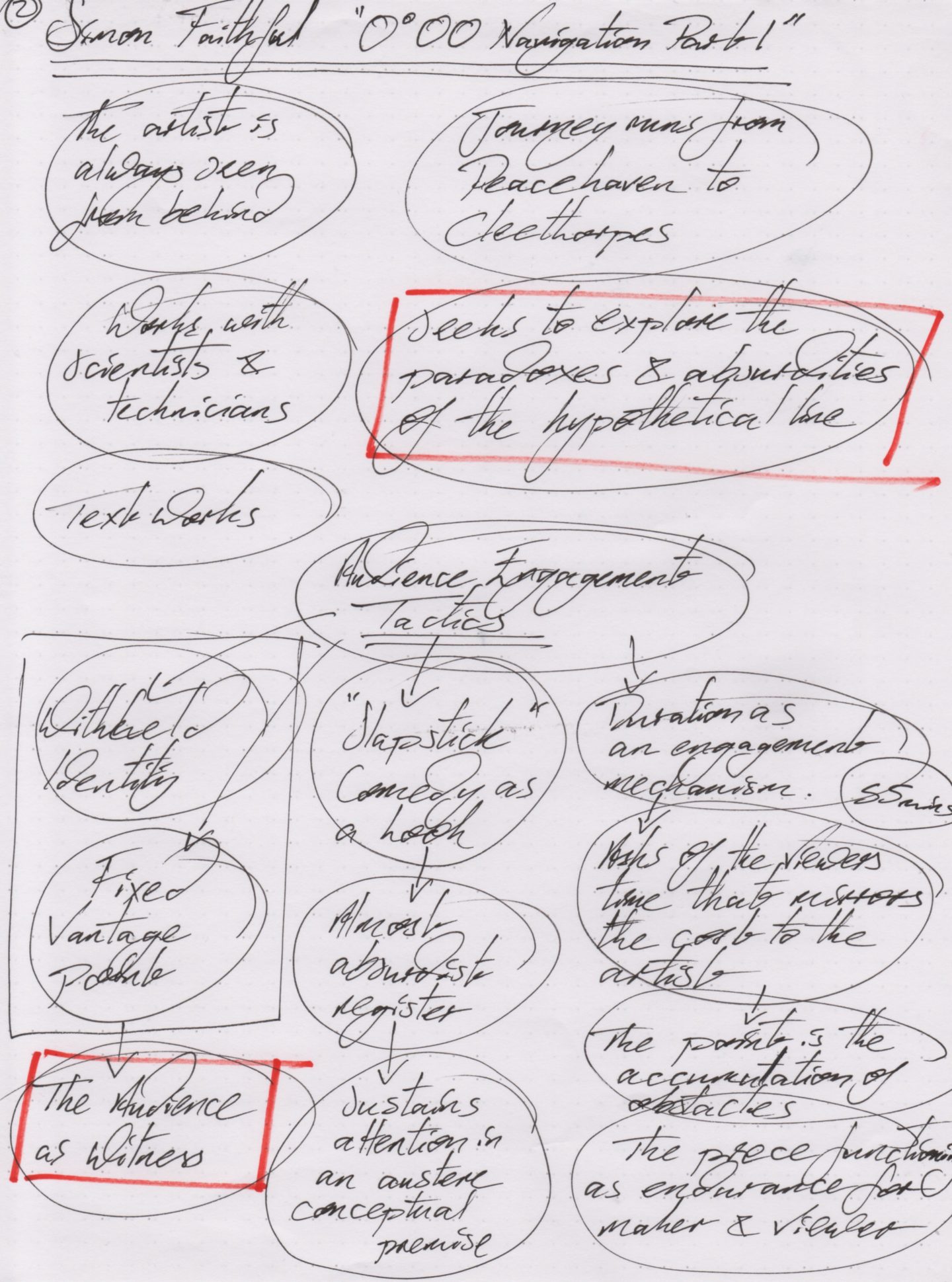
- Figure always seen from behind
- By denying the viewer the artist’s face or point of view, the audience is kept as witness following a body rather than inhabiting it
- The audience is implicated in the journey as observer not participant
- Slapstick physical comedy as a hook
- The journey and the resultant film could be seen in the tradition of British slapstick or physical comedy: one man’s epic journey along the prime meridian, negotiating every obstacle and every person that he meets (crossing private property, the M25, Gunpowder Park)
- The comic, almost absurdist register is the dimension that keeps a lay audience watching what is a fairly austere conceptual premise
- The humour – intended or otherwise – does the work of sustaining attention across the film’s duration
- Duration as the engagement mechanism
- The film is 55 mins long, and asks something of the viewers’ time that mirrors what it cost the artist
- You can’t fast forward to the “point” of the work, because the point os the accumulation of obstacles endured
- This is the piece functioning as endurance for both maker and audience, not just record of an endurance performance
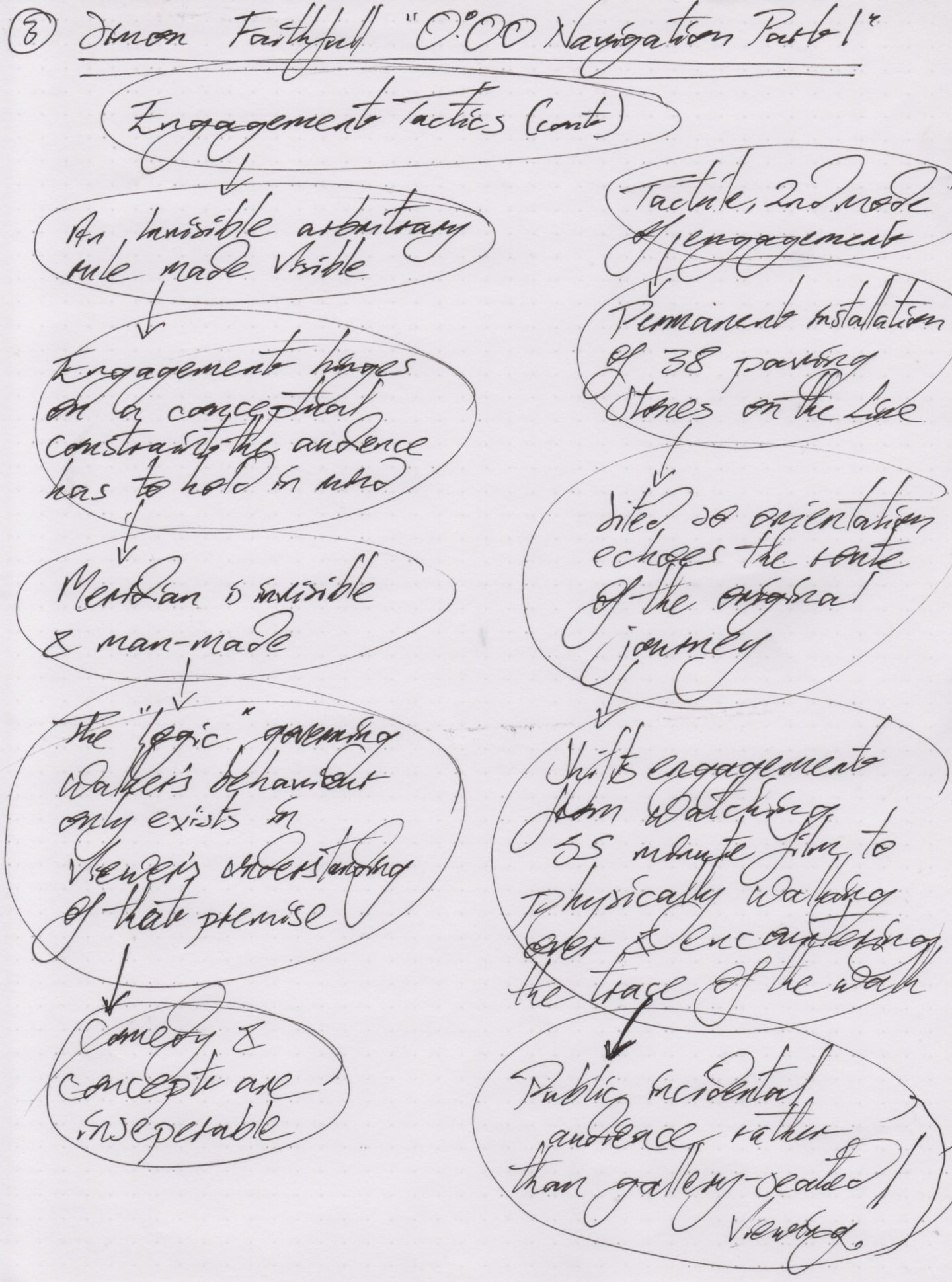
- An invisible, arbitrary rule made visible
- Whole engagement hinges on a conceptual constraint the audience has to hold in mind
- The artist is following the prime meridian as closely as possible – the prime meridian is invisible and man-made
- The “logic’ governing the walker’s absurd behaviour only exists in the audience’s understanding of that premise
- Comedy and concept are inseperable
- A second, tactile mode of engagement
- Permanent installation on the Line (East London Art Trail that connects Queen Elizabeth Olympic Park and the O2)
- 38 paving stones engraved with drawings made from a second, related Southward journey along the Prime Meridan
- Here engagement shifts from the ‘effort’ of sitting through a 55 min film to physically walking over and encountering the trace underfoot
- A public-incidental audience, rather than a gallery-going one


List of References
University of Salford (s.d.) Simon Faithfull, 0°00 Navigation Part I At: https://artcollection.salford.ac.uk/simon-faithfull-000-navigation/ (Accessed: 25/07/26)
simonfaithful.com (2026) 0º00 Navigation Part I: A Journey Across England At: https://www.simonfaithfull.org/works/0-navigation/ (Accessed: 25/07/26)
Haring Woods Studio (s.d.) Art of Common Space At: https://haringwoods.com/art-of-common-space/ (Accessed: 25/07/26)
The Line (2026) Simon Faithful At: https://the-line.org/artist/simon-faithfull/ (Accessed: 25/07/26)
University of Salford (2008) 0º00 Navigation Part I At: https://artcollection.salford.ac.uk/simon-faithfull-000-navigation/ (Accessed: 25/07/26)
Wikipedia (2026) Simon Faithfull At: https://en.wikipedia.org/wiki/Simon_Faithfull (Accessed: 25/07/26)
Parker’s Box (2011) Going Nowhere: Simon Faithfull At: https://www.parkersbox.com/exhibitions/past/2011/goingnowhere.html (Accessed: 25/07/26)
List of Illustrations
Fig.1. Faithfull, S (2009) 0º00 Navigation Part I, (Still from video) [Video] At: https://artcollection.salford.ac.uk/simon-faithfull-000-navigation/ (Accessed: 25/07/26)
Fig.2. Faithfull, S (2009) 0º00 Navigation Part I, (Still from video) [Video] At: https://artcollection.salford.ac.uk/simon-faithfull-000-navigation/ (Accessed: 25/07/26)
Fig.3. Faithfull, S (2009) Accra Container Yard [Drawing] At: https://www.simonfaithfull.org/drawings-from-line-0/ (Accessed: 25/07/26)
Fig.4. Faithfull, S (2009) Villers sur Mer, France (N.49o326, E.0o00) [Drawing] At: https://www.simonfaithfull.org/drawings-from-line-0/ (Accessed: 25/07/26)
Fig.5. Faithfull, S (2023) 0º00 Navigation Part II: A Journey Across Europe and Africa, [Photograph] At: https://www.ucl.ac.uk/slade/news/10645/simon-faithfull-navigation-part-ii-a-journey-across-europe-and-africa-2023 (Accessed: 25/07/26)
Fig.6. (2009) 0º00 Navigation part I – A Journey Across England (details) [Uncompressed QuickTime video] At: https://artcollection.dcms.gov.uk/artwork/m18697-1/ (Accessed: 25/07/26)
Klanghaus: Darkroom
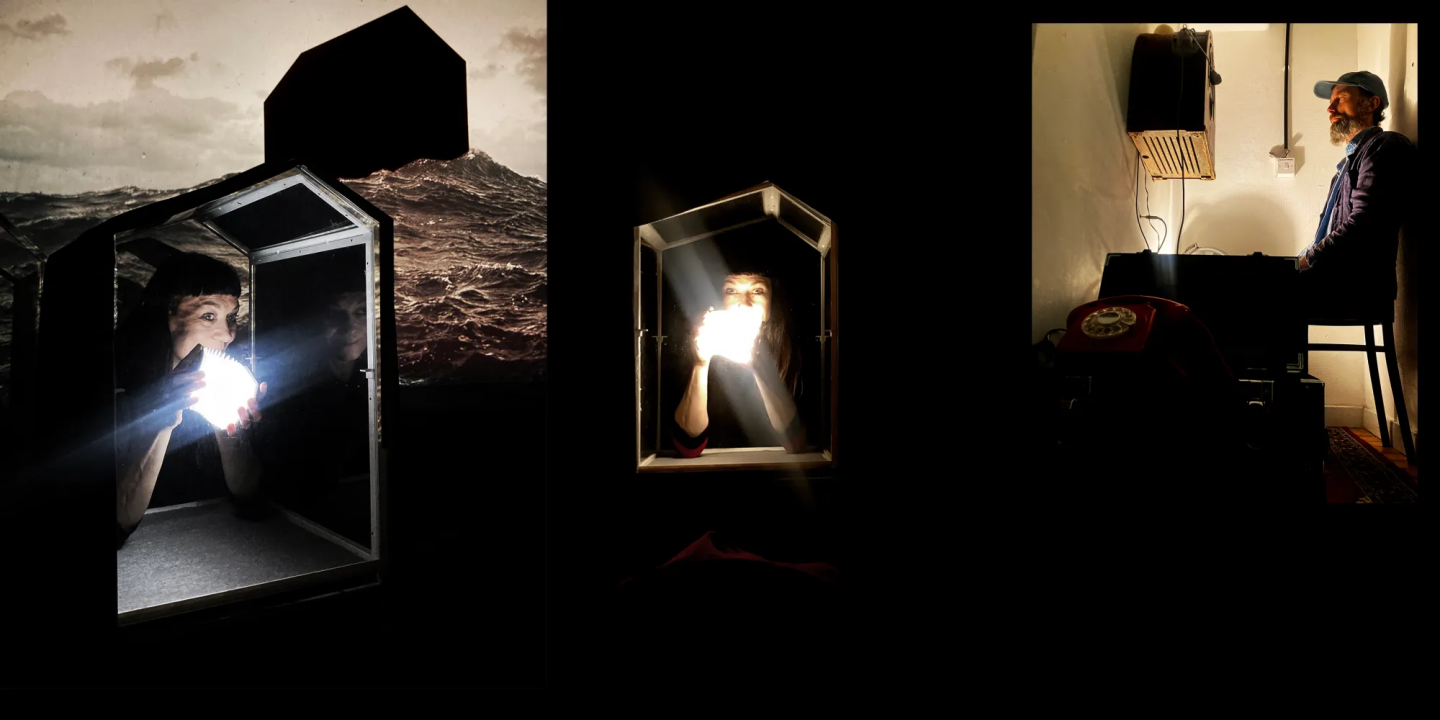
Fig.1. Scenes from Darkroom (2026)
Research Notes
Description of the Project
Is a totally engulfing sound installation, delivered live to an audience of one. Experiential and immersive, it is a singular journey, an introspective meditation through the nervous system and a visceral response to climate change. *Reimagined for 6 people for Brighton Festival 2026. The human connection was significant. The story will continue to grow. (Klanghaus, 2026)
A totally immersive solo/ small-group sensory installation by KlangHaus, the collective formed by art-rock band the Neutrinos and visual artist/ filmmaker, Sal Pittman, that I was fortunate to experience at the Brighton Festival. A live sound-and-senses piece conducted in pitch darkness with a duration of 20 minutes. Originally developed for an audience of one, further expanded for a maximum audience of six people.
The audience is welcomed into a small low-lit room ante-room, where they are introduced to what to expect with the performance. They are then led into the performance space and sat, spread about, amongst a range of musical instruments, recording equipment and other performance ephemera. The lights are completely extinguished, depriving each member of the audience of their sight – an uncanny, initially discordant experience for me. The performance begins with sounds of the sea lapping at a shore, and a the replication of calm breeze by fans positioned in the room. The sounds build, man-made noises are introduced – a ferry leaving port, it’s foghorn loud in the visually deprived space. Then a helicopter overhead, the smacking of it’s rotor blades too loud to bear, the breeze is now the violent downdraught of the helicopter buffeting me in my seat, the acrid smell of exhaust fumes being forced into my nostrils. I have put on the ear defenders as the noise had become painful, but whilst the sound is loud but bearably muffled, I can feel the sound in all of my body. By this point of the performance, the whole of my emotional and physical presence is being triggered: I want to stay and I want to escape. I am present and I am lost. I am frightened, I am overwhelmed, I am disembodied – I found it an immensely difficult experience.
When the performance ends, the lights are dimly illuminated in the space, and the audience is led slowly into a separate quite sideroom, dressed with connected props. We are given chance to sit and quietly process our own personal experiences with a small cup of rosehip tea. Each of us is given a notebook to make a record of our experience however we wish to respond, and we are then encouraged – but not forced – to share our experiences amongst ourselves and the facilitating artists.
The experience was extraordinary, somatic, discordant, painful, confronting.
How the Work Engages an Audience
- Scale Reduction
- The founding tactic – initially performed to an audience of one, then to 6 at the Brighton Festival
- Built around intimacy – the opposite tactic to most immersive theatre which tends to focus on larger groups
- A staged threshold before the dark
- Audiences are walked through a deliberate sequence of framing steps before entering into complete darkness
- Led into a ante-room and given the “rules’ explaining what to expect and establishing a safe space prior to the performance
- Audience is allowed a quick look around the room before it’s plunged into darkness: audience can build a quick mental map of the space they are about to lose sight of
- Classic consent/ safety-priming tactic; orient the person, name the boundaries, the remove control
- Sensory deprivation as the central device
- Sight removal is the engine of the piece
- Visual sensory deprivation allows deeper connection to the sound, a fast track to the nervous system, allowing a personal, deeply felt interior journey
- Lack of sight all other senses become heightened
- Spatialised Sound
- Sound is a wide range of musical genres, sound effects and natural sounds
- Spatialised sound live in real time using speakers and sensory equipment placed around the room
- Narrative arc built on escalation and reversal
- Dramaturgy follows a clear emotional curve as opposed to staying ambient throughout
- “I can hear birds singing, some water sloshing in the distance and the gentle rolling of the sea waves. But these waves become louder and louder, until a huge one swallows me and takes me underwater. I’m shaken and what happens next can only be described as the apocalypse.” (Meloni, 2023)
- Cross-sensory layering beyond sound
- Sound, Smell and physical sensation (fans > wind) are deployed as a plot point
- Exhaust fumes/ burnt smell at the piece’s low point is a deliberate sensory cue standing in for environmental devastation
- Lands alongside the absence of natural sounds such as birdsong or water
- Physical vulnerability as engagement tool
- The audience members, sitting space out from each other, in the dark, creates bodily vulnerability that the performance embraces
- The structured post-show debrief
- A spoken/ conversational debrief with the artists
- A notebook given to each audience member to record their personal experience in anyway they saw
- Both capture and validate the emotional response immediately, whilst still raw, rather than letting the audience leave
- Testimony as social proof and as a framing device
- Company actively collects and uses audience and scientist quotes as part of how the piece is marketed to future audiences
- Pairing with a companion piece
- At Brighton Festival 2026, Darkroom is deliberately programmed alongside Last Haus a more communal, high-energy work, to encourage audiences from one show to attend another
- Each show is in service to the other
- The contrast between the shows is a tactic in itself: Darkroom – solitary and introspective / Last Haus is described as a “love song to togetherness” (Pittman, s.d.)
- Isolation and dread, followed by collective warmth
- Accessibility as an engagement strategy in its own right
- Klanghaus explicitly design for wider participation
- Working with consultants with lived experience to address the needs of neurodivergent attendees – altering light frequencies, making room transitions less stressful, providing transcriptions and sensory maps
- Not specific to Darkroom – reflects a company-wide tactic of lowering barriers that would otherwise be exclusionary
List of References
darkroom.work (s.d.) Darkroom, a show for one person in complete darkness : A climate wake-up call. At: https://darkroom.work/ (Accessed 02/08/26)
Gaul, K (2023) Review: KLANGHAUS: DARKROOM at Summerhall, Lower Church Basement – Ed Fringe At:https://www.theatretravels.org/post/review-klanghaus-darkroom-at-summerhall-lower-church-basement-ed-fringe (Accessed 02/08/26)
Klanghaus.co (2026) Darkroom At: https://klanghaus.co/klang-show/short-films/ (Accessed 02/08/26)
Klanghausinfo.co.uk (s.d.) Klanghaus At: https://www.klanghausinfo.co.uk/ (Accessed 02/08/26)
Meloni, M (2023) Review: KlangHaus: Darkroom, EdFringe At: https://everything-theatre.co.uk/2023/08/review-klanghaus-darkroom-edfringe/ (Accessed 02/08/26)
Pittman, S (s.d.) KlangHaus | InHaus + Darkroom At: https://salpittman.com/klanghaus/inhaus/ (Accessed 02/08/26)
List of Illustrations
Fig.1. Pittman, S (2026) Scenes from Darkroom [Photograph] At: https://klanghaus.co/klang-show/short-films/ (Accessed 02/08/26)