
“Cold Dark Matter: An Exploded View” (1991) Cornelia Parker
I “I like the sound of that. it’s a scientific term. It was coined to describe all the stuff in the universe you can’t quantify. All the stuff they know is there, but you can’t see, which seemed a perfect description”
(Parker (s.d.) cited in Perry 2019)
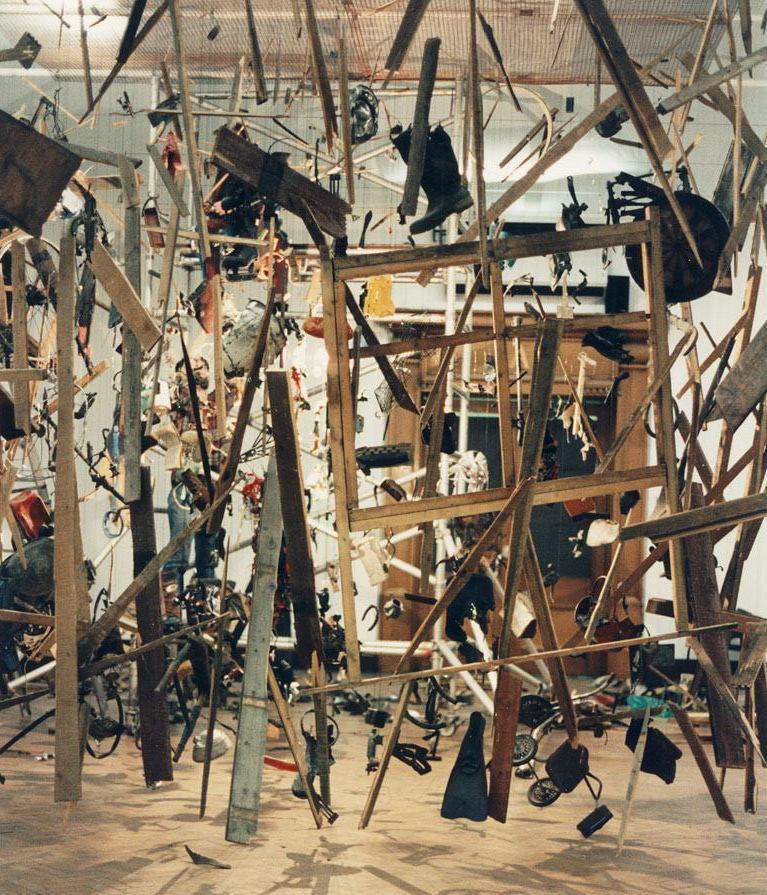
Fig.1. Object installation without light bulb (1991)
Fig.2. Cold Dark Matter, by Cornelia Parker (2015)
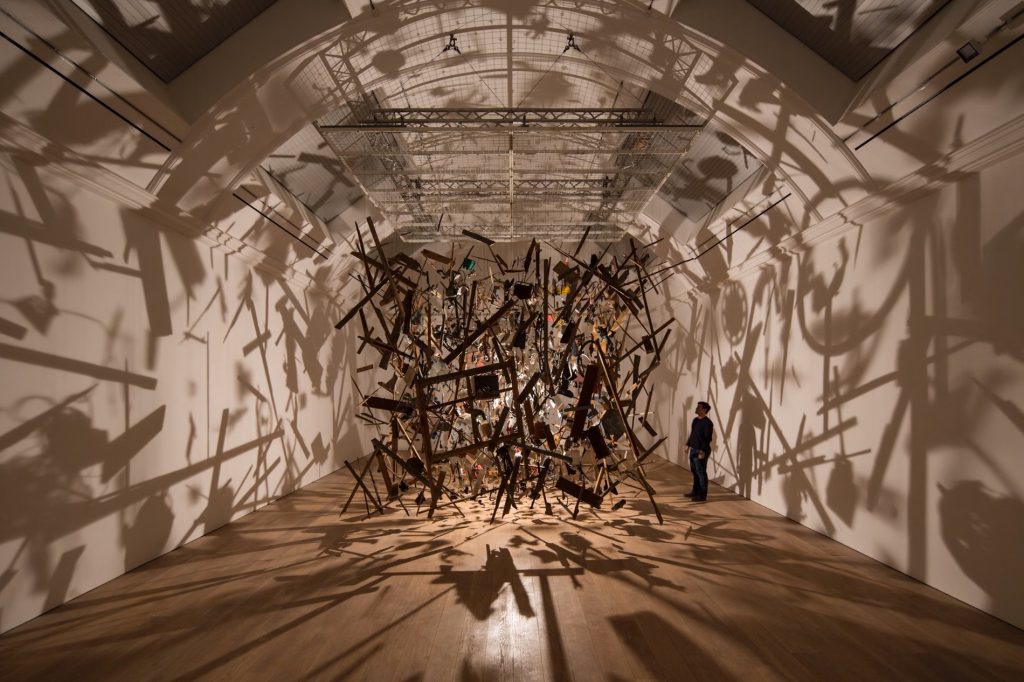
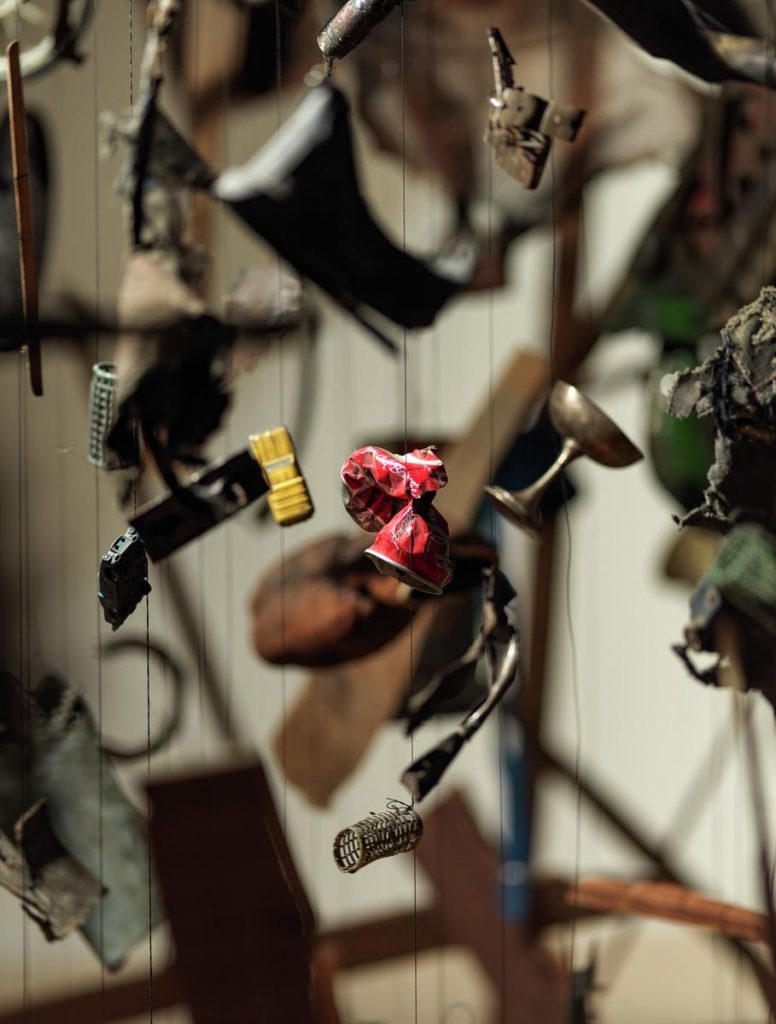
Fig.3. Cold Dark Matter: An Exploded View (Detail) (1991)
I think in a way, the label, the title, liberates me quite a lot. It allows the material to be transformed beyond recognition, without having to give up its history.”
– (parker, 2000 cited in Jones, Batchen et al, 2001 21-22)
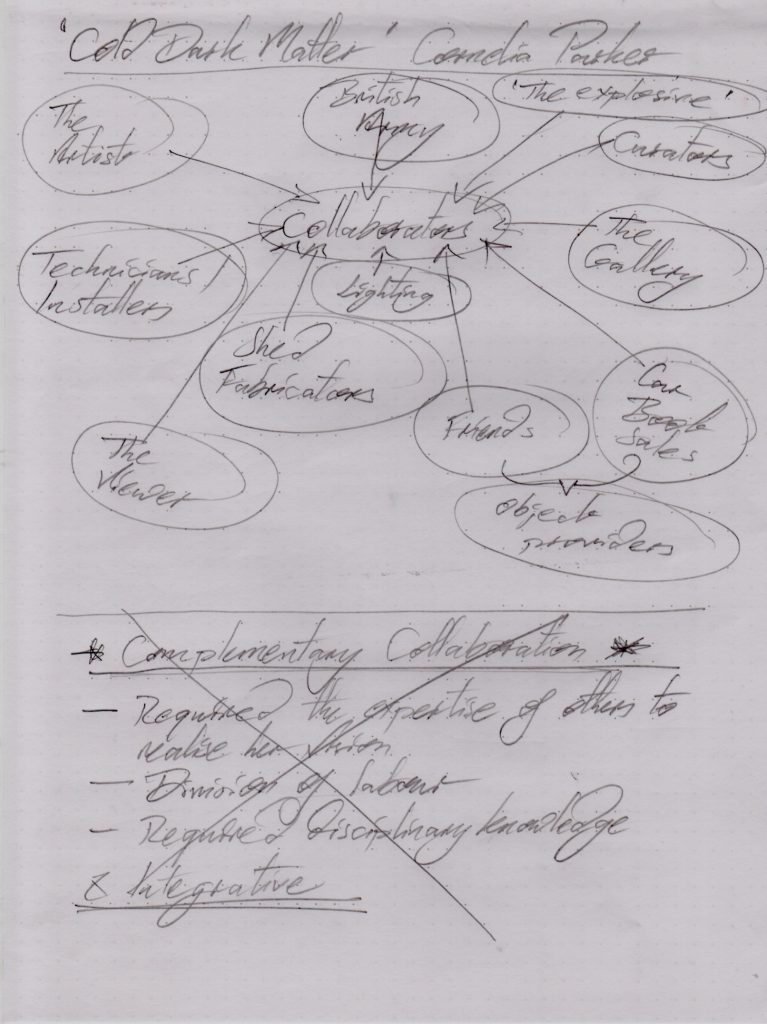
Collaborators
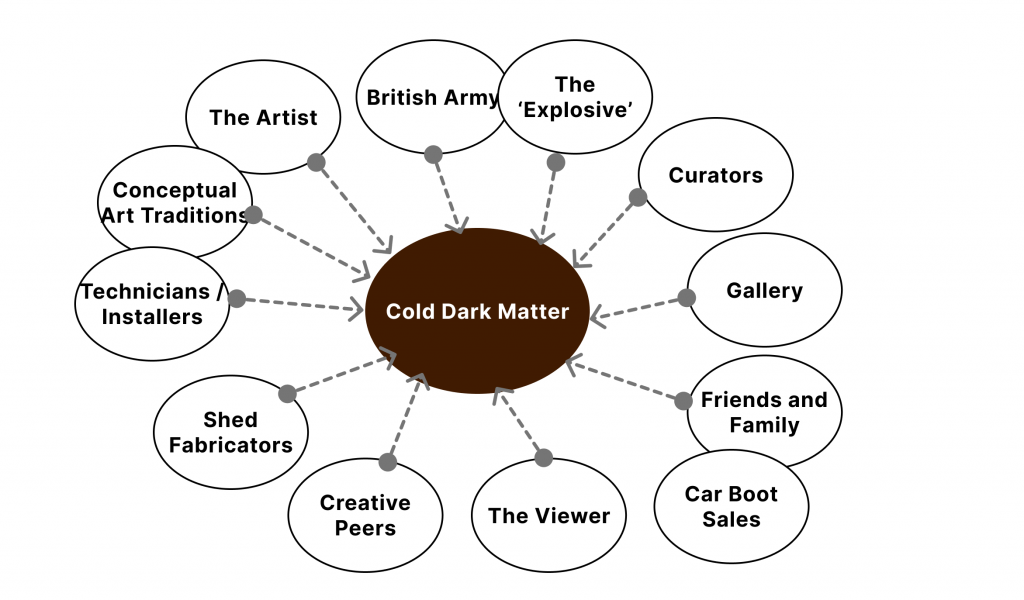
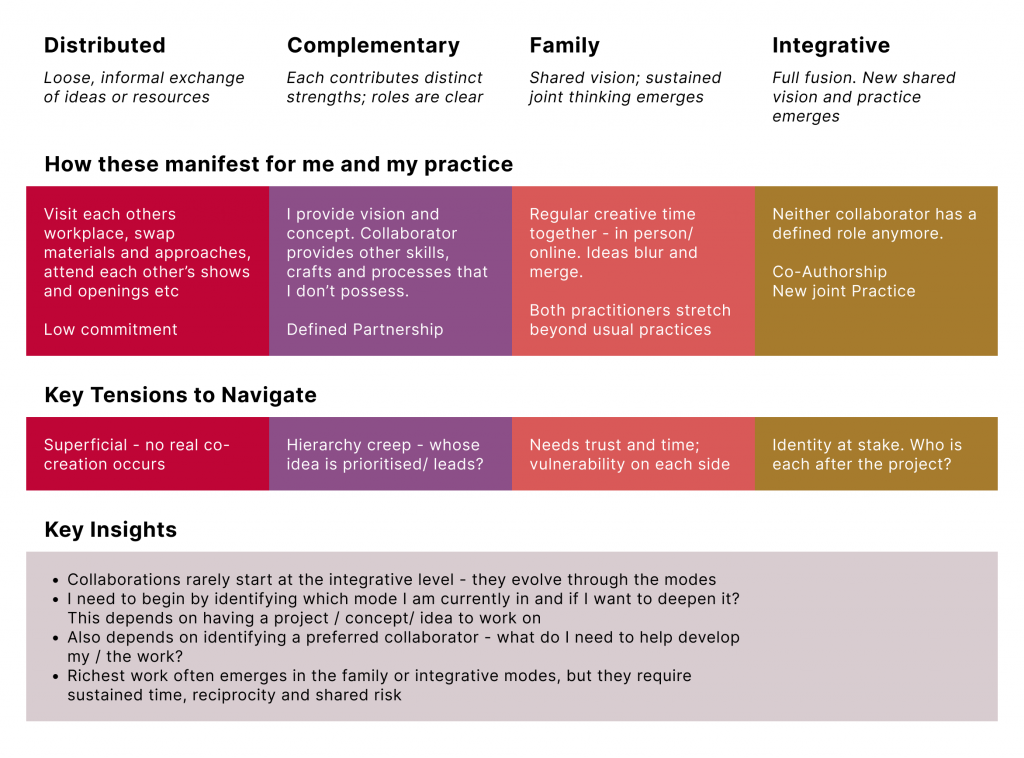
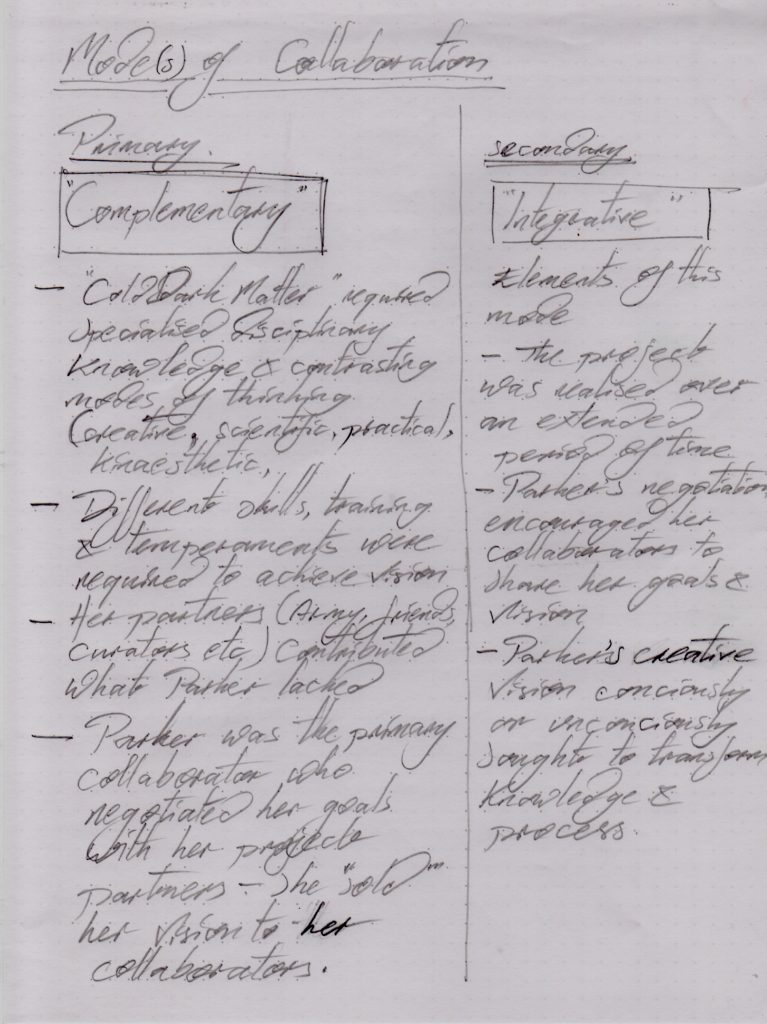
Mode(s) of Collaboration Underpinning “Cold Dark Matter”
A fallacy of a casual reader of John-Steiner’s work, is the inability to see past the siloing of modes necessary for the written discourse. The reality is that collaboration is fluid, less defined, I would say ‘messy’, processing between different states dependent on a multitude of influences – time, context, availability of skills, presence and temperament of collaborators – and many more. With this in mind, I would suggest that 3 modes of collaboration were present throughout the creation of Parker’s “Cold Dark Matter”.
Complementary Collaboration
Clearly present
- Parker provided the conceptual and artistic framework – the idea, the object (a shed filled with domestic items) and the curatorial intention
- Cold Dark Matter required specialised institutional domain knowledge (explosives, fabrication, lighting, installation, scientific theory) and contrasting modes of thinking (Lateral, Critical, Analytical, Systems, Day Dreaming, Procedural) to be realised
- Related, this domain knowledge required different specialist skills, training (and the associated temperaments) to deliver (the Army’s explosive experts; curators, technicians, lighting engineers to install; empathic and creative friends to donate objects)
- Parker’s collaborators contributed the skills and knowledge that she lacked
- Parker was the lead collaborator. It was her vision and goals that were negotiated and then managed with her project partners
Distributed Collaboration
More diffusely present
- Parker’s work sits within the late-1980s/ early 1990s YBA context and broader post-Minimalist and Arte-Povera conversations about destruction, materiality and the afterlife of objects.
- Her thinking was shaped by
- Dialogues with peers and curators
- existing conceptual art traditions
- the shared intellectual ecosystem of that moment
- None are ‘formal collaborators, but Distributed collaboration refers to exactly this ambient, community-level co-creation of meaning that underpins the making of Cold Dark Matter
Integrative Collaboration
Very vaguely present
- I would argue that there were elements of this mode at play during the project
- Parker’s negotiation skills encouraged her collaborators, though not artistically responsible for the project, into sharing her vision and goals for the project
- Parker’s vision and process tacitly and/ or knowingly sought to transform existing knowledge – and by knowledge I include artistic practice, exploration of uncommon and new materials, how non-creative disciplines and expertise can be used for artistic expression, the questioning of perceptions, and how art intersects with other domains e.g. science
“Parker’s collaboration with the army, a repressive apparatus working for the State, problematises contemporary artistic practice.”…..”Parker, like an agent provocateur, persuades the law to perform for her without breaking the law. Her practice infiltrates into the system and infects like a pathogen, like a refugee, like an alien”
– (Ghosh and mukherjee, 2024: 86)
Project Discoveries and Challenges
The ‘Right Shed’
- Researched sheds were all too romantic
- Blowing up someone’s specific shed made the project too biographical
- Parker commissioned a composite shed assembled from the wood of old sheds
- Specified an 8′ x 12′ shed with windows
- The resultant distinction – between the personal and the archetypal – was a conceptual and logistical decision
Gathering Shed Contents
- Shed objects gathered over 3 month period
- Sources: friends and car boot sales
- Some with personal significant “Remembrance of Things Past” by Proust & “An Artist’s Dilemma” by James Boswell
- Curation of objects was its own process
- Objects needed to feel universally recognisable and not individually meaningful
Choosing the Explosive
- Invited to Army School of Ammunition
- They demonstrated potential of various explosives by blowing up a car and a table
- Parker chose plastic explosives as these provided an archetypal explosion free of pyrotechnics and special effects
Loss of Material
- After the explosion, remains of the shed and dispersed objects were carefully gathered
- Some objects never found – blown far away or totally destroyed
- The work was reshaped by what survived, meaning an element of chance was introduced to the final work
Knowledge-based process
Navigating an unfamiliar field: military collaboration
- Collaboration required her to engage with the technical knowledge of explosives
- Understanding the different properties of explosives, selecting the correct one to produce the desired visual effect and not a theatrical explosion required genuine technical enquiry
Discovery of installation and suspension as transformation
- Significant discovery emerged during the assemblage process
- Seeing the pieces laid on the gallery floor, Parker refers to them looking like a morgue – death
- Once suspended and raised in the air, they were transformed and re-animated. They could be contemplated instead of provoking horror
- The single light source created huge shadows creating the illusion of explosion or coalescence. The decision to suspend the fragments, the artworks defining gesture, was made in the ‘doing’
Rethinking sculpture
- This piece works against traditional ideas of sculpture
- Traditional = concerned with solidity
- Cold Dark Matter = fragmentation and materials in flux
- The work deepened and grew from an understanding of what sculpture could be
- The ‘exploded view” as conceptual reference
- The work references Parker’s fascination with old encyclopaedias and technical drawings
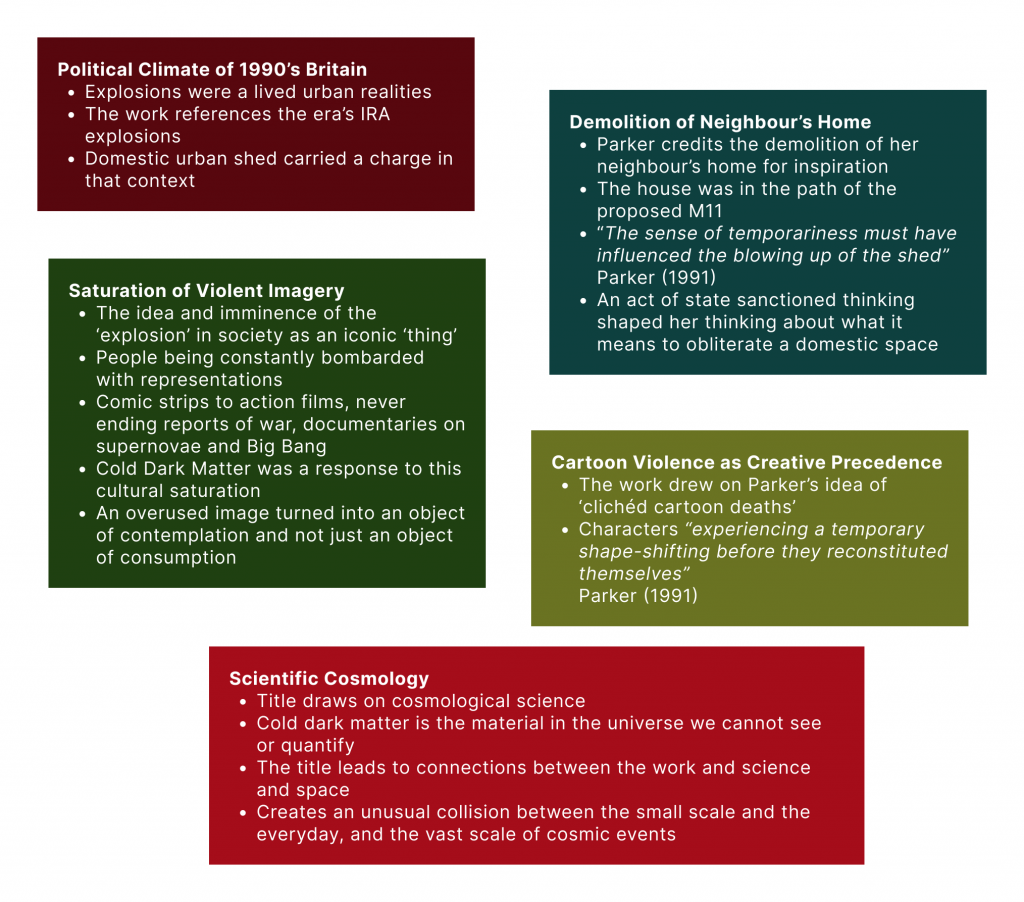
External Influences
Approaching a Collaboration with Another Maker
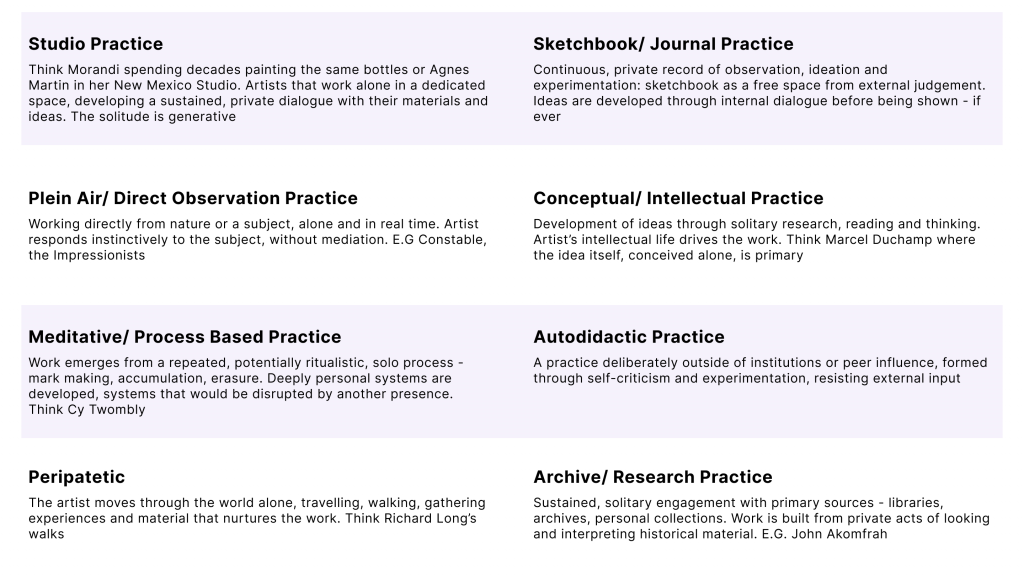
Non-Collaborative Approaches
Research Insights
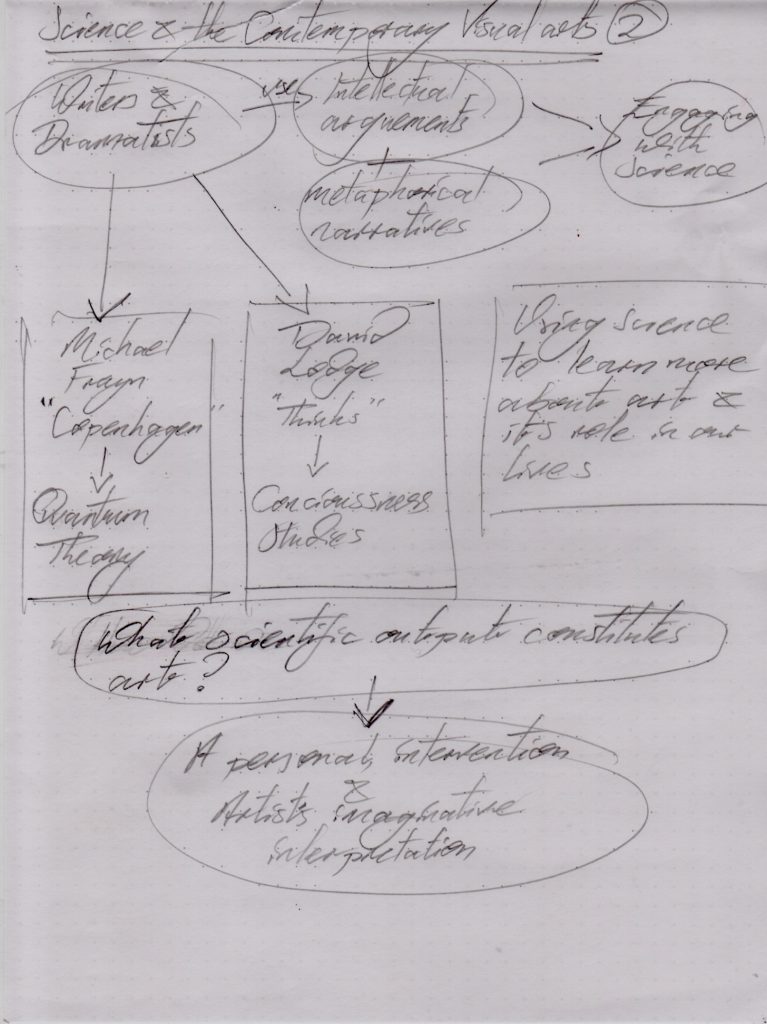
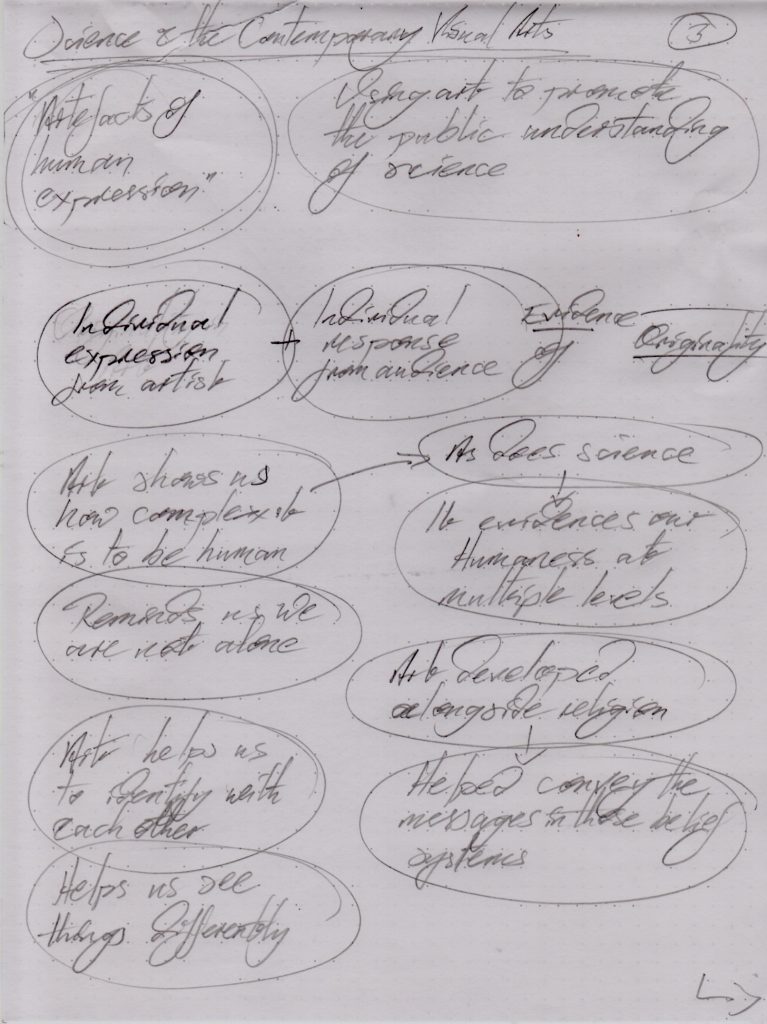
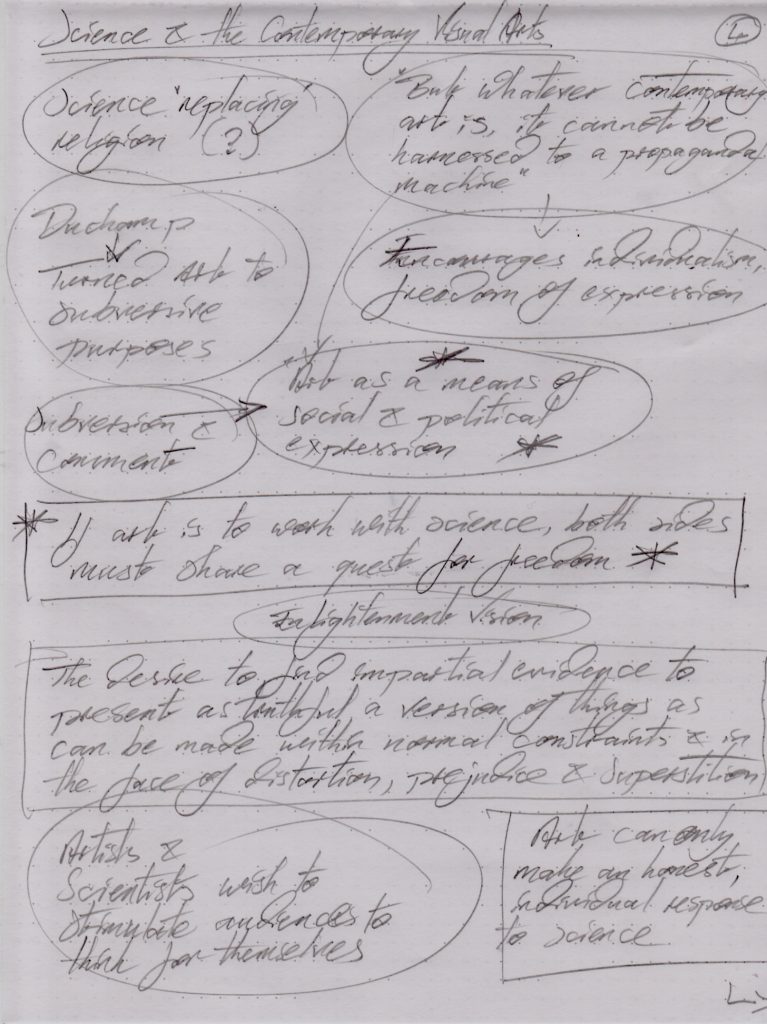
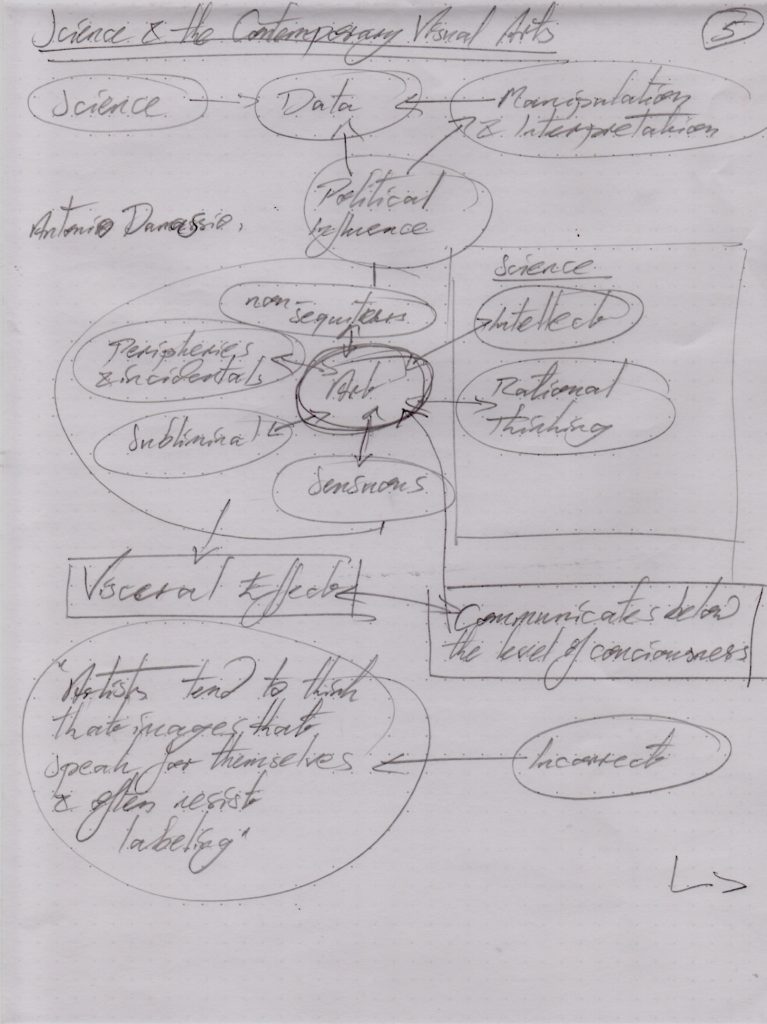
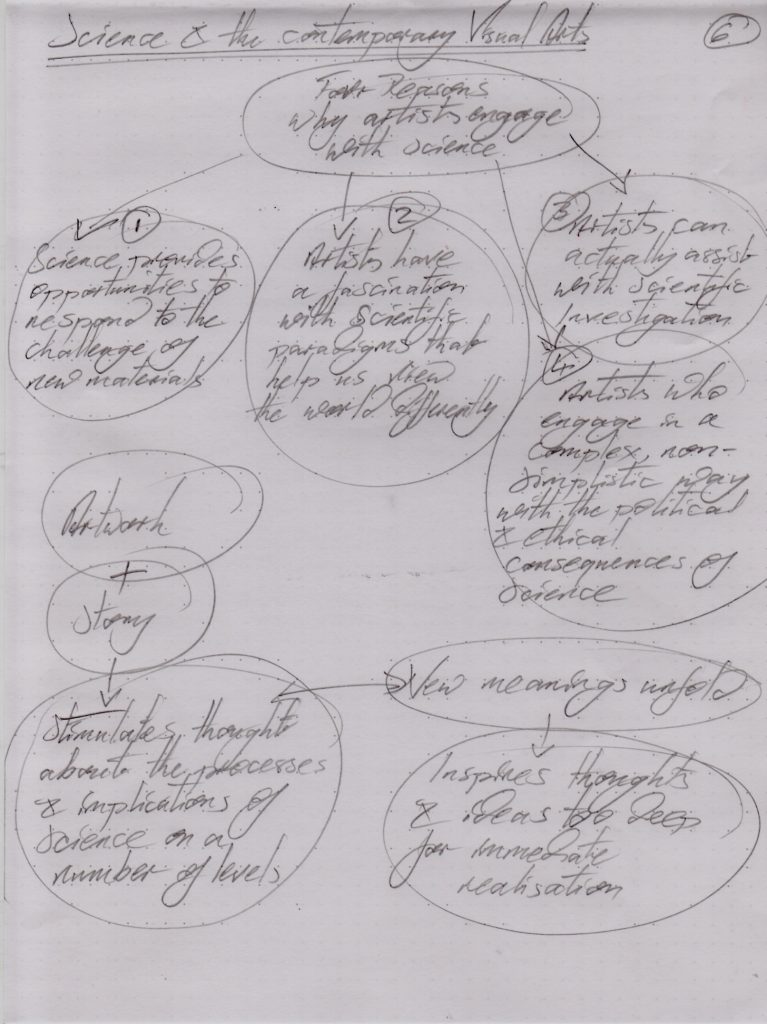
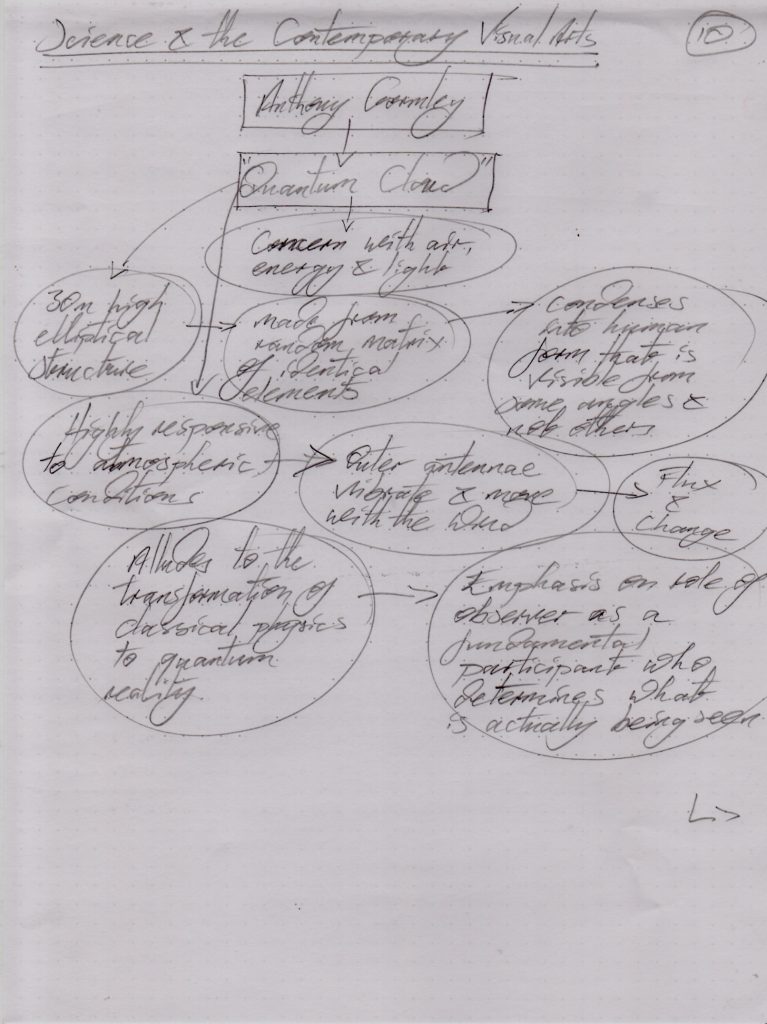
- Ede proposes a four-mode taxonomy of how artists engage with science
- Responding to new materials
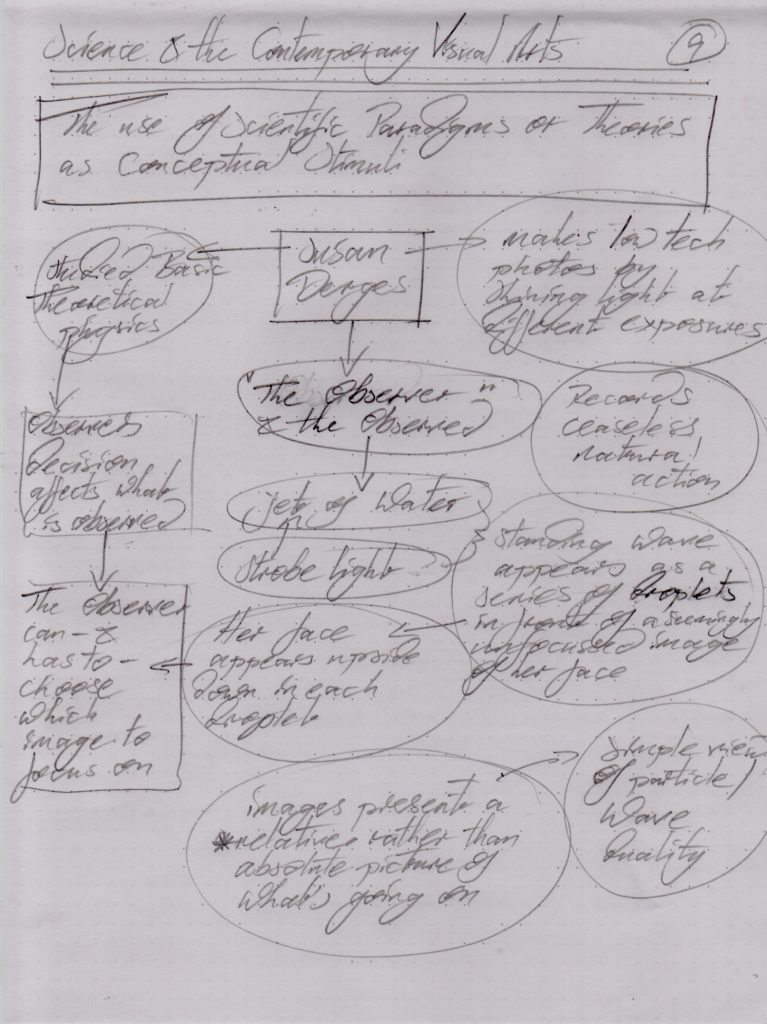
- Drawing on scientific paradigms as conceptual stimuli
- Art practice as a genuine collaborator in scientific investigation
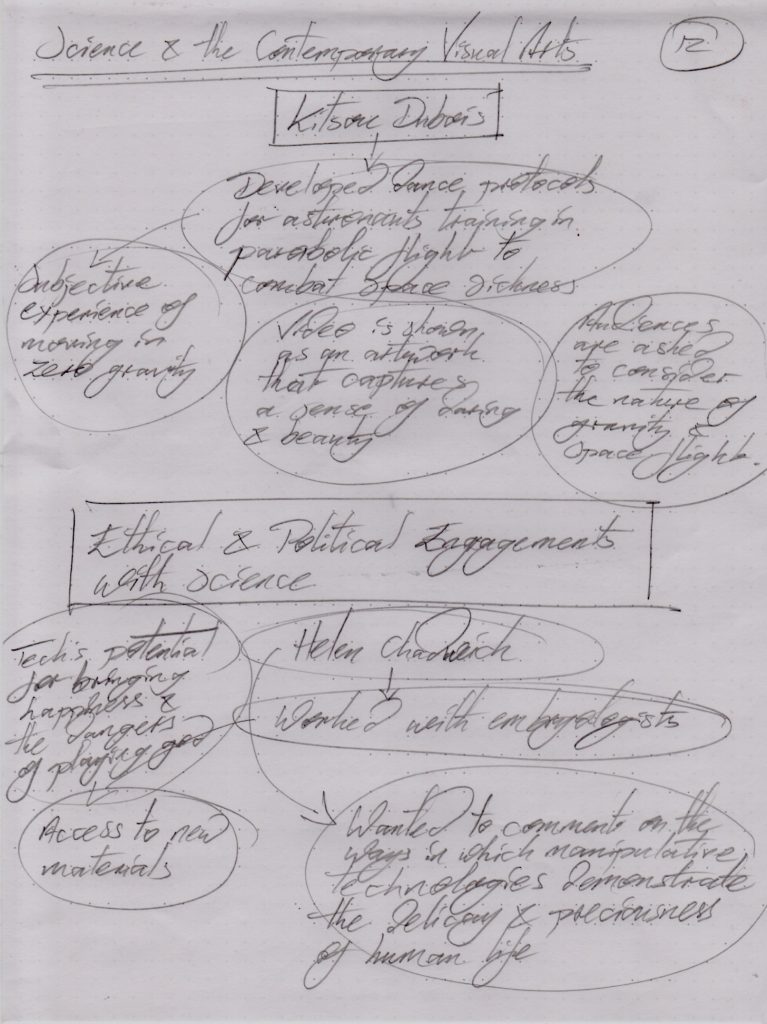
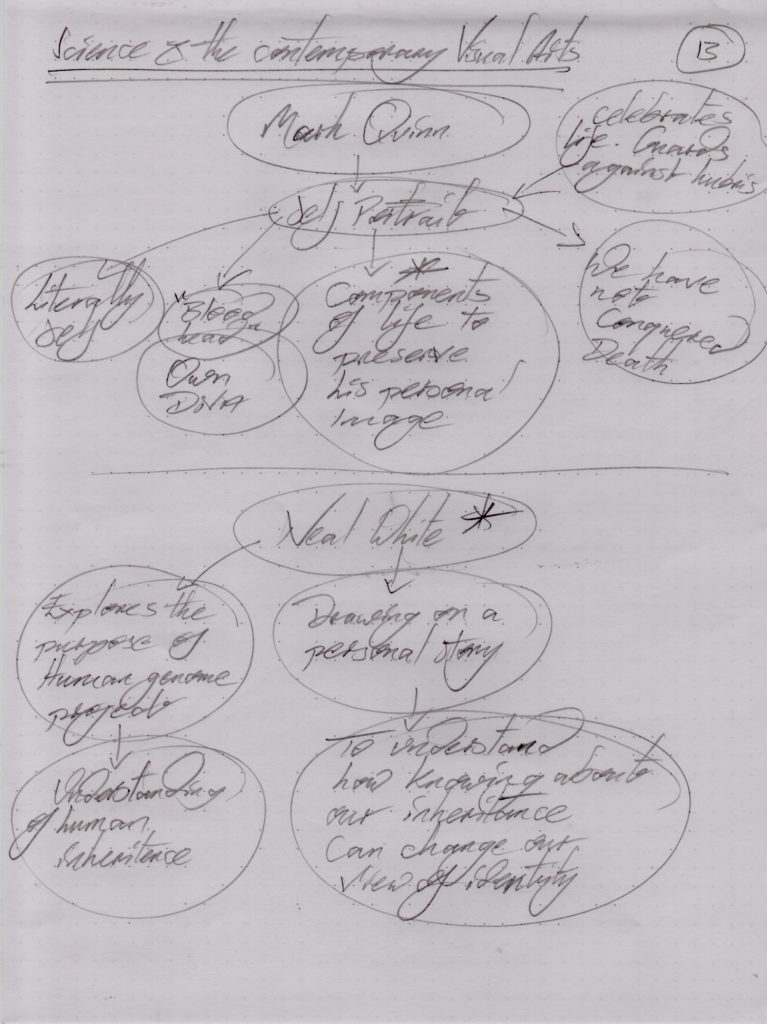
- Engaging with the political and ethical consequences of science
- How can this taxonomy dovetail/ complement/ collaborate with John- Steiner’s modes?
- How and where can both apply to other discipline collaborations beyond art-science?
- Collaboration as Material Access
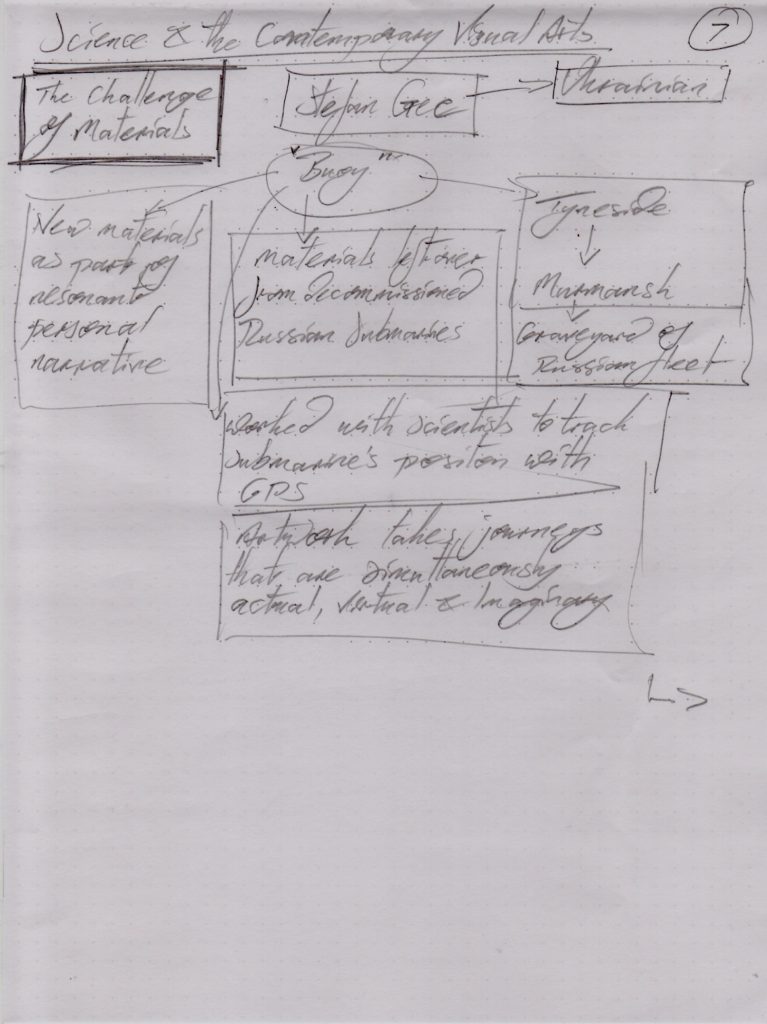
- Some of the most compelling examples are driven by artists who gain access to scientific environments and materials they couldn’t otherwise reach
- Helen Chadwick needed the Assisted Conception Unit at King’s College Hospital, both intellectually and practically – she had to learn to operate a pipette with scientific precision to work with the embryos – apprentice-like relationship
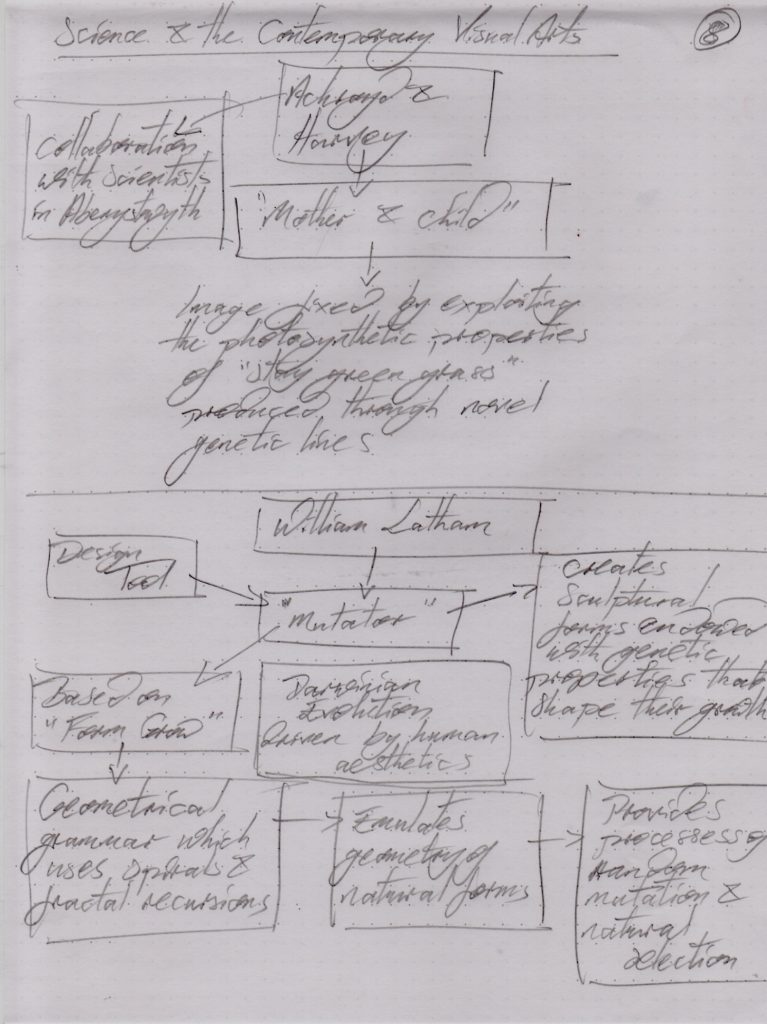
- Ackroyd and Harvey’s grass photo required geneticists at Aberystwyth to develop the “stay-green’ grass strains that enabled photosynthetic image-fixing
- Some of the most compelling examples are driven by artists who gain access to scientific environments and materials they couldn’t otherwise reach
- Collaboration as Mutual Reframing
- Richest examples show each discipline/ party reframing the work of the other
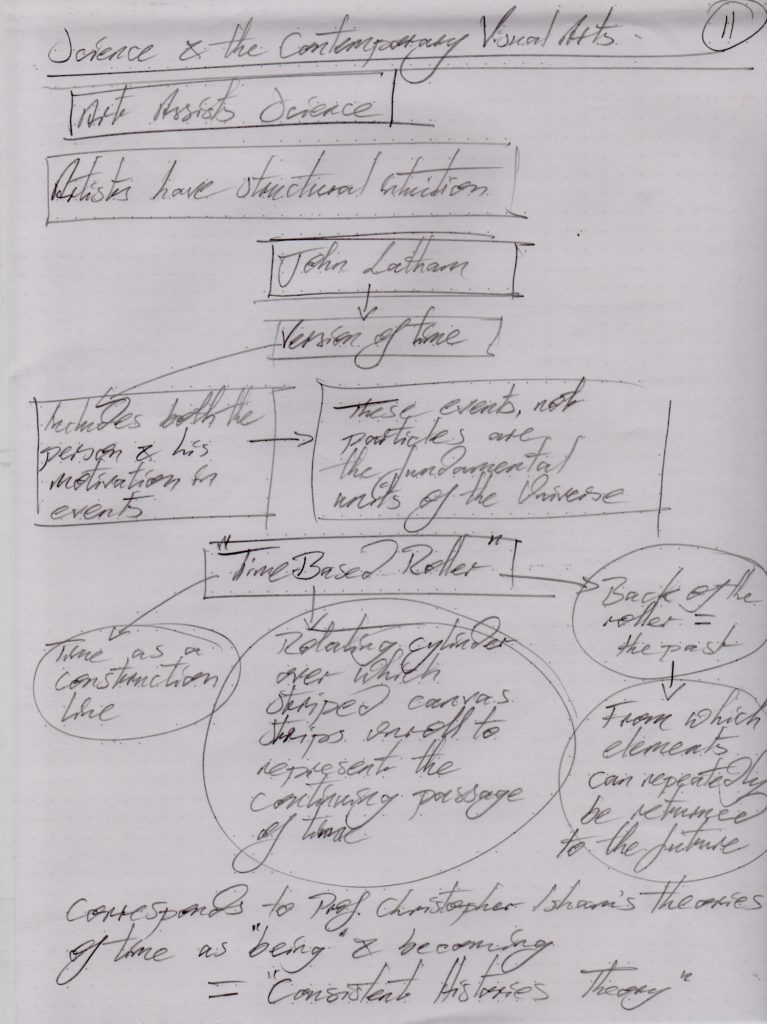
- Stefan Gec worked with Oxford geographers on GPS tracking, but the scientific tool became part of the artwork’s meaning – “journeys that are simultaneously actual, virtual and imaginary” (Ede, 2002: 69)
- John Latham, “Time Based Roller” attracted physicist Christopher Isham as the visual metaphor mirrored his theoretical work.
- Collaboration as Shared Inhabitation
- Quaking Houses Wetland Project: Artists and Scientists integrating within a community context, each having to master parts of the others domain – artists understanding engineering constraints, scientists attending to aesthetics and social context. The long-lasting friendships formed suggest the collaboration extends beyond the initial Wetland Project
- Choreographer as Research Instrument
- Kitsou Dubois zero-gravity work: artist’s subjective, embodied experience experience became data
- Her dance practice in zero-gravity generated insights that unified disparate strands of research in Imperial College’s Biodynamics Group
- The artist was more than just illustrating science – she was practicing it, albeit in a limited sense
- Tensions
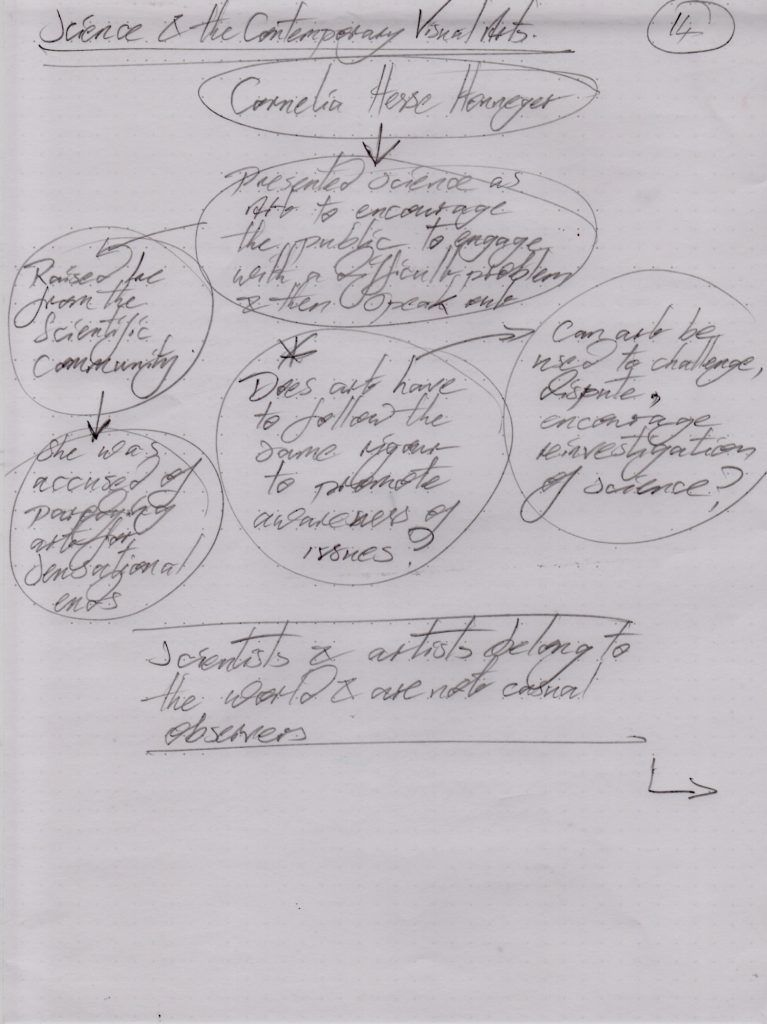
- Ede identifies the problem of art being instrumentalised for public understanding of science goals which risks sub-ordinating artist’s independent voice
- Also flags the “labelling” issue: artworks that need contextual explanation to function fully, but where explanation risks turning them didactic
- Third Tension as evidenced by Cornelia Hesse Honneger’s ‘nuclear deformity’ paintings
- When an artist adopts scientific subject matter without scientific methodology, genuine controversy can arise, instead of productive dialogue
- Through-line
- Through all successful collaborations, neither party simply illustrated the other’s work
- Most generative partnerships involve a real transfer of competence, access or perspective, beyond what each side could achieve alone
Science and Art’s Metaphorical Intersection
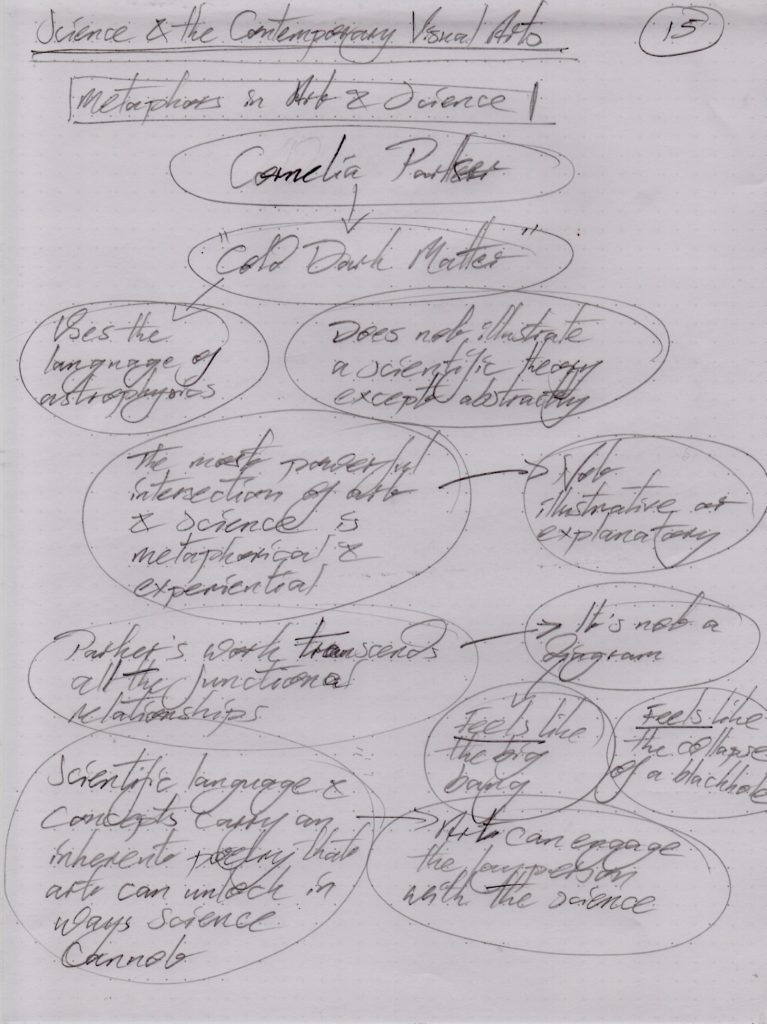
- Ede’s central insight is that the most powerful intersection of art and science isn’t illustrative or explanatory – it’s metaphorical and experiential
- Cornelia Parker’s work, “Cold Dark Matter” transcends the functional relationships (challenge of materials, visualizing theories, aiding research, etc.)
- The exploding shed isn’t a diagram of the big ban – rather it feels like one (or what we imagine it could feel like within our human experience-set) and simultaneously it feels like a black hole’s collapse. Ambiguity is the point of the work
- More deeply, scientific language and concepts carry an inherent poetry that art unlocks in ways science cannot
- “Cold Dark Matter”, “Gravitational Implosion” are dry, technical and precise in a physics manual
- When embodied in a physical, visual, emotionally resonant artwork, they become richer – uncertainty, duality, the uncanny, maybe sublime scale of cosmic forces made tangible through the humble vehicle of a garden shed
- The subtle argument about the role of the observer
- Science aims to eliminate subjective perception in favour of objective truth
- Parker’s work does the opposite, inviting alternative perceptions, suspending meaning between opposites (Expansion/ Contraction, Violence/ Peace) rather than resolving them
- Positions art as science’s complement – where science pins things down, art holds them open
- Insight: The deepest relationship between art and science isn’t about one serving the other, it’s about art revealing the latent wonder and ambiguity already present in the scientific imagination
Questions/ Thoughts
- How do Ede and John-Steiner’s taxonomies relate/ contradict/ support disrupt each other?
- How can they relate to my work? How can the relationship between them relate to my work?
- How valid is it/ is it necessary to apply an intellectually define framework to collaboration when collaboration should be a fluid, organic process that naturally occurs?
- The only noticeable inflexion point should be “I want/ need to collaborate to realise my idea”. Is it important to the actual process of collaboration that we are noticing and intellectualising the mode? In doing that we are wasting precious energy, time and capabilities that are better spent on the realisation of the work.
- I am starting to see my work through an autoethnographic lens – which prioritises the personal experience as a valid form of evidence of a relationship to cultural situations.
- How do these models co-exist with an autoethnographic lens?
- Specifically can an autoethnographic practice have a relationship or placce within Ede’s model? Can autoethnographic evidence be regarded as valid when positioned in parallel to scientific evidence? Can an equivalence be drawn between the two?
- In my opinion collaboration sits in service of the ideas/ concepts. At present, this unit appears to be siloing collaboration out as the distinct primary entity, pushing the ideas that need creative expression to the rear.
- If collaboration is not intrinsic to the creative realisation of a concept/ idea, then it shouldn’t be pursued purely for the sake of collaborating.
- Nor should we be forced into collaborative process when a concept is not present as a suitable vehicle for that process
Research Notes
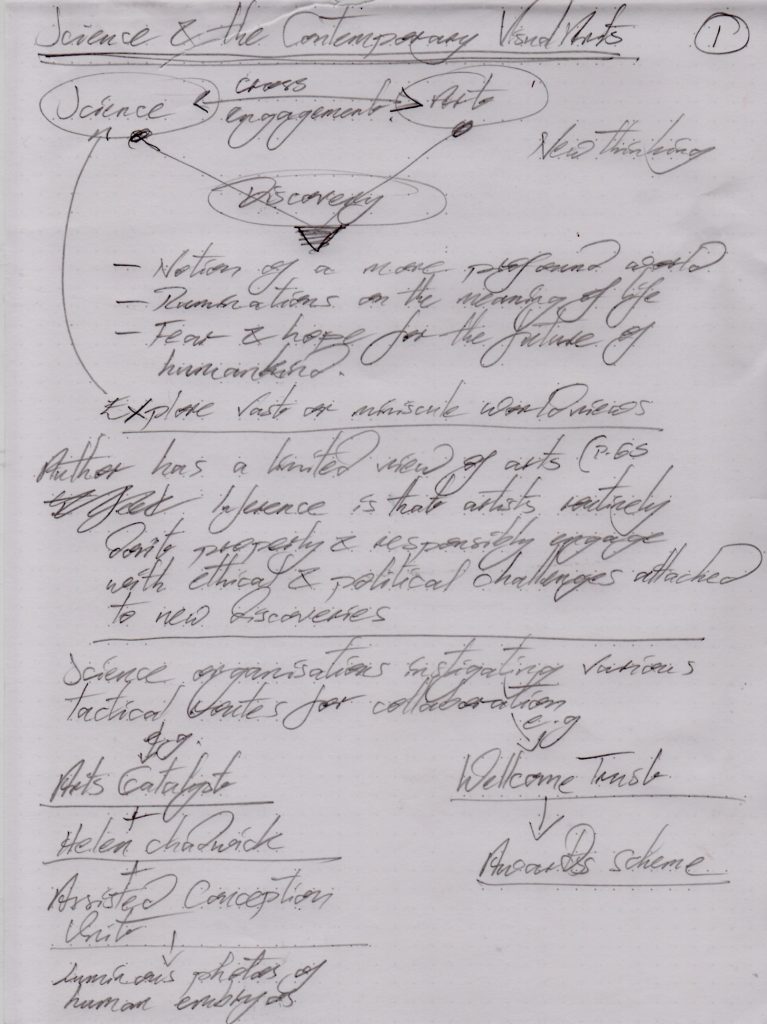
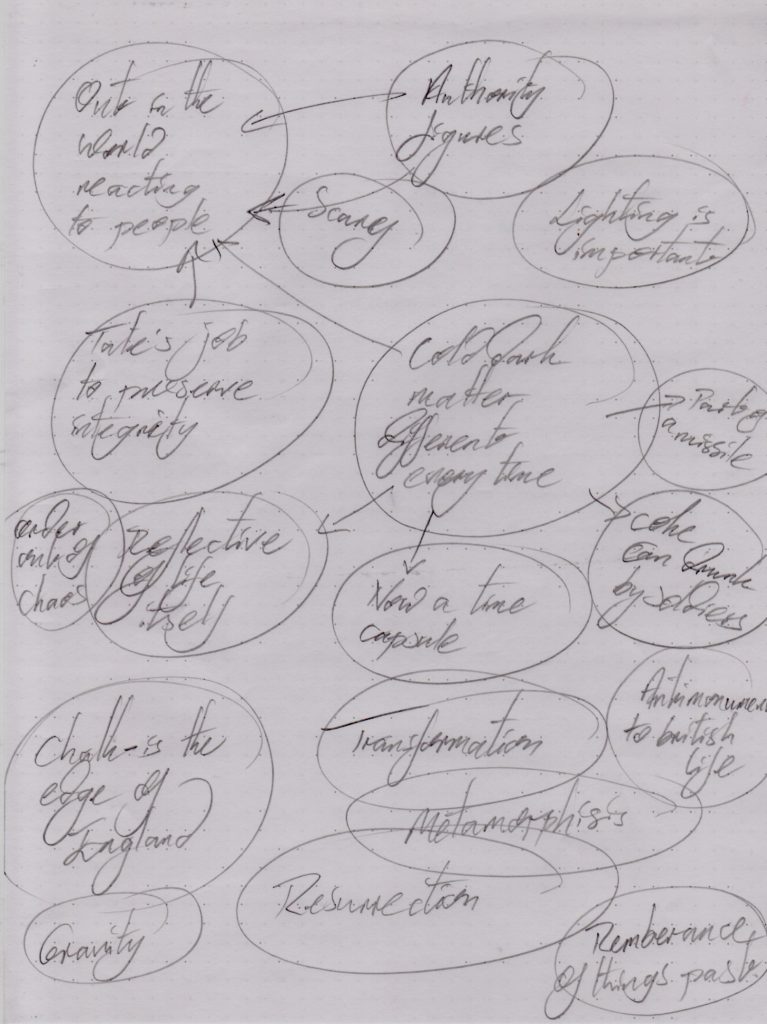
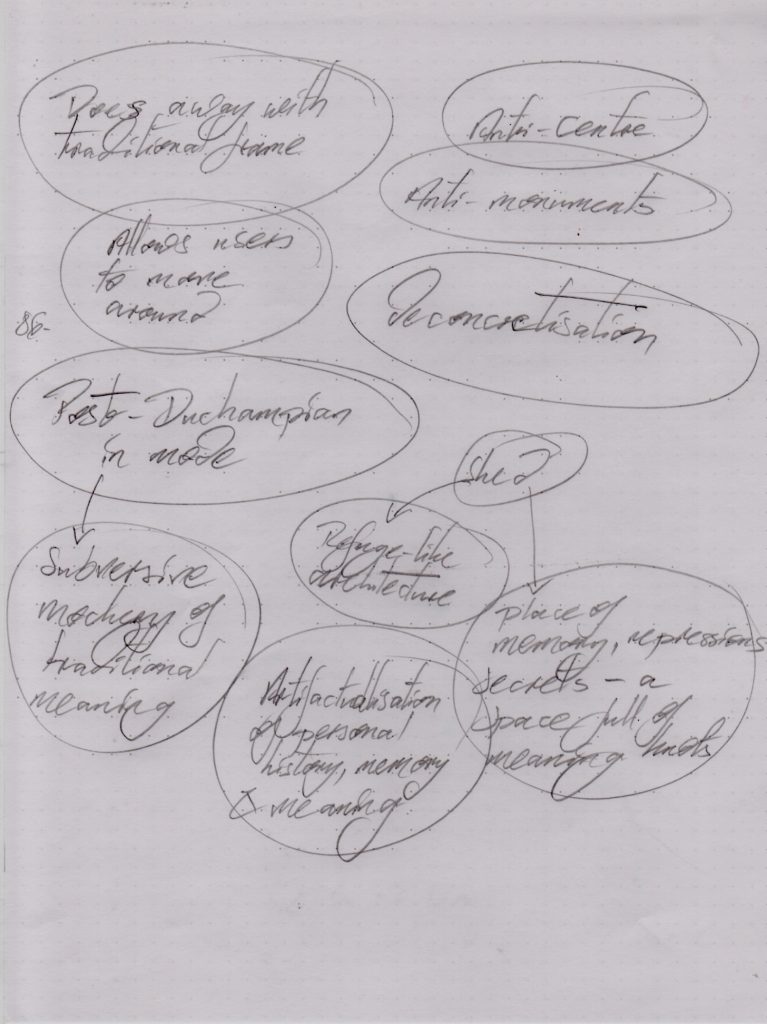
References
Jones, A., Batchen, G., Gonzales-Day, K., Phelan, P., Ross. C., Gómez-Pẽna, G., Sifuentes, R., Finch, M. (2001) ‘The Body and Technology’ In: Art Journal 60 (1) pp.20-39
Perry, G (2019) ‘Cornelia Parker Cold Dark Matter, An Exploded View 1991) [Online Video] At: https://youtu.be/NrTvMxPl3xA?si=RjCi2Bfxr68d5RYQ (Accessed 22/03/26)
Bibliography
Bayles, D. and Orland, T. (1993) Art and Fear: Observations on the Perils (and Rewards) of Artmaking Souvenir Press: London
Ede, S. (2002) Science and Contemporary Visual Art. Public Understanding of Science (Bristol, England) 11(1), pp65-78. Available at: https://doi.org/10.1088/0963-6625/11/1/304 (Accessed 11/03/26)
Tate (s.d.) The Story of Cold Dark Matter At: https://www.tate.org.uk/art/artworks/parker-cold-dark-matter-an-exploded-view-t06949/story-cold-dark-matter (Accessed 18/03/26)
The Guardian (2015) Mindbombs and meteor shows: Cornelia Parker at the Whitworth Art Gallery At: https://www.theguardian.com/artanddesign/2015/feb/11/cornelia-parker-whitworth-art-gallery (Accessed 22/03/26)
Dixon, D (2015) ‘Objectified: An Artist’s Approach to Materials Science’ In: Science 348 (6230) pp.51
Ask the Artist: Questions for Cornelia Parker (2022) [Online Video] At: https://youtu.be/I3yeKlUmsBs?si=0XGPuG-PZC5yysNd (Accessed 22/03/26)
Ghosh, A., Mukherjee, S. (2024) ‘Exploding all Explosions. Reconfiguring art and architectural meaning, matter and space with Cornelia Parker’s Cold Dark Matter (1991)’ In: Edinburgh Architecture Review 38 (1) pp.80-93
List of Illustrations
Fig.1. Parker, C (1991) Cold Dark Matter: An Exploded View – Object installation without light bulb [Exploded Objects and Shed] At: https://www.tate.org.uk/art/artworks/parker-cold-dark-matter-an-exploded-view-t06949/story-cold-dark-matter (Accessed 20/03/26)
Fig.2. Parker, C (2015) Cold Dark Matter by Cornelia Parker [Exploded Objects and Shed] At: https://www.theguardian.com/artanddesign/2015/feb/11/cornelia-parker-whitworth-art-gallery (Accessed 20/03/26)
Fig.3. Parker, C (1991) Cold Dark Matter: An Exploded View (Detail) [Exploded Objects and Shed] At: https://www.tate.org.uk/art/artworks/parker-cold-dark-matter-an-exploded-view-t06949 (Accessed 20/03/26)