
Notes
Phenomenology is the study of structures of consciousness as experienced from the first-person point of view. The central structure of an experience is its intentionality, its being directed toward something, as it is an experience of or about some object. An experience is directed toward an object by virtue of its content or meaning (which represents the object) together with appropriate enabling conditions. (Woodruff Smith, 2013)
Literally, phenomenology is the study of “phenomena”: appearances of things, or things as they appear in our experience, or the ways we experience things, thus the meanings things have in our experience. Phenomenology studies conscious experience as experienced from the subjective or first person point of view. (Woodruff Smith, 2013)
phenomenology studies the structure of various types of experience ranging from perception, thought, memory, imagination, emotion, desire, and volition to bodily awareness, embodied action, and social activity, including linguistic activity. The structure of these forms of experience typically involves what Husserl called “intentionality”, that is, the directedness of experience toward things in the world, the property of consciousness that it is a consciousness of or about something. According to classical Husserlian phenomenology, our experience is directed toward—represents or “intends”—things only through particular concepts, thoughts, ideas, images, etc. These make up the meaning or content of a given experience, and are distinct from the things they present or mean. (Woodruff Smith, 2013)
Conscious experiences have a unique feature: we experience them, we live through them or perform them. Other things in the world we may observe and engage. But we do not experience them, in the sense of living through or performing them. This experiential or first-person feature—that of being experienced—is an essential part of the nature or structure of conscious experience (Woodruff Smith, 2013)
As Husserl and others stressed, we are only vaguely aware of things in the margin or periphery of attention, and we are only implicitly aware of the wider horizon of things in the world around us. Moreover, as Heidegger stressed, in practical activities like walking along, or hammering a nail, or speaking our native tongue, we are not explicitly conscious of our habitual patterns of action. (Woodruff Smith, 2013)
If there is one unifying idea behind the idea of phenomenology it is an intense concern about the way the world appears to the person experiencing the world (Moran, 2000). Phenomenologists seek to describe that experience, and this goal sets it apart from more causal / positivist approaches to social research, particularly behavioural psychology, and from explanatory general theory such as marxism and functionalism. A phenomenological approach is interested in the subjectivity of the observer but it need not be confined to the level of the individual. Phenomenologists are interested in the way we come to share similar understanding of the world and the way we construct a sphere of intersubjectivity, an implicit agreement about how the world looks, sometimes referred to as the life-world. (University of Warwick, s.d.)
Phenomenology is further concerned with our distorted understanding of the world. For example in Husserl, in particular, there is a sense that we could reach genuine insight about the world if we could strip back our preconceptions. This idea is taken up in the idea of ‘bracketing’ as a research practice, i.e. putting aside the assumptions you would normally make about whatever it is you are researching. Husserl sees undistorted insight as intuitive – to be honest the word is used counter intuitively – to imply a level of objective understanding reached after a great deal of examination and reflection. (University of Warwick, s.d.)
It sees consciousness as developed through experience, not the work of a disembodied mind. It takes all consciousness as intentional – in other words when we try to make sense of something it is always with a purpose in mind. We have to supply the purpose and this leads to the existentialist view point which posits that there is no a priori meaning to existence, the world just is and we have to face up to this existential fact. (University of Warwick, s.d.)
In particular, ‘phenomenology’ is typically understood as ‘the what’ that is studied or investigated in the philosophy of mind: it is ‘the passing show’, ‘the flux of experience’, ‘experience as it is undergone’, it is ‘the what’ that makes it so that there is a ‘what it is like’ to subjective experience. (Glendinning, 2009)
Phenomenology is a form of qualitative research that focuses on the study of an individual’s lived experiences within the world. (Neubauer et al, 2019)
In simple terms, phenomenology can be defined as an approach to research that seeks to describe the essence of a phenomenon by exploring it from the perspective of those who have experienced it. The goal of phenomenology is to describe the meaning of this experience—both in terms of what was experienced and how it was experienced (Neubauer et al, 2019)
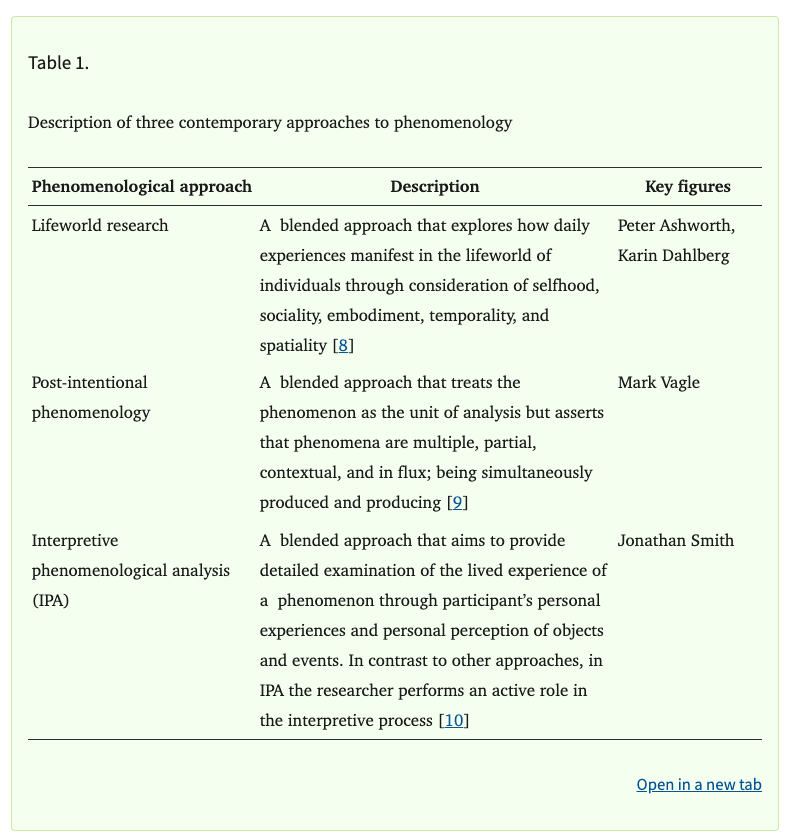
Fig.1. Description of three contemporary approaches to phenomenology (Neubauer et al 2019)
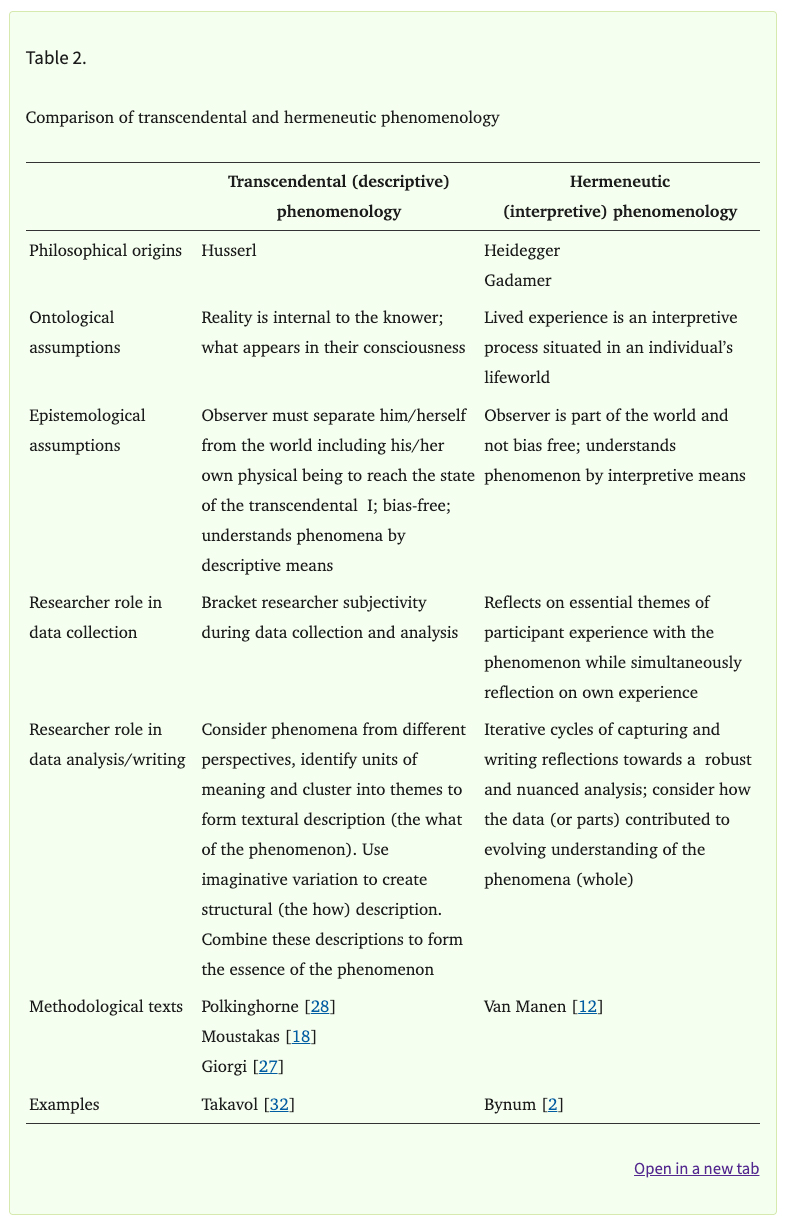
Fig.2. Comparison of transcendental and hermeneutic phenomenology (Neubauer et al 2019)
Husserl contended that a lived experience of a phenomenon had features that were commonly perceived by individuals who had experienced the phenomenon. These commonly perceived features—or universal essences—can be identified to develop a generalizable description. The essences of a phenomenon, according to Husserl, represented the true nature of that phenomenon. The challenge facing the researcher engaging in Husserl’s phenomenology, then, is:
To describe things in themselves, to permit what is before one to enter consciousness and be understood in its meanings and essences in the light of intuition and self-reflection. The process involves a blending of what is really present with what is imagined as present from the vantage point of possible meanings; thus, a unity of the real and the ideal
In other words, the challenge is to engage in the study of a person’s lived experience of a phenomenon that highlights the universal essences of that phenomenon (Neubauer et al, 2019)
Heidegger is interested in human beings as actors in the world and so focuses on the relationship between an individual and his/her lifeworld. Heidegger’s term lifeworld referred to the idea that ‘individuals’ realities are invariably influenced by the world in which they live.
Given this orientation, individuals are understood as always already having an understanding of themselves within the world, even if they are not constantly, explicitly and/or consciously aware of that understanding
Consciousness is, instead, a formation of historically lived experiences including a person’s individual history and the culture in which he/she was raised
An individual cannot step out of his/her lifeworld. Humans cannot experience a phenomenon without referring back to his/her background understandings. Hermeneutic phenomenology, then, seeks ‘to understand the deeper layers of human experience that lay obscured beneath surface awareness and how the individual’s lifeworld, or the world as he or she pre-reflectively experiences it, influences this experience’ Hermeneutic phenomenology studies individuals’ narratives to understand what those individuals experience in their daily lives, in their lifeworlds.
hermeneutic phenomenology must go beyond description of the phenomenon, to the interpretation of the phenomenon. The researcher must be aware of the influence of the individual’s background and account for the influences they exert on the individual’s experience of being.
Hermeneutic phenomenology studies the meanings of an individual’s being in the world, as their experience is interpreted through his/her lifeworld, and how these meanings and interpretations influence the choices that the individual makes [13]. This focus requires the hermeneutic phenomenologist to interpret the narratives provided by research participants in relation to their individual contexts in order to illuminate the fundamental structures of participants’ understanding of being and how that shaped the decisions made by the individual
researchers working from this tradition should openly acknowledge their preconceptions, and reflect on how their subjectivity is part of the analysis process
(Neubauer et al, 2019)
(hermeneutic phenomenology) Starts with identifying an interesting phenomenon that directs our attention towards lived experience. Members of the research team then investigate experience as it is lived, rather than as it is conceptualized, and reflect on the essential [phenomenological] themes that characterize the participant’s experience with the phenomenon, simultaneously reflecting on their own experiences. Researchers capture their reflections in writing and then reflect and write again, creating continuous, iterative cycles to develop increasingly robust and nuanced analyses. Throughout the analysis, researchers must maintain a strong orientation to the phenomenon under study (i. e., avoid distractions) and attend to the interactions between the parts and the whole. This last step, also described as the hermeneutic circle, emphasizes the practice of deliberately considering how the data (the parts) contribute to the evolving understanding of the phenomena (the whole) and how each enhances the meaning of the other (Neubauer et al, 2019)
In the hermeneutic approach to phenomenology, theories can help to focus inquiry, to make decisions about research participants, and the way research questions can be addressed. Theories can also be used to help understand the findings of the study. One scholar whose engagement with hermeneutic phenomenology is widely respected is Max van Manen. Van Manen acknowledges that hermeneutic phenomenology ‘does not let itself be deceptively reduced to a methodical schema or an interpretative set of procedures.’ Instead, this kind of phenomenology requires the researcher to read deeply into the philosophies of this tradition to grasp the project of hermeneutic phenomenological thinking, reading, and writing. (Neubauer et al, 2019)
The Noesis root is the Greek verb of Nosin and it means to comprehend, ascertain and ruminate. Husserl considers Noesis as meaning giving stratum of experience. Noema is taken from the Greek word of Nous. This term is applied for referring to mind and intellect. Noema is the meaning of an act where Noesis is considered to be a meaning giving part of an act. Noesis is the act of thinking and ruminating. Noema is considered as belonging to thinking and thoughts. Husserl argues that there will be no Noematic moment without a noematic moment to which it specifically belongs (Husserl, 2003). Husserl states any intentional act is based on two poles of Noema and SciPress applies the CC-BY 4.0 license to works we publish: https://creativecommons.org/licenses/by/4.0/30 Volume 53 Noesis. Noesis gives meaning to intentional act and Noema is a meaning which is given to intentional act. In other words, any intentional act has an “I-pole” or Noesis and has an “objectpole” or Noema. Noesis and Noema of an act are not regarded as object of that act. In fact, Noesis and Noema are of content types, where Noema is an ideal and timeless component of phenomenological; content. Noesis is the act of thinking and ruminating and Noema belongs to thinking Husserl argues that there will be no Noematic moment without a noematic moment, which is to say Noema and Noesis are always in relation with each other. Although Husserl has not expressed his meaning about the concept of Noema clearly, Noema in the book Ideas is one of the fundamental concepts. (Shahabi and Rassi, 2015)
References
Glendinning, S (2009)What is Phenomenology? At: https://royalinstitutephilosophy.org/article/what-is-phenomenology/ (Accessed 20/05/26)
Neubauer, B., Varpio, L., Witkop, C. (2019) How phenomenology can help us learn from the experiences of others At: https://pmc.ncbi.nlm.nih.gov/articles/PMC6468135/ (Accessed 20/05/26)
University of Warwick (s.d.) What is phenomenology? At: https://warwick.ac.uk/fac/soc/ces/research/current/socialtheory/maps/phenomenology/ (Accessed 20/05/26)
Woodruff Smith, D (2013) Phenomenology At:https://plato.stanford.edu/entries/phenomenology/ (Accessed 20/05/26)
Shahabi, Z., Rassi, F. (2015) Husserl’s phenomenology and two terms of Noema and Noesis. International Letters of Social and Humanistic Sciences, 53, 29-34. https://nbn-resolving.org/urn:nbn:de:101:1-2019080113451315478441
List of Illustrations
Fig.1. Neubauer, B., Varpio, L., Witkop, C. Description of three contemporary approaches to phenomenology [Screenshot] At: https://pmc.ncbi.nlm.nih.gov/articles/PMC6468135/ (Accessed 20/05/26)
Fig.2. Neubauer, B., Varpio, L., Witkop, C. Comparison of transcendental and hermeneutic phenomenology [Screenshot] At: https://pmc.ncbi.nlm.nih.gov/articles/PMC6468135/ (Accessed 20/05/26)